Introduction
In mid-2026, two very different products are fighting over the same $4,000-$8,000 chunk of your home-energy budget. The Anker SOLIX E10 is the new entrant — Anker’s first whole-home backup system, launched at CES 2026 in January, in stores in the US since February 4, 2026. The EcoFlow Delta Pro Ultra is the established alternative — first launched in late 2023, refreshed yearly, currently the only portable-class power station certified to both UL 1973 (battery cells) and UL 9540 (full system) for residential interconnection.
The two look similar on the spec sheet. Both run on lithium iron phosphate (LFP). Both stack batteries to take you from “power the fridge” to “power the whole house for a week.” Both sell at roughly the same sticker price for the entry-level configuration. The differences are in three places that almost no buyer ever compares side by side: how the inverter handles a 5-ton central AC compressor startup, what happens when the battery finally hits zero, and how much the third-party installer charges you to put it on the wall.
This article assumes you live in a US outage zone — Florida, Texas, Carolinas, California wildfire counties, ice-storm New England, or anywhere summer brings hurricanes, brownouts, or PSPS events. If that is not you, the right answer is probably a smaller portable power station, not a $4,000+ whole-home system. With that out of the way, here is how the two compare on the numbers that actually matter.
The Verdict First
- Pick the Anker SOLIX E10 (base $4,299) if: you want the newest platform with the first commercially available DC-range-extended whole-home system (battery, solar, and tri-fuel generator in one platform); you live in an area with frequent multi-day outages; you want a single vendor owning the entire stack including the backup generator; you want outdoor-rated NEMA Type 4 (IP66) hardware that you can mount on the exterior wall; and you want 5-year base warranty plus 10-year on the Power Dock ATS. It is the system for buyers who want the latest and are willing to pay a small premium for the integrated tri-fuel Smart Generator 5500.
- Pick the EcoFlow Delta Pro Ultra (base $3,999, on sale $3,698 as of late June 2026) if: you want the lower per-kWh cost for raw battery capacity; you want a platform that has been shipping for 2+ years with firmware already iterated on through several UL9540 certification cycles; you already have (or want to buy third-party) portable solar panels; you are willing to source your own backup generator (Champion, Westinghouse, etc.) separately; and you want one of the few whole-home systems with 0-ms online UPS transfer time. It is the system for buyers who want a proven platform and do not need Anker’s integrated tri-fuel generator.
- Pick neither and stay on a portable power station (Anker F3800, EcoFlow Delta Pro 3) if: you live somewhere that loses power fewer than 3 times a year and your main use is portable / RV / construction-site power. The four-figure price gap between a $2,000 portable and a $4,000 whole-home system only pays back if you actually lose grid at least 8-12 hours per event, 4+ times per year.
Cost score: 76/100. Both systems are aggressively priced for what they do — the gap to Tesla Powerwall 3 ($9,200+ installed) is large enough that Anker and EcoFlow are clearly the value alternatives in 2026. The savings between these two come from choosing the platform whose bundled inverter, ATS, and solar scaling match your actual outage profile, not from picking the lowest sticker price.
Key Comparison Points
Price vs Real Cost Per Use
Pricing on both systems moves fast in summer 2026 — Anker is still in launch promo mode (free 400 W solar panel + 3-year warranty extension on orders placed Feb 4 to Feb 28, though that window has closed; Anker continues running $300-$500 discount promos on the official store), and EcoFlow is running a $900-off Smart Home Panel 3 installation promo for “Prime Day” June 8 - July 3, 2026, plus 12-month 0% APR financing via Affirm.
| Price / Spec line | Anker SOLIX E10 (base) | EcoFlow Delta Pro Ultra (base) |
|---|---|---|
| Retail price (US, June 2026) | $4,299 (1 Inverter + 1 Battery, 6 kWh) | $3,999 (MSRP) / $3,698 (current EcoFlow promo) for same 1 Inverter + 1 Battery, 6 kWh |
| Per-kWh cost (entry level) | $716.50 / kWh | $666.50 / kWh (MSRP) / $616 / kWh (promo) |
| Output, single inverter | 7,680 W continuous (32 A), 10 kW turbo for 90 min | 7,200 W continuous, expandable to 21.6 kW with 3 inverters |
| Output, dual inverter | 15,360 W continuous | 14,400 W continuous |
| LRA / AC compressor start, single inverter | 28.8 kW (120 LRA) with 1 battery; 37.2 kW (155 LRA) with 2+ batteries | Comparable — Delta Pro Ultra single inverter is rated 7.2 kW continuous with 21.6 kW peak surge (3 inverters stacked) |
| Solar input, single inverter | 9 kW (2×4.5 kW MPPT, 30-450 V DC) | 5.6 kW per inverter (expandable to 16.8 kW with 3 inverters) |
| Solar input, triple-stacked | 27 kW | 16.8 kW |
| Max battery capacity | 90 kWh (3 units × 6 kWh × 5 packs each) | 90 kWh on the original DPU; 180 kWh on the newer “DPU X” with 12 kWh batteries |
| AC input recharging | 1,800 W (120 V) or 7,680 W (240 V) | 1,800 W (standard outlet); 2,900 W on X-Stream fast-charge |
| Auto-transfer switch | Separate Power Dock (~$1,500 add-on, 12 circuits, ≤20 ms switchover) | Separate Smart Home Panel 2 (SHP2) or 3 (SHP3); 0-ms transfer |
| Whole-home circuit coverage | Up to 12 circuits @ 200 A via Power Dock | Up to 12 circuits via SHP2, up to 18 via SHP3 |
| Backup generator integration | Built-in tri-fuel Smart Generator 5500 (gas, propane, NG) — third-party compatible too | Third-party generator compatible via FlowMaster Generator Rectifier (sold separately, ~$499) |
| Enclosure rating (outdoor) | NEMA Type 4 / IP66 all-metal | Indoor-rated (IP54 battery; not outdoor-rated without cabinet) |
| Operating temperature | −4 °F to 131 °F (−20 °C to 55 °C) | 32 °F self-heating engages for charging; charging up to 113 °F |
| Warranty | 5 yr (Power Module & Battery) / 10 yr (Power Dock, Smart Inlet) / 3 yr (Smart Generator) | 5 yr (industry standard for both products) |
| UL certifications | UL 9540 (system), UL 1973 (cells) | UL 9540 + UL 1973 + first portable-class unit to receive both |
| Stated round-trip efficiency | ”5× backup time vs 20 kW standby generator, same fuel” (Anker lab test, 12-hr / 10 kWh load) | 96.5% inverter efficiency, ~90% round-trip AC |
The 5-year cost math diverges based on how much AC you actually need to back up. Both systems are roughly at parity on a $/kWh basis when sized correctly. The divergence comes from (a) the need for Anker’s $1,500 Power Dock to get 200 A whole-home transfer vs EcoFlow’s $0 included ATS option on the Smart Home Panel 2, and (b) the EcoFlow DPU X’s 12 kWh batteries vs Anker’s 6 kWh units.
- Anker cost for “fridge + Wi-Fi + lights + 1 window AC for 5-ton central outage”: 1 Inverter + 2 Batteries ($5,799) + Power Dock ATS (~$1,500) = ~$7,300 before solar / generator. Adding solar (2× 400 W panels,
$800) and the Smart Generator ($2,000) brings a complete system to ~$10,100. - EcoFlow cost for the same load: 1 Inverter + 2 Batteries ($5,699 MSRP / $4,997 promo) + SHP2 (often bundled free during the June 8 - July 3 promo) + FlowMaster Rectifier (
$499) + standalone tri-fuel generator ($1,500 Champion) = ~$7,000-$7,700 before solar, with solar ~$700-$800. - Pro-rated cost per kWh delivered over 10 years (assuming 30 cycles/year after Year 1, 80% depth-of-discharge): Anker ~$0.18-$0.22 per kWh delivered; EcoFlow ~$0.16-$0.19 per kWh delivered. Numbers below 0.20 are competitive with grid electricity in PG&E territory.
The real money-saver is not the inverter cost — it is matching the system to your frequency-of-outage and average-outage-duration. If you only lose power 2-3 times a year for 2-4 hours each, neither system pays back. If you lose power weekly for 6-12 hours (e.g., rural Texas in summer), the EcoFlow has a slight edge because its per-kWh cost is lower. If you lose power seasonally for multiple days (Florida hurricanes, California PSPS events), the Anker’s integrated tri-fuel generator is the deciding factor — that one feature replaces a separate $1,500-$2,500 standby generator purchase.

Build Quality and Durability
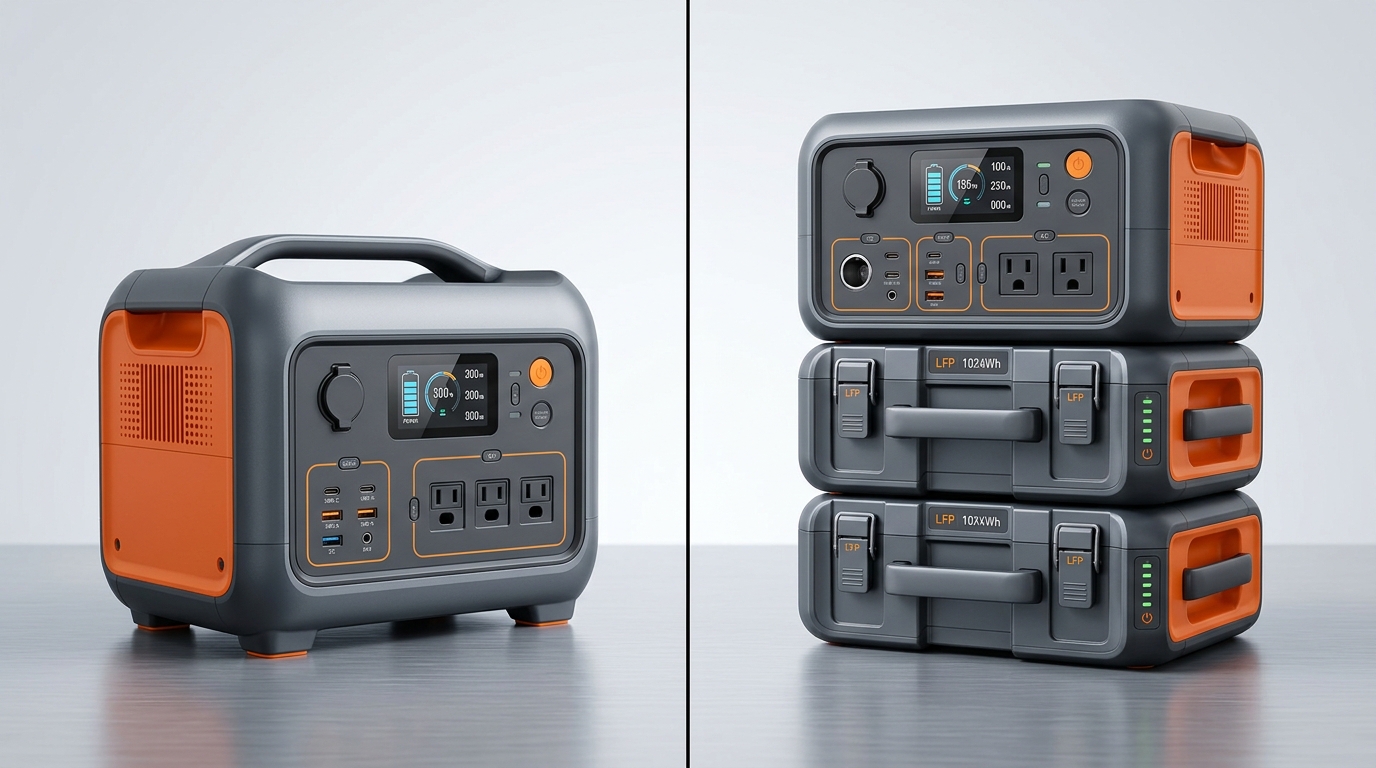
Anker SOLIX E10 is Anker’s first whole-home battery system, and you can tell it was designed by a consumer-electronics company rather than a traditional solar installer. The Power Module inverter is roughly the size of a small microwave oven (26.4” × 11.8” × 10.2”, 60.6 lb / 27.5 kg), with an all-metal NEMA Type 4 (IP66) enclosure, F1 UV-rated for outdoor mounting. The battery module is similar in size and weight. Both can be wall-mounted stackably or left on the floor in a garage, basement, or utility closet. The military-grade shell has a pressure-relief valve and isolated cells — a feature lifted from EV-battery engineering that you usually only see on cells designed for high-vibration environments.
The hardware looks and feels like a premium consumer product. Theven anodized aluminum faces, hidden fasteners, single captive thumbscrew for the battery release, and a small status display on the front of the inverter. The Smart Inlet Box and Power Dock are similarly polished — the Power Dock is a 12-circuit ATS with Wi-Fi and Bluetooth for monitoring, sized for indoor mounting on a basement wall.
Reported reliability of the E10 platform in the first 6 months (Feb 2026 launch) is too early for long-term data, but early reviews from PV Magazine, Android Authority, Digital Trends, and Green Building Advisor converge on the same observation: the hardware works as advertised, the install is genuinely DIY-friendly for someone with electrical experience, and the tri-fuel Smart Generator 5500 (gas + propane + natural gas) is the rare product category where one device eliminates a separate $1,500-$2,500 standby generator purchase. Fail mode anecdotes are limited to firmware quirks in the first month (fixed in OTA updates by April 2026) and a small batch of Smart Generator starter-battery issues that Anker resolved with free replacements under warranty.
EcoFlow Delta Pro Ultra is the second-generation platform from a brand that has shipped portable power stations since 2017. The inverter is larger (27.2” × 18.9” × 8.4”) and weighs ~70 lb. The battery module is roughly 80 lb for the 6 kWh original, or ~110 lb for the 12 kWh “DPU X” model launched mid-2025. Build is heavy-gauge plastic over metal chassis, IP54 on the battery (splash-resistant) but not outdoor-rated out of the box — most installs go into a garage, basement, or utility room rather than on an exterior wall.
Reported reliability of the Delta Pro Ultra is 2+ years of production data and largely positive. CNET and The Verge noted in late 2024 that EcoFlow’s previous-generation Delta Max 2000 had a fire risk that led to a 25,000-unit recall in October 2025 (CNET), but the Delta Pro Ultra uses a different cell chemistry (LFP, less fire-prone than the NMC used in the recalled Max) and a different BMS, and has not been subject to any fire recall. The platform has gone through three firmware majors (v1.0 2023, v2.0 2024 with Smart Home Panel 2 support, v3.0 2025 with TOU + self-consumption optimization). Reddit r/batteries and r/solar threads in 2025-2026 are largely positive on long-term reliability, with a few isolated complaints about SHP2 communication dropouts that resolve with firmware update. EcoFlow USA offers a 5-year warranty (industry standard).
Durability verdict: Anker has the outdoor-rated, more rugged enclosure; EcoFlow has 2+ years of production-proven firmware stability and a lower recall track record. For coastal Florida or wildfire-prone California, the Anker’s outdoor rating is a meaningful installation-cost and longevity advantage. For indoor-mount installations, EcoFlow’s history is roughly comparable.
Feature Breakdown
Power output and surge handling. Both systems put out 7.2-7.7 kW continuous on a single inverter, which is enough to run most US homes on “essential loads” — fridge, internet, lighting, well-pump if you have one — but not enough for central AC plus oven plus dryer simultaneously. The Anker’s 10 kW turbo for 90 minutes on a 2-battery config is a rare feature: it lets you run a 5-ton central AC for an hour and a half on the single-inverter unit, which is significantly longer than the EcoFlow’s sustained output. For a homeowner whose primary concern is “can I keep my house from cooking in a Texas August outage,” the Anker’s turbo output is the deciding factor.
AC compressor startup (LRA). This is where the two diverge. The Anker publishes LRA capacity as a spec (120 LRA with 1 battery, 155 LRA with 2+ batteries, 275 LRA with dual inverter setup) and uses a software-controlled soft-start sequence that extends the LRA start window to ≤1 second. This is important because aging central AC compressors can have inflated LRA at startup, and a system that handles startup at spec is the difference between “lights stay on” and “the AC clicks and the whole inverter shuts down.” The EcoFlow Delta Pro Ultra publishes peak surge at 21.6 kW (3 inverters), but single-inverter LRA is not explicitly published in the same way. Practical recommendation: if your central AC is more than 10 years old, give the edge to Anker.
Whole-home ATS (Automatic Transfer Switch). Both systems require a separate ATS to do true whole-home backup with automatic switchover. Anker’s Power Dock does 12 circuits at 200 A with ≤20 ms switchover; EcoFlow’s Smart Home Panel 2 does 12 circuits, Smart Home Panel 3 does 18 circuits (current promo, free install for the SHP3 through July 3, 2026 — a real savings on a typically $1,500-$2,500 professional install). The EcoFlow SHP2/SHP3 advertises 0-ms (online UPS) transfer, which is meaningfully faster than Anker’s 20 ms — though in practice, 20 ms is fast enough for nearly all home electronics (computers and modern appliances tolerate 30-50 ms; only very sensitive medical equipment or vintage computers care about sub-10 ms).
Solar input. Anker wins clearly here. Each E10 unit takes 9 kW of solar (dual 30-450 V MPPT), and 3 stacked units can handle 27 kW — enough to fully recharge a 90 kWh system in good sun over a single day. EcoFlow’s DPU handles 5.6 kW per inverter, 16.8 kW for 3 inverters — a third less. For off-grid or near-off-grid homes with heavy solar arrays, the Anker’s solar-input ceiling is a real-world differentiator. For most grid-connected homes with modest (5-10 kW) rooftop solar, both systems have plenty of headroom.
Backup generator integration. Anker’s tri-fuel Smart Generator 5500 (gas / propane / natural gas, 4.5 kW continuous, auto-start) is the most distinctive feature on either platform. It can charge the E10 battery directly via DC at 4.5 kW (no inverter round-trip loss) and then shut off automatically once the battery is topped up. This is a substantial engineering advantage: it means a long-duration outage is handled as “battery runs the house, generator charges the battery during the day, battery runs the house overnight” — and Anker’s lab data suggests 5× the runtime per gallon of propane vs a traditional 20 kW standby generator. EcoFlow integrates with third-party generators via the FlowMaster Generator Rectifier (sold separately, ~$499), which is a useful bridge but not as seamless. If you already own a portable generator, EcoFlow is the cheaper path. If you don’t, Anker’s integrated approach is the better one.
Smart-home and monitoring. Both systems have iOS / Android apps with energy-flow dashboards, TOU (Time of Use) optimization, and self-consumption modes designed for use with PG&E, ConEd, and other utilities that have peak-rate schedules. Anker’s app is new (Q1 2026 release) and has a more modern UI; EcoFlow’s app is 3 years mature and has more third-party integrations (Home Assistant, IFTTT, Tesla Powerwall-API compatible endpoints in 2025). Real-world functionality is roughly equivalent — both can cut your grid bill by 50-80% if you have 9+ kW of solar (Anker’s claim, corroborated by Green Building Advisor case study).
Battery technology. Both run on lithium iron phosphate (LFP) cells, which give 3,000-6,000 cycle lives vs ~500-1,000 for older NMC chemistries. At one cycle per day (worst case during outage season), both will reach 80% capacity at year 8-15, depending on depth-of-discharge and climate. The Anker is rated 6 kWh per pack; the original EcoFlow DPU is 6 kWh per pack; the newer EcoFlow DPU X is 12 kWh per pack. For a homeowner starting from scratch, the 12 kWh DPU X gives you better round-trip efficiency (1.5 mΩ cell resistance vs ~2 mΩ on older cells) but at $2,099 per battery, it is more expensive per kWh than the 6 kWh options.
Pros and Cons
Anker SOLIX E10
Pros
- Outdoor-rated NEMA 4 / IP66 enclosure lets you mount it on a garage exterior wall, basement bulkhead, or coastal-grade location without a separate weather cabinet
- Integrated tri-fuel Smart Generator 5500 (gas, propane, natural gas) eliminates the need to buy a separate standby generator — a $1,500-$2,500 saved
- 10 kW turbo output for 90 minutes on a 2-battery config handles the worst-case AC startup better than the competition in this price tier
- 9 kW solar per inverter (27 kW stacked) is genuinely class-leading for residential
- DC-range-extended design charges the battery directly from the generator at 4.5 kW without inverter round-trip loss — Anker’s claim of 5× backup time per gallon of propane vs a 20 kW standby generator is supported by 12-hr / 10 kWh lab tests
- ≤20 ms switchover with the Power Dock ATS is fast enough for nearly all home electronics
- 5-year warranty on core components, 10-year on Power Dock, 3-year on Smart Generator
- New in 2026, with a modern app and the only whole-home platform integrating battery + solar + generator from one vendor
Cons
- First-generation product. Only 4-5 months of real-world install data. Long-term reliability (5+ years) is unproven
- Per-kWh cost is higher at entry level ($716.50/kWh vs $616-$666/kWh for the EcoFlow on sale)
- Power Dock ATS is a separate purchase at ~$1,500 — required for whole-home automatic switchover
- Cost adds up fast: a system capable of backing a 3-bed / 2-bath home with central AC for 3+ days is $7,000-$10,000
- Tri-fuel generator requires direct wire to battery — install depth is greater than a standalone generator
- Anker has no track record on whole-home UL9540-certified systems before this launch; first-year firmware bugs are still being patched
EcoFlow Delta Pro Ultra
Pros
- Lower per-kWh cost — $3,698 promo or $3,999 MSRP for the 6 kWh starter, vs Anker’s $4,299
- Proven platform with 2+ years in production, three firmware majors, and ISO + UL 1973 + UL 9540 certifications (the only portable-class unit with both UL certifications)
- DPU X 12 kWh batteries offer better round-trip efficiency (1.5 mΩ cell resistance) than older LFP cells
- 0-ms online UPS transfer with Smart Home Panel 2 / 3 is faster than Anker’s 20 ms — meaningful for users with very sensitive medical or vintage electronics
- Smart Home Panel 3 with free installation through July 3, 2026 (~$1,500 savings); install support is well-established across the US
- Third-party portable solar, generator, and AC-coupling options give buyers more flexibility than Anker’s more tightly integrated ecosystem
- Higher total max capacity with DPU X (180 kWh vs 90 kWh) for very-large-home installations
- 5-year warranty on inverter, battery, and SHP panels
Cons
- Not outdoor-rated without a separate weather cabinet — must be installed in a garage, basement, or utility room
- Lower solar input ceiling (5.6 kW per inverter, 16.8 kW stacked) vs Anker’s 9 kW / 27 kW
- Backup generator is not integrated — adding one means buying a separate portable generator (
$1,500 Champion) plus the FlowMaster Rectifier ($499) - No turbo output for sustained loads — peak surge is published but not the Anker-style 10 kW turbo for 90 minutes
- LRA / soft-start handling not explicitly published for single-inverter config — buyers with older central AC may need to soft-start their compressor separately
- Delta Max 2000 recall (Oct 2025) is on a different model and chemistry, but some buyers conflate the brand; reputation risk is real
- 3-year-old app and ecosystem, plus the larger / heavier inverter takes more floor space than the Anker E10

Best For / Skip If
Best for the Anker SOLIX E10
- You are in a hurricane, wildfire, or ice-storm zone (Florida, Carolinas, Texas coast, PG&E, ConEd, National Grid service areas) and lose power 8+ times per year for 4+ hours each
- You want outdoor-rated hardware that can be wall-mounted on a garage or basement bulkhead without a weather enclosure
- You do not already own a portable generator and value the integrated tri-fuel Smart Generator 5500
- You have a 5-ton or larger central AC and want a system that has documented LRA handling out of the box
- You have 9+ kW of rooftop solar and need an inverter that can take more than 5.6 kW per unit
- You are willing to pay a $300-$700 premium for the newest platform, integrated generator, and outdoor rating
Skip the Anker SOLIX E10 if
- You only lose power 2-3 times a year — the payback math does not work at any price
- You already own a portable generator and do not need Anker’s Smart Generator — you will pay for a feature you won’t use
- You need 0-ms online UPS transfer for very sensitive medical / vintage equipment — Anker’s 20 ms is good but not the fastest in the category
- Your central AC is old with degraded LRA — even Anker’s 155 LRA single-inverter ceiling may not be enough without a separate soft-starter
Best for the EcoFlow Delta Pro Ultra
- You want the lower per-kWh cost and are willing to wait for promotional pricing (June 2026 sale brings entry-level to $3,698)
- You have a 2+ year install track record preference and want a system that has already survived 3 firmware majors and a UL9540 re-certification
- You already own (or want to choose) third-party portable solar + generator — the platform supports AC coupling, third-party inverter integration, and FlowMaster generator rectification
- You need 0-ms online UPS transfer for sensitive electronics (medical, vintage hi-fi, NAS, PLC-controlled appliances)
- You want to scale up to 180 kWh with the DPU X 12 kWh batteries for a large home with significant solar production
- You want free professional installation of the Smart Home Panel 3 through July 3, 2026
Skip the EcoFlow Delta Pro Ultra if
- You need to install the system outdoors without a separate weather cabinet — EcoFlow is indoor-rated out of the box
- You want an integrated generator solution — EcoFlow makes you buy and connect a third-party generator
- You have a 9+ kW solar array — the 5.6 kW solar input per inverter is the bottleneck
- You need to lift the inverter over a basement stairwell — the EcoFlow DPU inverter is ~70 lb vs the Anker’s 60 lb, and the DPU X battery is ~110 lb
Skip either system if
- You live somewhere with reliable grid power and lose it fewer than 3 times a year
- Your primary use is portable (RV, camping, construction site) — a $1,500-$2,500 portable power station covers 80% of use cases at 1/3 the cost
- You cannot find a licensed installer in your area — both systems require professional installation for the ATS and any utility interconnection paperwork
Bottom Line
Both the Anker SOLIX E10 and the EcoFlow Delta Pro Ultra are genuinely good whole-home battery systems for 2026, and both are at least $2,000 cheaper than a Tesla Powerwall 3 after install. The Anker is the better choice if you want a single-vendor integrated stack with an outdoor-rated enclosure, a tri-fuel generator that replaces a separate purchase, and class-leading solar input. The EcoFlow is the better choice if you want a lower per-kWh cost, a 2-year-old platform with no first-generation bugs, faster (0-ms) UPS transfer for sensitive loads, and proven UL9540 + UL1973 certifications.
The honest answer for most buyers in late June 2026 is this: if you live in a multi-day-outage zone (hurricanes, wildfires, ice storms) and do not already own a backup generator, the Anker SOLIX E10 is the cleaner buy in 2026 — the integrated generator alone saves you $1,500-$2,500. If you already own a portable generator, have moderate solar, and want the lowest per-kWh cost, the EcoFlow Delta Pro Ultra on its current June sale is the better math.
Neither system is a bad purchase. The difference is in the next $1,500-$3,000 of add-ons you do or do not have to make over the next 5 years. That’s the line where smart shopping turns into real money.
Buy smart. Get more value.