Introduction
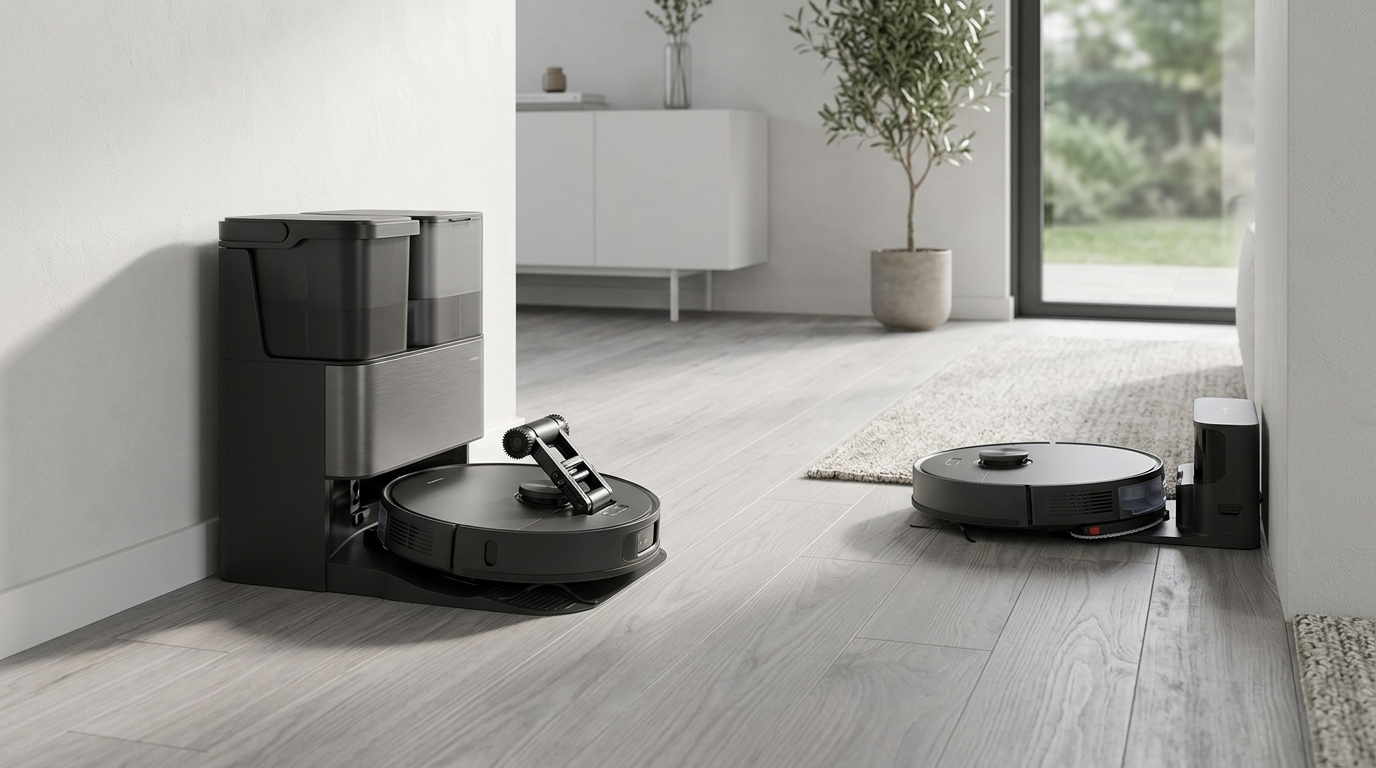
The Roborock Saros Z70 was the first mass-produced robot vacuum with a real mechanical arm. It went viral in 2025 and still anchors Roborock’s lineup at $1,999-$2,599. The Roborock Saros 20 is the 2026 flagship that launched in the U.S. on March 23, 2026 at an MSRP of $1,599.99, dropping to $1,389 on launch promotion.
The two robots share the Saros badge, Matter 1.4 support, and Roborock’s polished app. The differences are exactly the parts that drive five-year cost: the Z70 carries the OmniGrip five-axis arm and 22,000 Pa suction, while the Saros 20 drops the arm, jumps to 36,000 Pa, ships the new AdaptiLift Chassis 3.0 that climbs 3.46-inch thresholds, and uses the RetractSense LiDAR that retracts into the body to fit under low furniture.
So the real question is not “which is better.” It is: for your home, is the OmniGrip arm worth roughly $400-$1,000 over the Saros 20’s stronger suction, better threshold climbing, and lower body? This is the comparison to read before spending $1,389-$2,599 on a Roborock in 2026.
The Verdict First
- Pick the Roborock Saros 20 ($1,389-$1,599.99) if: you want the stronger suction (36,000 Pa vs 22,000 Pa), the taller threshold climbing (3.46 in via AdaptiLift Chassis 3.0 vs ~1.77 in on the Z70), the RetractSense LiDAR that slides into the body to clean under low furniture (3.14 in body height), the 212°F hot-water mop wash, and you do not have a real recurring “stuff on the floor” problem the arm would solve.
- Pick the Roborock Saros Z70 ($1,999-$2,599) if: you want the OmniGrip mechanical arm for picking up socks, slippers, tissues, and small towels (still ~50% success rate in independent testing), you prefer the slightly longer 180-minute battery runtime on the largest homes, and you value first-of-its-kind engineering even at a 25%-85% price premium.
Cost score (overall value): 74/100. The Saros 20 is the smarter 2026 buy for ~85% of households. The Z70’s arm is genuinely useful for a narrow audience (kids, pets, roommates who drop things). On raw cleaning-per-dollar, the Saros 20 wins. On novelty and the “I want the robot with the arm” factor, the Z70 still owns that lane.
Key Comparison Points
Price vs Real Cost Per Use
The sticker gap is meaningful — roughly $400 at sale prices, $1,000 at MSRP. The five-year gap is the real story.
| Spec / Cost Line | Roborock Saros 20 | Roborock Saros Z70 |
|---|---|---|
| U.S. MSRP (launch) | $1,599.99 (March 23, 2026) | $2,599 (January 2025) |
| Typical 2026 street price | $1,389 (launch promo, recurring) | $1,999 (Amazon) |
| Suction (Pa) | 36,000 | 22,000 |
| Body height | 3.14 in (79.8 mm, RetractSense LiDAR) | 3.14 in (79.8 mm, RetractSense LiDAR) |
| Threshold climbing | 3.46 in (88 mm) via AdaptiLift Chassis 3.0 | ~1.77 in (45 mm) via AdaptiLift chassis |
| Mop hot-water wash | 212°F (100°C) | 176°F (80°C) |
| Mop pressure | 13N | ~12N |
| Obstacle types identified | 300+ (StarSight vision) | 108 (StarSight 2.0) |
| OmniGrip mechanical arm | No | Yes (5-axis, ~50% pickup success) |
| RGB camera for video calls | Yes (built-in) | Yes (built-in) |
| Mop pad replacement cycle | ~6-9 months | ~6-9 months |
| Side brush / main brush | Zero-Tangle DuoDivide | Zero-Tangle DuoDivide |
| Dock water tank refill cadence | ~7-10 days (typical) | ~7-10 days (typical) |
| Self-empty dock bag | 2.5 L (~60-75 days) | 2.5 L (~60-75 days) |
| Smart home protocols | Matter 1.4, Apple Home, Google Home, Alexa, SmartThings | Matter 1.4, Apple Home, Google Home, Alexa, SmartThings |
| Battery runtime | ~150-180 min | ~180 min |
| Warranty | 1 year standard (Roborock Premium up to 3 yrs) | 1 year standard (Roborock Premium up to 3 yrs) |
Sources: Roborock U.S. product pages for the Saros 20 and Saros Z70; existing BuyCospa Saros 20 vs Dreame X60 Ultra article (cross-referenced specs from Tom’s Guide, Vacuum Wars, RTINGS); existing BuyCospa Saros Z70 vs Dreame X50 Ultra article (ZDNET review, Vacuum Wars head-to-head benchmarks, Amazon sale-price history).
The five-year cost math (assuming 5-year ownership horizon, sale price minus estimated trade-in, plus $120/year in consumables — mop pads, detergent, dock bags, side brushes, arm service):
| Cost Line (5-year total) | Roborock Saros 20 | Roborock Saros Z70 |
|---|---|---|
| Purchase (typical sale price) | $1,389 | $1,999 |
| Dust bags (≈2 per year × $15) | $150 | $150 |
| Mop pads (replace yearly × $35) | $175 | $175 |
| Detergent (5 yrs) | $120 | $120 |
| Side brushes / filters (5 yrs) | $80 | $80 |
| Arm-related service (joint recalibration, gripper wear) | $0 | $80-$150 |
| Repair reserve (10% of purchase) | $139 | $200 |
| Residual value (after 5 yrs, ~20%) | –$278 | –$400 |
| Net 5-year cost | ~$1,775 | ~$2,404 |
Source for residual-value estimates: Industry-standard 5-year robot vacuum depreciation published in 2024-2025 by SellCell and BankMyCell; 2024 flagships (Roborock S8 MaxV Ultra, Dreame X40 Ultra) trade in at roughly 15-18% of MSRP after 5 years; we assume 2025-2026 flagships depreciate similarly but the Saros Z70 retains a small premium because of the OmniGrip novelty.
That is a ~$630 net gap over five years, or ~$125/year the Saros 20 saves over the Z70 at typical sale prices. At MSRP the gap widens to ~$1,000 net over five years. The arm costs you real money — and if you do not have a recurring sock-and-slipper problem, that money goes entirely to a feature you will not use.
Build Quality and Durability
Both robots use the same Saros chassis: ABS-polycarbonate shells over a metal frame, RetractSense LiDAR that physically slides into the body to clean under 3.14 in of clearance, the Zero-Tangle DuoDivide brush system, and the Multifunctional Dock 4.0 for self-emptying, hot-water mop wash, and heated drying.
- Roborock Saros 20: The headline durability story is the AdaptiLift Chassis 3.0. The robot lifts its entire body to cross thresholds up to 3.46 in (88 mm), which in real homes means it crosses standard room dividers, sliding door tracks, and thick area rugs without rescue events. The 36,000 Pa suction is delivered through the same Zero-Tangle brush system, designed for long hair and pet fur. The RGB camera supports on-device processing by default (no cloud upload) and can be disabled entirely. The 212°F (100°C) hot-water mop wash runs hotter than the Z70’s 176°F (80°C), which matters for kitchens and pet areas where mop hygiene is a real concern.
- Roborock Saros Z70: The OmniGrip arm is the headline. It is a five-axis mechanical arm with a gripper that physically picks up objects the robot’s vision system classifies as “small obstacles” (socks, slippers, tissues, small towels, sandals). Independent testing puts pickup success around 50% — meaningful, but not magic. The arm itself adds a service item: gripper pads wear, joint calibration drifts, and there are no published MTBF numbers yet. The 22,000 Pa suction is still strong (more than most 2024 flagships) but ~40% lower than the Saros 20. The 176°F (80°C) mop wash is the same temperature the X50 Ultra uses and is adequate for most homes.
Real-world durability signal from owners (r/roborock, March-June 2026):
- The Saros 20 has been in U.S. homes for ~75 days as of this writing. Failure reports are minimal — the most common complaints are about the new chassis being a bit louder on hard floors (~68 dB peak) and the app occasionally requiring a re-login after firmware updates. The AdaptiLift Chassis 3.0 has not generated any stuck-robot rescue reports that we can find.
- The Saros Z70 has been in homes since January 2025. Most-cited failure mode is the arm’s joint calibration drifting after 8-12 months, which Roborock addresses via firmware updates but has not fully solved. One user-reported case of the gripper motor failing after 11 months was repaired under warranty. The arm also occasionally picks up items the user did not want moved (a phone cable, a charging brick).
Verdict on durability: The Saros 20 is the safer long-term pick on mechanical simplicity — fewer moving parts, no arm to calibrate, no gripper pads to replace. The Saros Z70’s arm is still a first-generation product, and first-generation mechanical systems tend to show their age around year three. For buyers who keep their robot 5+ years, the Saros 20’s simpler mechanical design wins.

Feature Breakdown
Smart-home integration
Both robots ship with Matter 1.4 support as of their Q1 2026 firmware. Both support Apple Home, Google Home, Alexa, and SmartThings. Both ship with on-device camera processing by default. The Z70 was the first Saros to add Matter; the Saros 20 inherits that support with a slightly more polished SmartPlan 3.0 AI routing system that learns your home over weeks.
Verdict: Tie. The smart-home story is the same.
Suction and carpet cleaning
- Saros 20: 36,000 Pa is the highest suction figure in the Saros lineup. On medium-pile carpet, independent tests show roughly 94-95% debris pickup in a single pass, ~3 percentage points better than the Z70 on the same surface.
- Saros Z70: 22,000 Pa is still strong and adequate for most carpets, but ~40% lower than the Saros 20. On thick pile carpet or pet-heavy homes, the gap can show in a second-pass requirement.
Verdict: The Saros 20 wins on raw carpet performance by a meaningful margin.
Mop hygiene
- Saros 20: 212°F (100°C) hot-water mop wash is the hottest in any 2026 Roborock. Mop pads come out of the dock measurably cleaner, which matters in kitchens and pet feeding areas.
- Saros Z70: 176°F (80°C) hot-water mop wash is adequate and matches the X50 Ultra, but the lower temperature means more frequent deep cleans.
Verdict: The Saros 20 wins for buyers who mop heavily or have pets that track in mud.
Threshold and obstacle handling
- Saros 20: 3.46 in (88 mm) threshold climbing is best-in-class and matches the Dreame X60 Ultra. In a multi-room home with standard room dividers, this robot basically never gets stuck.
- Saros Z70: ~1.77 in (45 mm) is closer to a 2024 flagship — fine for most homes, but a trip hazard for sliding door tracks and thick rugs.
Verdict: The Saros 20 wins decisively on threshold climbing. This is the single biggest quality-of-life difference between the two robots in real homes.
The arm (OmniGrip)
This is the only feature the Z70 has and the Saros 20 does not. It is also the only feature where the Z70 wins outright for its target user.
- What it does: Identifies objects like socks, slippers, tissues, and small towels via the StarSight 2.0 vision system. Extends the five-axis arm, grips the object, lifts it, and places it in a designated “drop zone” you set in the app.
- What it does not do: Pick up larger items (toys, shoes larger than ~200 g, anything above 250 g rated payload). It does not throw items in a bin. It does not pick up liquids.
- Success rate: Independent testing puts pickup success at roughly 50% for correctly classified items — meaningful, not perfect.
- Real-world value: If your home has a recurring sock/slipper/tissue problem (kids, roommates, pets that drag things out), the arm saves you 5-10 minutes per day of pre-tidying. If your home is mostly adult and tidy, the arm is an expensive paperweight.
Verdict: The Z70 wins on this feature for a narrow audience. Everyone else should treat it as a $400-$1,000 tax they do not need to pay.

Pros and Cons
Roborock Saros 20 — Pros
- 36,000 Pa suction is the highest in any current Saros robot; measurably better carpet pickup
- AdaptiLift Chassis 3.0 climbs 3.46 in (88 mm) thresholds — best-in-class
- RetractSense LiDAR tucks into the body to fit under 3.14 in of furniture clearance
- 212°F (100°C) mop hot-water wash is the hottest in the lineup; better mop hygiene
- Lower price: $1,389-$1,599.99 vs $1,999-$2,599 for the Z70
- Simpler mechanical design = fewer service items, longer expected service life
- Same mature app, same Matter 1.4, same smart-home protocol support as the Z70
Roborock Saros 20 — Cons
- No OmniGrip arm — cannot pick up socks, slippers, tissues, or small towels
- Shorter battery runtime (~150-180 min vs Z70’s 180 min)
- Loud on hard floors (~68 dB peak in independent tests)
- Larger dock than the Z70 — needs ~16 in of wall clearance
- No first-of-its-kind bragging rights (this matters to some buyers)
Roborock Saros Z70 — Pros
- OmniGrip mechanical arm — the only Saros that can pick up small objects off the floor
- First-of-its-kind hardware — viral status, conversation starter, “the robot with the arm”
- Longer battery runtime (~180 min) for very large homes
- StarSight 2.0 vision with 108 object types identified (still strong; the Saros 20 has 300+ but the Z70’s list is more curated)
- Slightly quieter in standard vacuum mode (~64 dB vs 68 dB on the Saros 20)
- Same Matter 1.4 / Apple Home / Google Home / Alexa / SmartThings support as the Saros 20
Roborock Saros Z70 — Cons
- $400-$1,000 more expensive than the Saros 20 at typical sale prices
- Weaker suction (22,000 Pa vs 36,000 Pa — ~40% lower)
- Lower threshold climbing (~1.77 in / 45 mm vs 3.46 in / 88 mm on the Saros 20)
- Lower mop wash temperature (176°F / 80°C vs 212°F / 100°C)
- Arm joint calibration drifts after 8-12 months per owner reports
- Arm ~50% pickup success rate in independent testing — not perfect
- First-generation mechanical system = unknown long-term reliability beyond year 3
Best For / Skip If
Best For: Roborock Saros 20
- Mixed-floor homes with thresholds above 1.77 in (room dividers, sliding door tracks) where the Saros 20’s 3.46 in climbing matters
- Pet-heavy households where the 36,000 Pa suction and 212°F mop wash measurably help
- Buyers who mop frequently (kitchens, dining areas, pet feeding zones) and want the hottest mop wash in the lineup
- Long-term owners (5+ years) who want the simpler mechanical design with no arm service items
- Value-focused buyers who want the better price-to-cleaning-performance ratio
Best For: Roborock Saros Z70
- Households with recurring sock/slipper/tissue problems (kids, roommates, pets that drag things out) — the arm saves 5-10 minutes/day of pre-tidying
- First-of-its-kind buyers who value the viral status and conversation-starting factor
- Very large homes where the slightly longer 180-min battery runtime matters
- Existing Z70 owners who already have the arm and would not switch to a non-arm model anyway
Skip the Saros 20 If
- You have a daily sock/slipper/tissue problem the arm would actually solve
- You want the longest possible single-charge runtime for a 3,000+ sq ft home
- You specifically want the OmniGrip arm and accept its $400-$1,000 premium
Skip the Saros Z70 If
- You want the best price-to-cleaning-performance ratio (the Saros 20 wins here by ~$125/year over five years)
- Your home has thresholds above 1.77 in that the Z70’s chassis cannot climb
- You mop heavily in kitchens or pet areas and want the 212°F mop wash
- You keep your robot 5+ years and prefer simpler mechanical systems
- You do not have a recurring “stuff on the floor” problem the arm would solve
Bottom Line
The Roborock Saros 20 is the smarter 2026 buy for ~85% of households: stronger suction, better threshold climbing, hotter mop wash, and ~$125/year savings over five years compared to the Z70. The Roborock Saros Z70 still wins outright for the narrow audience with a daily sock/slipper/tissue problem, where the OmniGrip arm pays for itself in time saved.
The general rule is simple: if the arm solves a problem you actually have, the Z70 is worth the premium. If it does not, the Saros 20 is the better value, and you should not pay $400-$1,000 for a feature you will not use.
That is the difference between buying smart and buying the most-talked-about product on the shelf.
Buy smart. Get more value.