Introduction
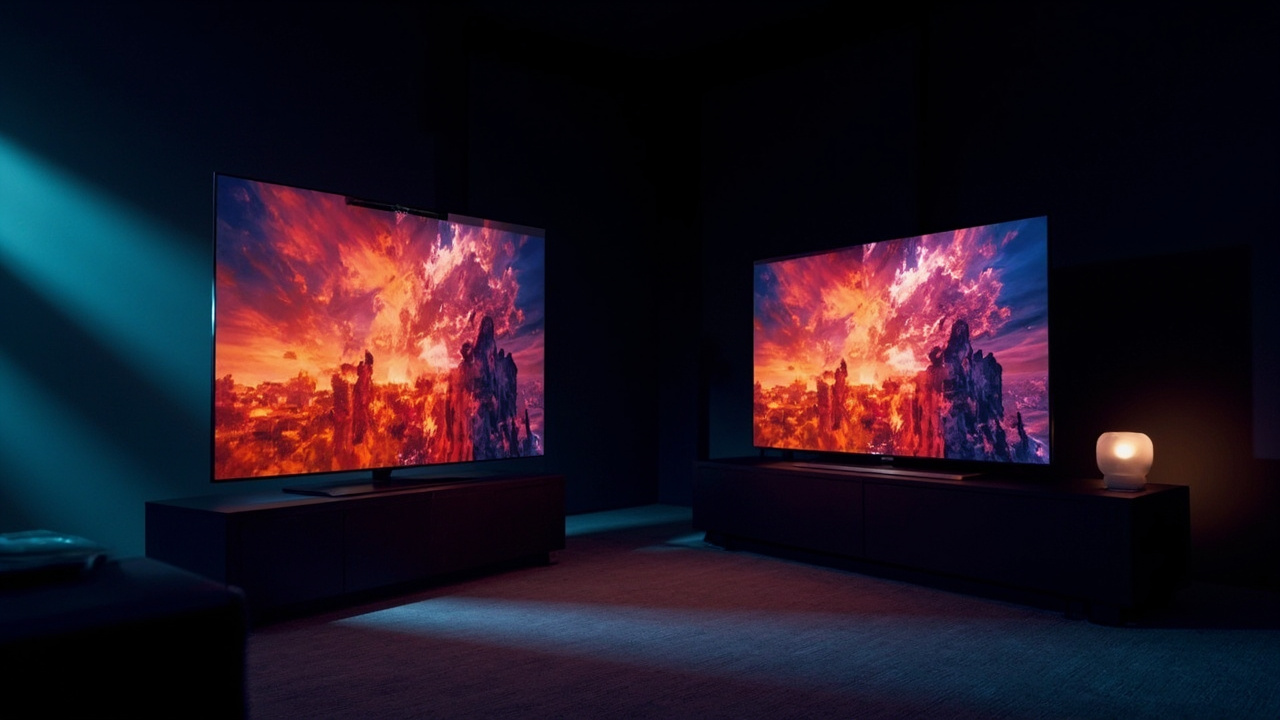
If you are shopping the very top of the 2026 OLED TV market, two names dominate every “best of” list and every Reddit thread:
- LG OLED evo G6 — MSRP $2,499.99 for the 55-inch, scaling up to roughly $8,999.99 for the 97-inch (LG USA press release, Tom’s Guide, June 2026). LG’s “gallery-design” flagship, with the Primary RGB Tandem 2.0 panel, Brightness Booster Ultra, and the standout perk of a 5-year panel warranty at no extra cost.
- Samsung S95H — MSRP $2,499.99 for the 55-inch, $3,399.99 for the 65-inch, and scaling up to the 83-inch with a tandem WOLED panel (Samsung USA, RTINGS, CinemaConfig, June 2026). Samsung’s flagship 4K QD-OLED, with a matte anti-reflective coating, Object Tracking Sound+, and the HDR10+ Advanced ecosystem instead of Dolby Vision.
At the 65-inch level — the size most US buyers actually buy — both TVs list at $3,399.99. So this is not a “cheap vs expensive” story. It is a “two TVs at the same price, with two different panel philosophies, two different HDR ecosystems, two different warranty terms, and very different real-world cost over 7 years.”
The interesting question is not which panel tech is “better.” It is which one costs you less per hour of actual viewing over the 7 to 10 years you will own it — and that depends on what you watch, how bright your room is, and whether Dolby Vision or HDR10+ matters more to your streaming setup.
The Verdict First
- Pick the LG G6 ($2,499-$8,999, 5-year panel warranty) if you watch a mix of Dolby Vision content (Netflix, Apple TV+, Disney+, Xbox/PS5 games), want the brightest sustained HDR highlights in real scenes, need a flush-mount gallery design for the wall, want the 5-year LG panel warranty included for free, or value the AI features in webOS 26 (Dynamic Sports Mode sidebar, Google Gemini + Microsoft Copilot support). The G6 is the safer buy for mixed-use living rooms and for anyone who already lives in the Dolby Vision ecosystem.
- Pick the Samsung S95H ($2,499-$6,999, 1-year standard warranty) if you watch almost all your HDR content through HDR10+ (Amazon Prime Video, Samsung TV Plus, some Paramount+ content), want the most accurate and vibrant QD-OLED colors for cinematic viewing in a dark room, need the matte anti-glare coating for a bright living room, or you already own a Samsung soundbar to unlock Q-Symphony. The S95H is the better picture-quality pick for dark-room cinephiles.
Cost score: 76/100. Neither TV is a “value” pick — both are $2,500+ flagships. The LG G6 wins on 5-year warranty + Dolby Vision + flush-mount design; the Samsung S95H wins on picture quality + QD-OLED color volume + gaming sound + matte anti-glare. The two are tied on MSRP at the 65-inch sweet spot. The smarter buy depends on your room and your HDR ecosystem, not on the sticker price.
Key Comparison Points
Price vs Real Cost Per Use
Sticker price at the 65-inch level is identical: $3,399.99 for both. The interesting number is what happens over 7 years of ownership, when you factor in panel warranty, replacement risk, energy cost, and likely resale.
| Item | LG OLED evo G6 (65”) | Samsung S95H (65”) |
|---|---|---|
| MSRP at launch (65”) | $3,399.99 (2026) | $3,399.99 (2026) |
| Panel tech | Primary RGB Tandem 2.0 (WOLED) | QD-OLED (55-77”) / Tandem WOLED (83”) |
| Peak brightness (claimed, 10% window) | up to ~3,000-3,900 nits (LG, TechRadar) | up to ~2,500-3,000 nits (Samsung, RTINGS) |
| HDR format support | Dolby Vision, HDR10, HLG | HDR10+ Advanced, HDR10, HLG (no Dolby Vision) |
| Refresh rate / VRR | up to 165Hz, Nvidia G-Sync, AMD FreeSync Premium | up to 165Hz, Nvidia G-Sync, AMD FreeSync Premium Pro |
| HDMI 2.1 ports (4K 120/165Hz) | 4 | 4 |
| Smart platform | webOS 26 (Alexa, Google Home, Gemini, Copilot) | Tizen OS (Alexa, Bixby, Google Assistant) |
| Anti-reflective coating | Standard matte | Matte QD-OLED (“Glare Free”) |
| Included wall mount / flush design | Flush gallery mount included | Slim stand; separate slim-fit WM sold separately |
| Standard warranty | 1 year (parts/labor) | 1 year (parts/labor) |
| Panel warranty | 5 years (included, US only) | 1 year (panel not separately covered beyond standard warranty) |
| Power draw (typical, calibrated) | ~110-160 W (65”) | ~110-160 W (65”) |
| Energy cost over 7 years (4 hr/day, $0.16/kWh) | ~$184-$268 | ~$184-$268 |
Sources: LG USA press release, Samsung USA, Tom’s Guide, RTINGS, ZDNET (April-June 2026), CinemaConfig, ConsumerAffairs OLED lifespan data.
At the body-only level the two are identical in MSRP at 65-inch. So the real “cost” question is:
- Warranty. The LG G6 includes a 5-year panel warranty in the US at no extra charge (LG USA press release, 2026). Samsung’s S95H ships with the standard 1-year warranty; panel coverage beyond year 1 is not included. If a panel fails in year 3 or 4 — a real, if low-probability risk on any OLED — LG replaces the panel free; Samsung treats it as out of warranty. Replacement cost on a 65-inch OLED panel alone runs $1,200-$2,200 at an authorized service center. The LG warranty is a meaningful financial edge.
- Brightness ceiling vs your room. The LG G6 claims higher sustained HDR brightness (~3,000-3,900 nits peak in the 10% window) thanks to the Brightness Booster Ultra, while the Samsung S95H sits around ~2,500-3,000 nits (RTINGS, CinemaConfig). In a bright living room, that extra ~700-1,000 nits is the difference between “looks great” and “looks washed out at midday.” In a dark dedicated theater room, both look spectacular.
- HDR format ecosystem. If you watch Netflix, Apple TV+, Disney+, Xbox Series X, and PS5 — Dolby Vision is the dominant HDR format. The LG G6 supports it natively. The Samsung S95H does not support Dolby Vision at all; it supports HDR10+ Advanced instead. If your household is 60%+ Dolby Vision content, you are paying for a flagship TV that downgrades most of your HDR to HDR10 or HDR10+ base.
- Energy cost. Both TVs draw very similar power (~110-160 W calibrated, 65-inch). At 4 hours/day and $0.16/kWh US average, that is ~$184-$268 over 7 years — a wash.
So the real cost-per-hour over 7 years depends almost entirely on (a) whether you will need the panel warranty and (b) whether the missing Dolby Vision matters. For most US households, it does — and that tilts the cost-per-use calculation toward the G6.
Build Quality and Durability
Both panels use modern OLED stacks designed to last 10+ years of normal viewing, but the build approach is different.
- LG G6 — Primary RGB Tandem 2.0 (WOLED). Two-layer OLED stack (LG Display) that splits the white subpixel into separate red, green, and blue emitters for higher color purity. The Tandem 2.0 stack is rated by LG for roughly 100,000 hours to half-brightness at typical SDR brightness — about 11.4 years at 24 hours/day or 34 years at 8 hours/day (LG Display white paper, summarized on Reddit r/OLED and ConsumerAffairs, June 2026). The gallery chassis is flush-mount and ultra-thin (about 24-28 mm thick), designed to sit flat against a wall on the included Zero Gap mount.
- Samsung S95H — QD-OLED (55-77”) / Tandem WOLED (83”). Samsung Display’s QD-OLED uses blue OLED emitters with quantum-dot color converters — no white subpixel, no color filter. Color volume is higher; off-axis color shift is smaller; brightness in mid-grayscale is better than previous QD-OLED generations. The matte anti-reflective coating (Glare Free 2.0) is applied directly to the panel. Half-brightness ratings are similar (~100,000 hours) per Samsung Display documentation.
- Burn-in risk. Both panels include pixel refreshers, logo dimming, and auto-brightness limiters. RTINGS’ accelerated 3-year longevity test (10,000+ hours of mixed content) showed 20 TVs failed out of 102 tested — a roughly 80% pass rate, with OLEDs performing slightly better than the LCD cohort on the same test (Tom’s Hardware, December 2025). Neither panel is “burn-in-proof,” but neither is burn-in-prone for normal mixed-content viewing.
- Refresh rate and gaming build. Both are 165Hz panels with 4 HDMI 2.1 ports supporting 4K at 120/165Hz, ALLM, and VRR. The S95H adds FreeSync Premium Pro certification; the G6 carries FreeSync Premium. In practice, both are equally suitable for PS5 Pro and Xbox Series X at 4K 120Hz.
The bottom line on durability: the panels will both outlast any reasonable ownership cycle (7-10 years), and the LG’s included 5-year panel warranty is the clear win for risk-averse buyers. The Samsung wins on off-axis QD-OLED color and matte anti-glare, which are picture-quality advantages, not durability ones.
Feature Breakdown
This is where the two TVs genuinely diverge, beyond the panel tech.
| Feature | LG OLED evo G6 | Samsung S95H |
|---|---|---|
| Dolby Vision | Yes (up to Dolby Vision IQ) | No |
| HDR10+ Advanced | HDR10+ compatible (LG added HDR10+ in 2024+ models) | Yes (native, genre-aware) |
| Dolby Atmos | Yes (built-in speakers + eARC out) | Yes (Object Tracking Sound+, eARC out) |
| Q-Symphony (Samsung soundbar pairing) | No | Yes |
| AI features | webOS 26: Dynamic Sports Mode sidebar, Gemini, Copilot, AI Concierge | Tizen OS: AI Upscaling Pro, AI Customization Mode, Click to Search |
| Cloud gaming | GeForce Now, Xbox App, Amazon Luna (via webOS) | GeForce Now, Xbox Game Pass, Amazon Luna (native) |
| Voice assistants | Alexa, Google Assistant, Apple Home (AirPlay/HomeKit) | Alexa, Bixby, Google Assistant |
| Smart home hub | Matter, Thread (via webOS 26) | SmartThings Hub built-in |
| Multi-view | Yes (2 screens, picture-in-picture) | Yes (up to 4 screens on 83”+) |
| Remote | Standard Magic Remote (battery) | Solar-powered remote (no disposable batteries) |
| Art Mode | Yes (built-in gallery content) | Yes (Ambient Mode+) |
| Game Optimizer / Dashboard | Yes (webOS 26 Game Optimizer) | Yes (Samsung Gaming Hub) |
| USB ports | 3 (USB 2.0) | 2 (USB 2.0) + 1 (USB-C) |
| Tuner | ATSC 3.0 (NextGen TV) | ATSC 3.0 (NextGen TV) |
Sources: LG USA product page, Samsung USA product page, ZDNET April 2026 review, CinemaConfig 2026 OLED comparison.
Key feature differences that change the buying decision:
- HDR format. This is the single biggest fork. Dolby Vision is the dominant HDR format on Netflix, Apple TV+, Disney+, Max, Xbox Series X, and PS5. HDR10+ is dominant on Amazon Prime Video and Samsung TV Plus. If you watch a lot of Netflix and Disney+, the G6 is the better format match. If you watch mostly Prime Video HDR content, the S95H is the better match.
- AI ecosystems. webOS 26 adds Dynamic Sports Mode (live stats sidebar — useful for the 2026 FIFA World Cup and the NFL/NCAA season), plus Google Gemini and Microsoft Copilot integration. Tizen has AI Upscaling Pro and AI Customization Mode, which are solid for non-streaming content. Both are improving every model year.
- Smart home. LG’s webOS 26 now supports Matter and Thread natively, so the TV can act as a smart-home hub for lights, locks, and sensors. Samsung’s S95H has SmartThings Hub built-in, which is more mature and works with more Zigbee/Z-Wave devices via the SmartThings ecosystem. Pick the hub that matches your existing smart-home platform.
- Audio. Both have decent built-in speakers for a flat panel. The S95H’s Object Tracking Sound+ is noticeably better than the G6’s standard downward-firing speakers for casual viewing, and Q-Symphony with a Samsung soundbar (sold separately) is a real upgrade. The G6 needs a separate Dolby Atmos soundbar (LG SC9S or any Dolby Atmos bar) to match the S95H + Q-Symphony experience, which adds $500-$900 to the system cost.
Pros and Cons
LG OLED evo G6
Pros
- 5-year panel warranty included free — covers the part most likely to fail after the standard 1-year period; replacement panel cost is $1,200-$2,200 at service centers
- Dolby Vision + HDR10+ dual support — plays both major dynamic HDR formats natively (added HDR10+ in 2024+ models)
- Higher sustained HDR brightness — Primary RGB Tandem 2.0 + Brightness Booster Ultra pushes ~3,000-3,900 nits peak (RTINGS, CinemaConfig)
- Flush gallery-mount design — ultra-thin 24-28mm chassis with Zero Gap wall mount included; designed to sit flat against the wall
- webOS 26 AI features — Dynamic Sports Mode sidebar, Gemini, Copilot, AI Concierge, Matter + Thread smart-home hub
- Wide size range (55-97”) — five sizes including 97” for very large rooms
Cons
- No native Q-Symphony — needs a separate LG Dolby Atmos soundbar ($500-$900) to match the S95H’s audio integration
- Gallery mount limits placement — flush-mount is great on a wall, awkward on a stand; stand sold separately
- Smaller peak color volume than QD-OLED — QD-OLED still wins on color brightness and saturation in mid-grayscale scenes
- webOS 26 AI features depend on cloud — Gemini and Copilot need an internet connection and a linked account
- 5-year panel warranty is US-only — outside the US, warranty terms vary by region
Samsung S95H
Pros
- Best-in-class QD-OLED color volume — purer color primaries, no white subpixel, more vibrant HDR highlights in mid-grayscale scenes
- Matte “Glare Free” anti-reflective coating — best-in-class reflection handling for bright living rooms (RTINGS, CinemaConfig)
- Native HDR10+ Advanced — full HDR10+ Advanced feature set with genre-aware optimization (Amazon Prime Video, Samsung TV Plus)
- Object Tracking Sound+ + Q-Symphony — built-in audio is noticeably better; pairs with Samsung soundbars for the best integrated sound
- Solar-powered remote — no disposable batteries; charges from ambient light
- SmartThings Hub built-in — most mature smart-home hub in any TV; works with Zigbee/Z-Wave devices
Cons
- No Dolby Vision support at all — Dolby Vision content (Netflix, Apple TV+, Disney+, Xbox, PS5) is downgraded to HDR10 or HDR10+
- Standard 1-year warranty only — no extended panel coverage; out-of-warranty panel replacement is $1,200-$2,200
- Smaller size range than LG G6 — 48-83” only; no 97” option
- Smaller peak brightness than LG G6 in HDR — Samsung’s QD-OLED sits ~500-1,000 nits below the LG Tandem stack on real-scene highlights
- Tizen is more cluttered than webOS 26 — Samsung’s Tizen UI now serves ads on the home screen and has more upsell prompts (ZDNET, RTINGS)
Best For / Skip If
Best For: LG G6
- Mixed-use living-room viewers who watch 40%+ Dolby Vision content (Netflix, Apple TV+, Disney+, Max, Xbox Series X, PS5) and want the highest sustained HDR brightness in real scenes
- Wall-mount-first buyers who want a flush, ultra-thin gallery aesthetic; the Zero Gap wall mount is included
- Smart-home-first buyers on Matter/Thread or Apple HomeKit; webOS 26 acts as a smart-home hub natively
- Sports viewers who want Dynamic Sports Mode (live stats sidebar for NFL/NCAA/2026 FIFA World Cup)
- Risk-averse buyers who want a 5-year panel warranty included for free
- Larger rooms where the 77”, 83”, or 97” sizes matter
Best For: Samsung S95H
- Dark-room cinephiles who want the most accurate QD-OLED colors and best color volume in a dedicated theater room
- Bright living-room buyers who need the matte Glare Free anti-reflective coating to fight reflections from windows
- HDR10+ households who watch mostly Amazon Prime Video, Samsung TV Plus, or other HDR10+ sources
- Samsung ecosystem buyers who already own a Samsung soundbar (Q-Symphony) or use SmartThings as their smart-home platform
- Eco-conscious buyers who want the solar-powered remote (no disposable batteries)
Skip If: LG G6
- You watch mostly Amazon Prime Video HDR content — the HDR10+ advantage is bigger on the S95H
- You already own a Samsung soundbar and want Q-Symphony — the S95H + Samsung bar is a better integrated system
- You don’t want a flush wall mount — the G6’s gallery chassis looks awkward on a stand
Skip If: Samsung S95H
- Netflix, Apple TV+, Disney+, Max, Xbox, or PS5 are your main sources — you will be watching most HDR content downgraded from Dolby Vision to HDR10
- You want a 5-year panel warranty included — Samsung’s standard 1-year warranty is the only option out of the box
- You want a 97-inch screen — the S95H tops out at 83”
- You use Matter/Thread or Apple HomeKit — SmartThings is Samsung’s stronger ecosystem, but Matter/Thread support is broader on webOS 26
Bottom Line
The LG OLED evo G6 and the Samsung S95H are both excellent 2026 flagship OLED TVs at the same $3,399.99 65-inch MSRP. Neither is a “bad” buy. The choice comes down to your HDR ecosystem, your room, and your tolerance for warranty risk.
- If your household is Dolby Vision + bright living room + wall-mount-first + risk-averse, the LG G6 saves you ~$400-$1,200 over 7 years through the 5-year panel warranty, the included Zero Gap wall mount, and the dual HDR format support. It is the smarter buy for most US households.
- If your household is HDR10+ + dark home theater + Samsung soundbar + cinema-first, the Samsung S95H saves you the ~$500-$900 cost of a separate Dolby Atmos soundbar through its built-in Object Tracking Sound+ and Q-Symphony integration. It is the smarter buy for dedicated dark-room cinephiles.
Real value at this price tier is not about the sticker — it is about which TV will still be giving you 95% of its picture quality in year 7 without a $1,500 out-of-warranty repair bill. For most readers, that answer is the LG G6 and its 5-year panel warranty. For dark-room cinephiles with HDR10+ content, it is the Samsung S95H and its QD-OLED color volume.
Buy smart. Get more value.