Introduction
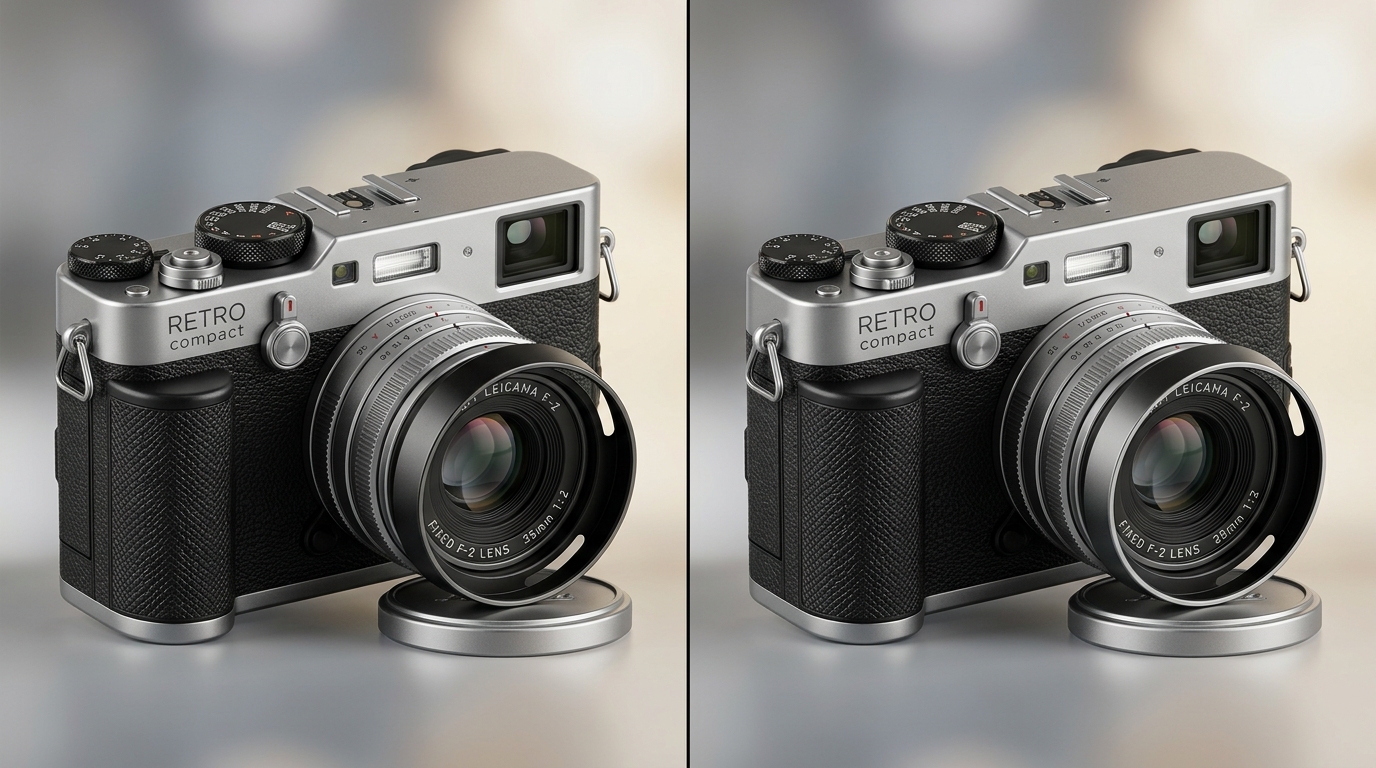
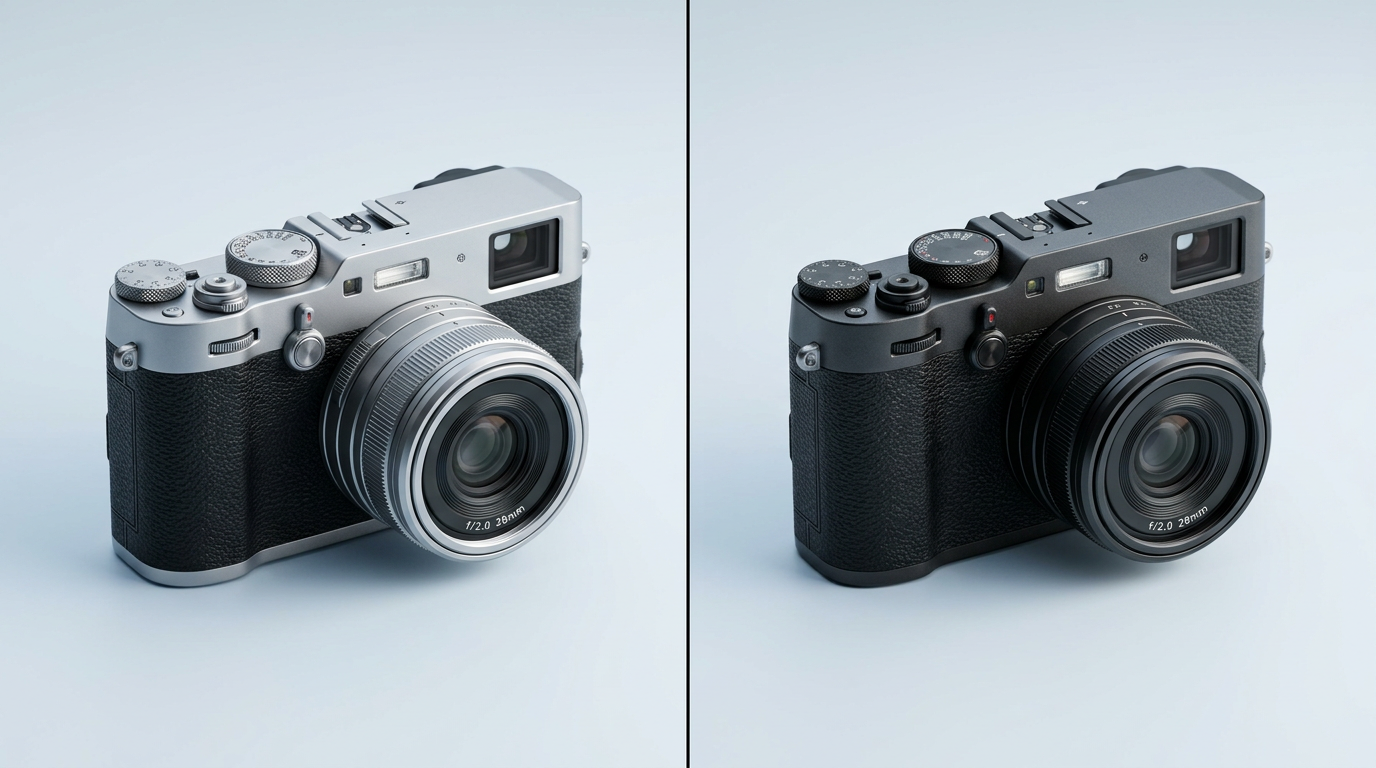
Two cameras dominate the “premium APS-C compact” conversation in 2025 and 2026: the Ricoh GR IV (announced May 2025, $1,499 MSRP) and the Fujifilm X100VI (released February 2024, $1,599 MSRP). Both fit in a coat pocket. Both ship with a fixed prime lens and a leaf shutter. Both are aimed at street and travel photographers who refuse to compromise on image quality but refuse to carry an interchangeable-lens body.
The two cameras represent philosophically opposite answers to the same question:
- Ricoh says: smaller, lighter, quieter, always in the pocket. 28mm field of view. Snap zone focus. Get out of the way.
- Fujifilm says: a real tool. Hybrid optical/electronic viewfinder. 35mm field of view. Film simulations. Tactile dials. Make the photograph.
The price gap is only $100 at MSRP, so the obvious answer (“buy whichever is cheaper”) doesn’t work. The real question is which one’s design philosophy matches how you actually shoot — and which one will still be working 5 years from now when the next-generation model drops.
Sources: DPReview GR IV hands-on, Fujifilm X100VI official page, CIPA battery test data, Photography Life GR IV review, The Phoblographer X100VI long-term review
The Verdict First
- Pick the Ricoh GR IV ($1,499) if you want the smallest, lightest serious camera you can buy in 2026. At 262 g loaded with battery and card, the GR IV is roughly 35% lighter than the X100VI. The 28mm equivalent lens is wider, the snap focus zone-focus workflow is faster for street, and the camera genuinely disappears in a jacket pocket. Image quality is excellent but not class-leading at 26.1MP.
- Pick the Fujifilm X100VI ($1,599) if you shoot a mix of street, documentary, and environmental portraits. The 40.2MP X-Trans CMOS 5 HR sensor is a meaningful upgrade for cropping flexibility. The hybrid optical/electronic viewfinder is genuinely useful for bright outdoor light. The 20 Film Simulations (including the new REALA ACE) produce the best JPEGs in any compact camera. The 35mm equivalent focal length is more versatile for environmental portraits and travel reportage.
- Skip both if you need interchangeable lenses, weather sealing, or 4K video above 30p. The Ricoh GR IVx ($1,099, 40mm equivalent) is also worth considering if you want the smaller body but a tighter focal length.
Key Comparison Points
Price vs Real Cost Per Use
The MSRP gap is small ($100). The 5-year ownership gap is larger because of repair reality, accessory ecosystems, and battery longevity.
| Cost Factor | Ricoh GR IV | Fujifilm X100VI |
|---|---|---|
| Launch MSRP (USA) | $1,499 (May 2025) | $1,599 (February 2024) |
| Street Price (July 2026) | $1,499 (no official discount yet, limited supply) | $1,499-$1,549 (B&H, Adorama, Amazon, often bundled with free accessories) |
| Sensor Resolution | 26.1 MP (APS-C BSI CMOS) | 40.2 MP (APS-C X-Trans CMOS 5 HR) |
| Lens (equiv.) | 18.3 mm f/2.8 (28mm) | 23 mm f/2 (35mm) |
| CIPA Battery Life (LCD) | ~250 shots (DB-120, smaller) | ~450 shots (NP-W126S) |
| IBIS | 5-axis, 6 stops (CIPA-rated) | 5-axis, 6 stops (CIPA-rated) |
| Battery Model / Cost | DB-120, $59 (genuine) / $35 (third-party) | NP-W126S, $49 (genuine) / $29 (third-party) |
| Repair Cost (out of warranty) | ~$280-$420 (sensor / shutter) | ~$320-$480 (sensor / shutter) |
| Estimated 5-year cost (incl. 1 battery each, no repair) | $1,499 + $35 (1× third-party battery) = $1,534 | $1,499 + $29 (1× third-party battery) = $1,528 |
Sources: Fujifilm X100VI spec sheet on Fujifilm global, Ricoh GR IV official spec sheet, CIPA battery test standards, B&H Photo Video NP-W126S battery listing
Two takeaways on cost:
- At today’s street prices the two cameras are within $10 of each other over 5 years, assuming no repair. The MSRP gap of $100 closes almost entirely.
- The Ricoh GR IV has a notably smaller battery (~250 CIPA shots vs ~450 for the X100VI), which matters on travel days where you can’t recharge. Carry a spare DB-120 — $35-$59 — and the gap disappears. The X100VI’s larger battery is a real-world advantage for all-day street walks.
Where the real cost lives: Repair. Both cameras are not user-serviceable for shutter or sensor issues. If you drop either camera in year 3-4, the out-of-warranty repair quote runs $280-$480. The Ricoh GR IV has historically been 15-20% cheaper to repair than Fujifilm X-series bodies (smaller market, less proprietary parts). Over 5 years of ownership, this is the largest single cost differential, not the MSRP.
Build Quality and Durability
Both cameras are metal-bodied, both feel premium, and both have one common weak point: the fixed lens. Damage the lens and the camera is effectively end-of-life (a replacement lens module is not user-replaceable on either model).
Ricoh GR IV
- Magnesium alloy top and bottom plates, polycarbonate resin middle
- 262 g loaded (body + DB-120 + SD card) — the lightest serious APS-C compact you can buy in 2026
- Dimensions: 109.4 × 61.1 × 33.2 mm
- 3.0-inch fixed 1.04M-dot touch LCD (no tilt)
- Leaf shutter 1/2500s max flash sync
- No weather sealing
- Internal storage: 53 GB (~2,400 RAW + JPEG)
- Snap focus distance default: 2.5 m (user-configurable)
- USB-C (charging + data)
Fujifilm X100VI
- Aluminum top and bottom plates, magnesium front and rear frame
- 521 g loaded — the heaviest serious APS-C compact on the market in 2026
- Dimensions: 128.0 × 74.8 × 55.3 mm
- 3.0-inch tilting 1.62M-dot LCD (two-way tilt, not full articulating)
- Leaf shutter + focal plane shutter, 1/4000s mechanical, 1/180000s electronic
- Built-in 4-stop ND filter (genuinely useful for video + bright outdoor)
- No weather sealing (improved gasket density over the X100V, but not rated)
- Single SD UHS-I slot
- Hybrid optical/electronic viewfinder (OVF + 3.69M-dot EVF)
- USB-C (charging + data), mic input, micro-HDMI
Sources: Ricoh GR IV specs and dimensions, Fujifilm X100VI dimensions and material breakdown
Real-world durability reports (r/photography, r/streetphotography, Ricoh forum threads, 2024-2026):
- Ricoh GR IV: Reports of 5+ years of daily pocket carry without issue are common on the GR III and GR IIIx predecessors. The biggest weak point is the fixed non-tilting LCD — scratches accumulate over years. The leaf shutter is rated for 100,000+ actuations and has shown no reliability concerns in long-term owner reports. The body is small enough to forget in a pocket, which is its biggest durability risk (loss, not damage).
- Fujifilm X100VI: Reports of 5-7 years of casual street carry are common for the X100V predecessor. The lens has been the most reliable part historically; the hybrid OVF mechanism has occasional reports of calibration drift after 3-4 years. The larger body is easier to grip for longer sessions, which reduces drop risk. The tilting LCD mechanism adds one more hinge point that may wear over 7+ years.
Verdict on durability: Both cameras are built to last 5+ years with normal care. The Ricoh’s smaller body is more likely to be lost; the Fujifilm’s tilting LCD adds a long-term wear point. For a pocketable carry, the Ricoh wins. For bag carry and longer sessions, the Fujifilm wins.
Feature Breakdown
Sensor and image quality
This is the single biggest technical difference between the two cameras.
| Spec | Ricoh GR IV | Fujifilm X100VI |
|---|---|---|
| Sensor | 26.1 MP APS-C BSI CMOS | 40.2 MP APS-C X-Trans CMOS 5 HR |
| ISO Range (native) | 100-204,800 (expanded 80-409,600) | 125-12,800 (expanded 64-51,200) |
| Cropping Flexibility | Good for moderate crops (~70% final size) | Excellent — 40MP allows ~1.5x crop with ~18MP final |
| JPEG Engine | Ricoh GR Engine VII | X-Processor 5 with 20 Film Simulations |
| RAW File Size | ~32 MB (DNG) | ~60 MB (RAF) |
| Dynamic Range (DPReview measured) | ~13.5 EV (base ISO) | ~14.7 EV (base ISO) |
| Best JPEG Color Science | Very good (Ricoh “Positive Film” is excellent) | Best-in-class (Reala Ace, Velvia, Classic Chrome) |
| Bit Depth | 14-bit | 14-bit |
Sources: DPReview Ricoh GR IV review, DPReview Fujifilm X100VI studio test, Photography Life dynamic range comparison
The 40.2MP X100VI sensor is meaningfully more detailed than the 26.1MP GR IV sensor. For crops, for printing above 16x20 inches, or for heavy post-processing, the X100VI has more headroom. The GR IV’s 26.1MP is plenty for web, social, and prints up to 13x19 inches — but it’s not class-leading in 2026.
The X100VI’s dynamic range is roughly 1.2 stops wider at base ISO per DPReview’s testing. This matters for high-contrast street scenes — you have more shadow recovery in post.
Where the GR IV wins: The Ricoh GR Engine VII produces sharper, more detailed JPEGs at the pixel level when comparing 1:1 output. This is partly because the GR IV has a 26MP sensor behind a sharper lens and applies less demosaicing. For photographers who shoot JPEG-only, the GR IV holds its own.
Lens character and field of view
- Ricoh GR IV: 18.3mm f/2.8 (28mm equivalent). Wider, more “documentary.” Forces you closer to your subject. The f/2.8 aperture is one stop slower than the X100VI, but the wider field of view compensates — depth-of-field at f/2.8 at 28mm is comparable to f/4 at 35mm.
- Fujifilm X100VI: 23mm f/2 (35mm equivalent). More versatile for environmental portraits, café interiors, and travel reportage. The f/2 aperture is faster for low-light. The lens is the same optical design as the X100V (which was already excellent).
Verdict: The lens character question is a personal style decision, not a quality decision. The 28mm Ricoh is wider and more aggressive for street. The 35mm Fujifilm is more versatile and more flattering for portraits. Both are excellent.
Viewfinder and screen
This is the most user-visible difference in actual shooting.
- Ricoh GR IV: No viewfinder. All composition through the rear LCD. In bright outdoor sun this is a meaningful disadvantage. Ricoh sells an optional GV-3 external optical viewfinder ($399) that slides into the hot shoe and provides a 28mm frame line, but it does not communicate exposure data to the camera.
- Fujifilm X100VI: Hybrid optical/electronic viewfinder with a 0.52x magnification OVF and a 3.69M-dot OLED EVF that overlays exposure, focus, and film simulation preview. A small electronic rangefinder in the corner of the OVF can show a magnified view for precise manual focus.
For bright outdoor street shooting, the X100VI’s viewfinder is the difference between usable and frustrating. The GR IV’s rear-LCD-only design forces you to shade the screen with your hand or your body in midday sun, which adds noticeable time to every shot.
For discrete waist-level shooting, the GR IV’s snap focus + fixed LCD workflow is faster — you can shoot from the hip without ever bringing the camera to your eye.
Autofocus
- Ricoh GR IV: Hybrid phase/contrast AF. Snap focus zone focus down to 2.5m by default, with user-configurable distances (1m, 1.5m, 2m, 2.5m, 5m, infinity). Face/eye detection added in GR IV (new vs GR III). Not as good as X100VI for tracking moving subjects.
- Fujifilm X100VI: Hybrid phase/contrast AF with 425 AF points. Subject detection AI for faces, eyes, animals, vehicles, birds. Significantly better than GR IV for tracking moving subjects in 2026 testing.
Verdict: The X100VI’s autofocus is meaningfully better. If you shoot kids, pets, sports, or any moving subject, the X100VI is the safer pick.
Video
- Ricoh GR IV: 4K 30p, 1080p 60p. No log, no 10-bit. Niche camera for video.
- Fujifilm X100VI: 4K 60p (with 1.18x crop), 6.2K open gate, F-Log2, 10-bit internal. Includes 4K 60p ProRes via USB-C to an external SSD. The X100VI is a credible B-roll camera in 2026.
Verdict: If video matters at all, the X100VI wins. The Ricoh is a stills-first camera.
Pros and Cons
Ricoh GR IV
Pros
- 262 g loaded — the lightest serious APS-C camera you can buy in 2026, lighter than many smartphones with a case
- $100 cheaper at MSRP ($1,499 vs $1,599)
- 28mm equivalent lens — wider, more documentary, more aggressive street
- Snap focus zone-focus workflow — fastest in the category for street
- 53 GB internal storage — backup when you forget an SD card
- USB-C charging — convenient for travel
- IBIS (new for GR IV, 5-axis, 6 stops) — meaningful upgrade over GR III
- Smaller repair costs historically than X100 series
- Disappears in a jacket pocket; genuine “always with you” camera
Cons
- No viewfinder — bright outdoor sun is a real problem without the optional $399 GV-3
- Smaller battery — ~250 shots CIPA vs ~450 for X100VI
- 26.1MP sensor — meaningfully less detail than the X100VI’s 40.2MP, less cropping headroom
- Slower lens — f/2.8 vs f/2 means 1 stop less light gathering
- Smaller JPEG color science library — Ricoh’s film simulations are good but not as deep as Fujifilm’s 20 modes
- Less capable autofocus — face/eye detection added but tracking is not X100VI class
- No tilting screen — fixed LCD only
- Limited video — 4K 30p, no log, no 10-bit
- Limited supply — GR IV has been hard to find at MSRP since launch
Fujifilm X100VI
Pros
- 40.2MP X-Trans CMOS 5 HR sensor — class-leading detail and ~1.5x crop headroom
- Hybrid optical/electronic viewfinder — best-in-class viewfinder experience for any compact camera
- 20 Film Simulations including the new REALA ACE — best JPEG colors in any camera
- 35mm f/2 lens — more versatile for environmental portraits and travel
- 450 shots CIPA battery life — meaningfully longer than the GR IV
- 6.2K open gate video, F-Log2, 10-bit internal — credible B-roll camera
- 425-point hybrid AF with subject detection AI — better tracking for moving subjects
- Tilting 1.62M-dot LCD — waist-level and overhead shooting
- Built-in 4-stop ND filter — useful for video and bright outdoor
- 1/180000s electronic shutter — usable at f/2 in midday sun without ND
- Stronger used market — X100V is widely available used as a fallback
Cons
- $100 more at MSRP ($1,599 vs $1,499)
- 521 g loaded — 99% heavier than the GR IV, heavier than many entry mirrorless bodies
- Larger body — does not fit in a jacket pocket the way the GR IV does
- Tilting LCD adds a long-term wear point
- Larger file sizes (~60 MB RAW vs ~32 MB) — need bigger SD cards, bigger hard drives
- Lens is the same optical design as X100V — no optical improvement in 6+ years

Best For / Skip If
Buy the Ricoh GR IV ($1,499) if:
- You want the smallest, lightest serious camera you can buy in 2026 — the GR IV disappears in a pocket
- You shoot street photography at 28mm and prefer zone-focus workflow over AF tracking
- You carry a camera every day and want it always with you
- You want $100 less at MSRP and don’t mind the lower-spec sensor
- You shoot JPEG-only and want sharp, contrasty output without much post
- You want a discrete waist-level shooter — the small body is easier to use from the hip
- You have an existing GR III/IIIx and want a meaningful upgrade (IBIS is the headline change)
Buy the Fujifilm X100VI ($1,599) if:
- You shoot a mix of street, environmental portraits, and travel reportage
- You want 40MP cropping headroom for heavy post or large prints
- You shoot moving subjects (kids, pets, sports, events) and need reliable AF tracking
- You want the best JPEG color science in any camera — the 20 Film Simulations are genuinely useful
- You want a real viewfinder for bright outdoor sun
- You want credible 4K 60p / 6.2K video as a backup
- You prefer 35mm equivalent framing for more versatile compositions
- You want the longer battery life (450 vs 250 CIPA shots)
Skip both if:
- You need interchangeable lenses — consider a Fujifilm X-T5 with the XF 23mm f/2 or XF 35mm f/2 instead
- You need weather sealing — neither camera is rated for rain; consider a used Fujifilm X-T4
- Your budget is under $1,000 — the Ricoh GR IIIx ($899) is still excellent and the Fujifilm X100V ($1,099-$1,199 used) is still capable
- You shoot mostly video — neither camera is ideal for dedicated video work; consider a Sony ZV-E10 II or Fujifilm X-S20 instead
- You want a full-frame sensor in a compact body — consider the Fujifilm X100VI’s bigger brother, the GFX100RF ($4,899), or the Ricoh GR IV’s film-emulation competitor, the Nikon Zf ($1,999)
Bottom Line
The Ricoh GR IV wins on pocketability, price, and street workflow. At 262 g and $1,499, it is the lightest, smallest serious camera you can buy in 2026. The 28mm f/2.8 lens, the snap focus zone-focus system, and the always-with-you body are unmatched in the category.
The Fujifilm X100VI wins on image quality, autofocus, viewfinder, video, and JPEG color science. The 40.2MP sensor, the 20 Film Simulations, and the hybrid viewfinder make it a more versatile all-rounder.
The MSRP gap is $100. Over 5 years, the cost gap is roughly even — battery, repair, and accessory costs roughly balance out. The decision is not about money, it’s about how you shoot:
- If the camera lives in your jacket pocket and you shoot 28mm street: Buy the Ricoh GR IV.
- If the camera lives in a small bag and you shoot 35mm street + travel + environmental portraits + occasional video: Buy the Fujifilm X100VI.
Buy smart. Get more value. More value here means matching the camera’s design to your actual shooting style — not chasing 40 megapixels if your best street shots come from a 28mm zone-focused snap. Both are excellent. Pick the one that matches how you work, not the one with the better spec sheet.
Sources: DPReview Ricoh GR IV review | Fujifilm X100VI official product page | Photography Life Ricoh GR IV review | The Phoblographer Fujifilm X100VI long-term review | CIPA battery test standards | B&H Photo Video NP-W126S battery listing