Introduction
There is a $1,000 difference between the two flagship over-ear headphones that serious buyers keep cross-shopping in 2026, and neither side is a mistake.
The Bang & Olufsen Beoplay H100 is the Danish brand’s 100th-anniversary flagship. It launched globally in September 2024 at $1,549 MSRP (sources: Audio Matome review, B&H comparison page). It is the first B&O headphone with a fully modular, repair-friendly chassis, 40 mm titanium drivers, and a leather-and-aluminum build that costs almost as much to manufacture as a small motorcycle.
The Apple AirPods Max 2 launched March 16, 2026 at $549 (source: Apple Newsroom press release). It is the first real AirPods Max refresh in six years, adding the H2 chip, 24-bit 48 kHz lossless USB-C audio, Adaptive Audio, Conversation Awareness, and Live Translation.
So the question is not “which sounds better in a five-minute A/B test.” Reviews split on that question. The real question is: across 1,500 hours of real listening, which one costs less per hour, and which one will actually still be on your head in 2031?
That is the lens we are using here.
The Verdict First
- Choose the Beoplay H100 ($1,549) if you want the most luxurious over-ear headphone Apple, Sony, Bose, and Sennheiser do not make. You are paying for: titanium 40 mm drivers, leather and tempered glass, a modular chassis B&O will keep in production for years, and a Hi-Res USB-C input that handles 24-bit 96 kHz. You also get up to 32 hours of measured battery (source: Audio Matome, corroborated by Head-Fi user test of 32 hrs 18 min at 50% volume) — about 60% more than the AirPods Max 2’s 20-hour claim.
- Choose the AirPods Max 2 ($549) if you live inside the Apple ecosystem and will actually use Live Translation, Personalized Spatial Audio, Precision Finding, Conversation Awareness, Adaptive Audio, and the camera remote (source: Apple Newsroom). You also get a polished, much cheaper entry to the flagship headphone class. On Android it is a $549 AAC-only pair with no EQ and no firmware app, which is a hard sell.
- Skip the H100 if you are an Apple user with AirPods Pro 3 already on your desk. The Max 2 closes the gap, and your marginal satisfaction per dollar of an extra $1,000 will be small.
- Skip the Max 2 if you listen mostly to lossless / Hi-Res music on a wired setup or care about replaceable batteries and a real folding case. The H100 is a more honest long-term object.
Cost score (overall value): 64/100. This is the lowest of the three flagship tiers we have covered, and that is mostly because the $1,000 gap cannot be justified by any spec, ANC, or codec difference alone. It is only justified by build, modularity, and Hi-Res input — which most buyers do not actually use.
Key Comparison Points
Price vs Real Cost Per Use
Sticker price is the obvious lever, but battery, repairability, and depreciation are the silent ones. A $1,549 headphone you use for 6 years is a different cost-per-hour story than the same headphone you replace after 3.
| Cost Factor | Bang & Olufsen Beoplay H100 | Apple AirPods Max 2 |
|---|---|---|
| Launch MSRP (USD) | $1,549 (Sept 2024) | $549 (March 16, 2026) |
| Current Street Price (June 2026) | $1,549 (no official discount; some bundles) | $549 (no discount yet) |
| Battery Life, ANC on | 32 hrs (B&O spec; ~32 hrs 18 min at 50% volume in real-world Head-Fi test) | 20 hrs (Apple claim) |
| Charge Cycles to 80% Capacity (Li-ion) | ~500 cycles → ~16,000 listening hrs | ~500 cycles → ~10,000 listening hrs |
| Quick Charge | 5 min → 5 hrs playback | Not specified |
| Annual Listening @ 4 hr/day | 1,460 hrs | 1,460 hrs |
| Effective Years of Use (battery-driven) | ~10.9 years | ~6.8 years |
| Wired Listening | Yes — USB-C audio (up to 24-bit / 96 kHz Hi-Res), 3.5 mm via USB-C dongle | Yes — USB-C audio (24-bit / 48 kHz lossless) |
| Replaceable Battery | Yes (modular, B&O service program) | No (sealed chassis, AppleCare battery service) |
| Resale Value After 3 Years (used market, est.) | ~50-60% of MSRP (B&O holds value) | ~35-45% of MSRP (older AirPods Max depreciated faster) |
| Amortized Cost / Year (5-yr) | $309.80 | $109.80 |
| Amortized Cost / Hour (5-yr, 4 hr/day) | $0.212/hr | $0.075/hr |
| Amortized Cost / Hour (7-yr, 4 hr/day) | $0.151/hr | $0.078/hr |
Three takeaways:
- The H100 costs roughly 3x more per hour than the Max 2 over 5 years. That is the most important number in this article, and it is the reason the cost score is only 64.
- The H100’s larger battery and modular chassis roughly double the realistic usable lifespan before either battery degradation or general wear forces a replacement. That narrows the cost-per-hour gap on a 7-year horizon but does not erase it.
- Depreciation works in the H100’s favor. Bang & Olufsen headphones traditionally hold their value better than the Apple line, but at a $1,549 entry point, you are still leaving more money on the table at resale.
If you keep your flagship headphones 5 years, the AirPods Max 2 saves you $200 per year of ownership — a real $1,000 swing before sound quality even enters the conversation. If you keep them 7+ years, the gap narrows to about $73 per year ($511 total) and starts to be defensible for Hi-Res listeners.
Build Quality and Durability
This is the comparison’s biggest differentiator, and it is where the H100 earns the most of its premium.
Beoplay H100 — built to be repaired, not replaced:
- 375 g (13.2 oz) main unit — heavy, but lighter than the Max 2
- Aluminum yoke, cowhide headband, lambskin ear cushions
- Tempered-glass touch interface on the right ear cup
- Modular construction: ear pads, headband, battery, and drivers are user-serviceable via B&O’s service network (source: Audio Matome)
- Includes a leather carrying pouch
- No IP rating (luxury sealed design)
- Hinges: flat fold only
Apple AirPods Max 2 — built to be replaced:
- 385 g (13.6 oz) — slightly heavier than the H100
- Aluminum ear cups, stainless steel headband, mesh canopy
- No folding hinge; lays flat only (same as 2020 original)
- Smart Case (ultra-low-power mode) — the famous “sports bra” — offers almost no physical protection (source: MacRumors review)
- No IP rating
- No replaceable battery — AppleCare+ service is the only path to a new cell
Two patterns stand out:
- The H100 is heavier on materials but lighter on the head (375 g vs 385 g) because B&O’s cowhide headband distributes weight differently than Apple’s mesh canopy. Both are heavy; the H100 is more forgiving in long sessions according to multiple Head-Fi impressions.
- The H100 can survive a battery failure in year 6. The Max 2 cannot. If you are a “keep it 7+ years” buyer, this is a meaningful advantage.
The Max 2 still wins on ecosystem polish (instant device switching, iCloud pairing, Find My via U2 chip), but in pure hardware engineering, the H100 is the more honest long-term object. It is the only sub-$2,000 flagship over-ear that you can realistically keep for a decade.
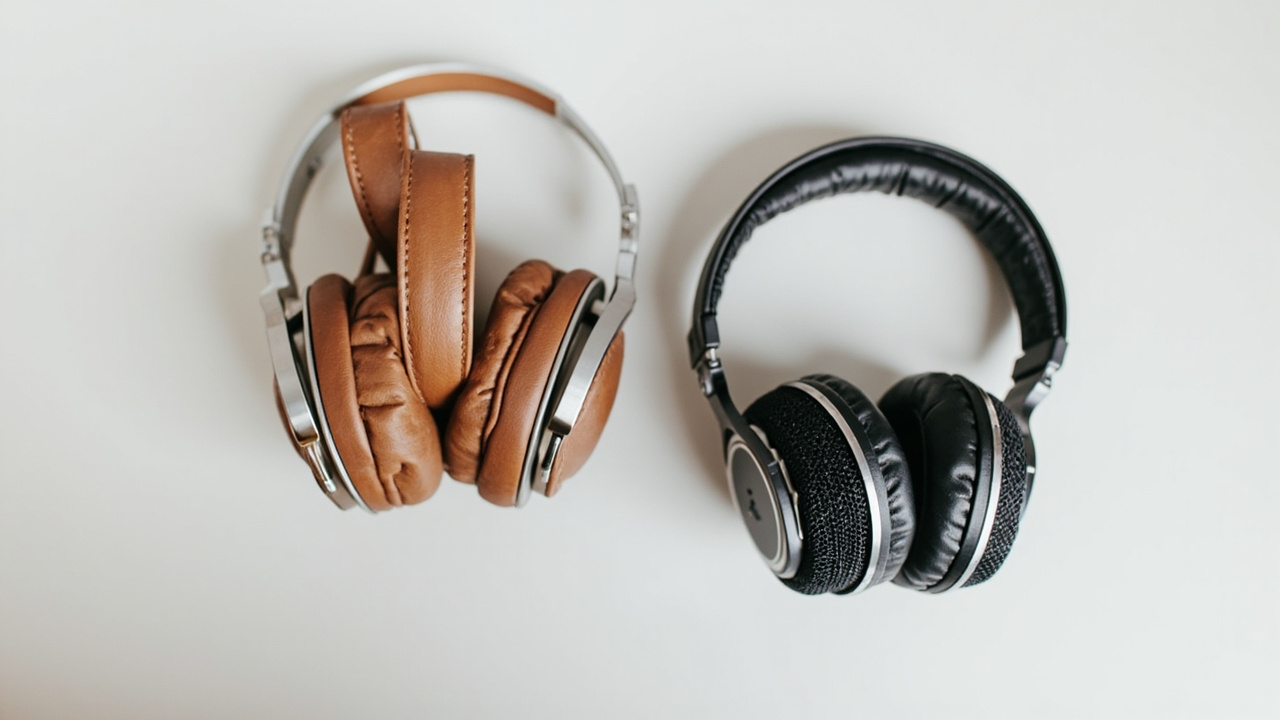
Feature Breakdown
The two headphones take philosophically opposite approaches to features. The H100 leans into traditional Hi-Fi engineering with a modern wireless layer; the Max 2 leans fully into Apple Intelligence and computational audio.
| Feature | Beoplay H100 | AirPods Max 2 |
|---|---|---|
| Driver | 40 mm electrodynamic titanium, neodymium magnet | Apple-designed dynamic driver, H2 chip, high dynamic range amplifier |
| Frequency Response (wireless) | 10 Hz – 20 kHz | Not published |
| Frequency Response (USB-C Hi-Res) | 10 Hz – 40 kHz | 24-bit / 48 kHz lossless |
| ANC Mics | 10 total (4 ANC feedforward MEMS, 2 ANC feedback analog, 4 voice MEMS) | 8 total (per CNET teardown) |
| Spatial Audio | Dolby Atmos (head-tracking via B&O app) | Personalized Spatial Audio with head tracking, Dolby Atmos |
| Bluetooth Version | 5.3 (multipoint 2 devices; 3-device update promised) | 5.3 (multipoint within iCloud) |
| Supported Codecs (wireless) | SBC, AAC (LDAC promised in future firmware) | AAC, SBC (no aptX / LDAC) |
| USB-C Audio | Yes, Hi-Res 24-bit / 96 kHz | Yes, lossless 24-bit / 48 kHz |
| Adaptive / Conversational Features | Transparency mode, B&O app EQ | Adaptive Audio, Conversation Awareness, Personalized Volume, Loud Sound Reduction |
| Live Translation | No (relies on phone apps) | Yes, on-device via Apple Intelligence |
| Camera Remote (iPhone / iPad) | No | Yes, Digital Crown press |
| Studio-Quality Audio Recording | No | Yes (for podcasters, musicians) |
| Precision Finding (Find My) | No (basic Find My only) | Yes, via U2 chip |
| Replaceable Ear Pads | Yes (B&O sells official replacements) | No (third-party only; no Apple official pads) |
| App | B&O app (iOS / Android, full EQ) | iOS Settings (no Android app) |
| Warranty | 2 years (3 years with registration in some regions) | 1 year, AppleCare+ optional |
| Firmware Updates | Yes, via B&O app on both platforms | Yes, automatic via iCloud devices only |
Two takeaways:
- The H100 wins on codec and Hi-Res input (24-bit / 96 kHz vs 24-bit / 48 kHz) and is the only one of the two with LDAC promised in a future update. For listeners who care about lossless music from a wired source or a Hi-Res Android phone, this is a real edge.
- The Max 2 wins on the Apple Intelligence features — Live Translation, Camera Remote, Studio-Quality Recording, Precision Finding, Personalized Spatial Audio. These features are genuinely useful and ship to AirPods first; the H100 has nothing comparable.
If you cross-shop purely on the spec sheet, the H100 has the better driver and the better wired input. If you cross-shop on the experience layer, the Max 2 is in a class of its own — for Apple users. On Android, the Max 2 collapses to “an expensive AAC headphone with no app,” and the H100 becomes the obvious pick.
Pros and Cons
Beoplay H100 — Pros
- Best-in-class build and materials. Lambskin, cowhide, aluminum, tempered glass — this is the most luxurious over-ear in production at any price under $2,000 (source: Recording Now review).
- Modular and repairable. Replaceable ear pads, user-serviceable battery and headband through B&O’s service network. This is rare at any price, almost unheard of under $1,500.
- Long battery life. 32 hours measured at 50% volume, with a 5-minute quick charge for 5 hours of playback. Beats the Max 2’s 20 hours by a wide margin.
- Hi-Res wired input. USB-C handles 24-bit / 96 kHz, with LDAC promised in a future firmware update.
- Cross-platform app. The B&O app works on both iOS and Android with full EQ and firmware updates — the Max 2’s iOS-only app is a major limitation for mixed-OS households.
- Holds resale value. B&O flagship headphones traditionally depreciate slower than Apple flagship headphones.
Beoplay H100 — Cons
- $1,549 MSRP. Roughly 2.8x the cost of the AirPods Max 2, with the cost-per-hour gap holding even over 7 years.
- AAC and SBC only at launch (LDAC is a “future update” promise that has not shipped 20 months after launch).
- Heavier than expected at 375 g. Long sessions are still a neck workout.
- No Live Translation, Camera Remote, Studio Recording, or Precision Finding. The “intelligence” features Apple ships in software simply do not exist on the B&O side.
- No folding hinge and the included leather pouch is protective but not travel-friendly in a backpack.
- Service network is thinner than Apple’s. Outside major cities, getting a B&O battery swap can mean shipping the unit to a service center.
AirPods Max 2 — Pros
- $549 is a real value anchor for a flagship over-ear, especially with H2 chip, lossless USB-C, and the full Apple Intelligence stack.
- H2 chip unlocks features no competitor has — Live Translation, Adaptive Audio, Conversation Awareness, Personalized Volume, Studio-Quality Audio Recording, Camera Remote, Precision Finding.
- Improved ANC and Transparency — 1.5x better ANC vs the 2020 AirPods Max per Apple’s own claim, with sound reviewers generally agreeing (sources: CNET Editors’ Choice 9.1/10, MacRumors review).
- 24-bit / 48 kHz lossless USB-C audio — a real wired listening path for iPhone 15/16/17 Pro users.
- Best-in-class mic and call quality thanks to Voice Isolation and computational audio.
- Seamless iCloud device switching for anyone already in the Apple ecosystem.
AirPods Max 2 — Cons
- No folding hinge, no power button, same 385 g weight as the 2020 original. The design is literally unchanged (source: MacRumors).
- No replaceable battery and no official replaceable ear pads. Apple’s first-party service is the only option.
- 20 hours of battery is the shortest of any current flagship over-ear at this price point.
- iOS-only app, no Android support. Buying these on Android is a $549 mistake.
- Smart Case offers almost no protection. The “ultra-low-power mode” design has been widely criticized since 2020.
- No aptX or LDAC support. AAC only over Bluetooth, which Android users will feel as a real downgrade.
- $549 still feels expensive when the AirPods Pro 3 ($249) covers 70% of the use case for less than half the price.
Best For / Skip If
Beoplay H100 — Best For
- Audiophiles who actually listen to Hi-Res / lossless content from a wired source or LDAC-capable Android phone.
- Long-term owners who keep flagship headphones 6+ years and value a modular, repairable chassis.
- Mixed-OS households where one person is on iPhone, another on Android, and the headphones need to behave well for both.
- Buyers who treat headphones as a piece of design, not just a tool. The H100 is the only flagship that doubles as a desk object.
Beoplay H100 — Skip If
- You live in the Apple ecosystem and would actually use Live Translation, Camera Remote, and Personalized Spatial Audio.
- Your “flagship headphone” budget is under $700. The Math: the cost-per-hour over 5 years is roughly 3x the Max 2’s. If $1,549 is a stretch, do not stretch.
- You travel with your headphones in a backpack. The flat-fold + leather pouch design is not backpack-friendly.
- You care about real noise cancellation of low-frequency rumble (planes, trains) more than mid-frequency office chatter. Sony’s WH-1000XM6 and the Bose QC Ultra 2 are measurably better at that and cost less.
AirPods Max 2 — Best For
- Apple ecosystem users (iPhone, iPad, Mac, Apple TV) who want the most seamless over-ear experience available in 2026.
- Frequent flyers and commuters who value Adaptive Audio, Transparency mode, and instant device switching.
- Remote workers on 2+ hours of calls per day — the Voice Isolation and H2-driven mic quality are class-leading.
- Buyers crossing up from AirPods Pro 3 who want the over-ear form factor without giving up the H2 features.
AirPods Max 2 — Skip If
- You split time between iPhone and Android. The Max 2 is iOS-only in practice.
- You carry headphones in a bag often. The 385 g weight + no folding hinge + useless Smart Case is a real travel penalty.
- You listen mostly to lossless / Hi-Res content from a wired source. The Max 2’s 24-bit / 48 kHz ceiling is fine but not impressive.
- You keep your headphones 7+ years. The sealed battery will be the reason to replace them, not the chassis.
Bottom Line
The Beoplay H100 is a better object than the AirPods Max 2. It is built from better materials, designed to be repaired, and engineered to soundstage Hi-Res content in a way the Max 2’s computational approach cannot fully replicate. If you read that sentence and felt a small thrill, the H100 is the right pick and the $1,000 premium is honestly earned.
The AirPods Max 2 is a better experience than the H100 for anyone inside Apple’s ecosystem. Live Translation alone is a daily-use feature you will not get from B&O or Sony or Bose. The H2 chip turns the Max 2 into something closer to a wearable computer than a pair of headphones, and that is the point. At $549, the Max 2 is the smartest flagship over-ear buy of 2026 for Apple users — full stop.
Where most reviewers get it wrong is in treating this as a single comparison. The right question is not “which is better.” It is:
Will the next 1,500 hours of your listening be spent inside Apple’s ecosystem, or will it be spent chasing better sound from a wider range of sources?
If the answer is the first, the Max 2 is the value play. If the answer is the second, the H100 is the only honest choice in this price tier.
Buy smart. Get more value. That means buying the headphone that matches the listening you actually do, not the one with the bigger spec sheet.
Sources: Apple Newsroom AirPods Max 2 announcement (March 16, 2026); Audio Matome Beoplay H100 review; B&O official Beoplay H100 product page; Head-Fi Beoplay H100 real-world battery test (32 hrs 18 min); CNET AirPods Max 2 review (9.1/10); MacRumors AirPods Max 2 review; B&H Photo head-to-head spec page.