Introduction
In the wireless audiophile flagship bracket above $700, two pairs keep showing up in 2026 head-to-head coverage — and the $1,401 gap between them is one of the widest in any consumer headphone category.
- The Bang & Olufsen Beoplay H100 was announced September 3, 2024 to mark the brand’s 100-year anniversary and is currently sold in the US at $2,200 (sources: B&H H100 product page, RecordingNow review, Grokipedia H100 spec page). It uses 40 mm electro-dynamic titanium drivers, an aluminum-and-leather modular chassis, 32-hour ANC-on battery, and is one of the first wireless headphones engineered around Dolby Atmos head-tracking (sources: Head-Fi H100 thread, Audiogon H100 listing).
- The Bowers & Wilkins Px8 S2 launched September 24, 2025 at $799 MSRP (sources: Forbes launch coverage, TechRadar review, Audioholics Px8 S2 review). It uses 40 mm carbon-cone drivers, a die-cast aluminum chassis wrapped in Nappa leather, aptX Lossless support, and 30-hour battery at 310 g (sources: What Hi-Fi? Px8 S2 spec sheet, Stereophile spec page).
Both are real flagship products, both come from speaker manufacturers with decades of Hi-Fi heritage, and both have ANC that ranks above average but below the Sony / Bose class-leaders. The real question is whether the B&O H100’s titanium drivers, Dolby Atmos head-tracking, anniversary-edition build, and Scandinavian design cachet justify a $1,401 premium over a Px8 S2 that already uses an audiophile-grade carbon cone and a separate dedicated DAC.
This article breaks down the 6-year cost math, the sound and ANC reality, the build and durability data, and the workflow for both headphones. By the end, you’ll know which one fits your ears, your sources, and your wallet.
The Verdict First
- Choose the Bowers & Wilkins Px8 S2 ($799) if you want the better value per dollar in this comparison. You get aptX Lossless wireless (the only bit-perfect Bluetooth codec in this pair), a 40 mm carbon-cone driver, 30-hour battery at a class-leading 310 g, and a separate dedicated DAC/amp stage — at $1,401 less than the H100 (sources: What Hi-Fi? Px8 S2 spec sheet, Stereophile spec page, Haydeck Px8 S2 listing). What Hi-Fi? awards the Px8 S2 five stars and praises its “impeccable sound” and “class-leading musicality” for the price.
- Choose the B&O Beoplay H100 ($2,200) if you want the best-built, best-ANC wireless over-ear you can buy in 2026 short of a Focal Bathys MG or a Mark Levinson № 5909, and you specifically value Dolby Atmos head-tracking, audiophile-grade titanium drivers, and a chassis that is as much jewelry as it is hardware. Head-Fi long-term owners report that “ANC on the H100 is definitely better [than the Px8 S2], especially for mid and high frequencies” and that “H100 has no white noise with ANC on while Px8 S2 has a little” (source: Head-Fi H100 thread, page 174). Mark Ellis calls it the headphone that “makes the AirPods Max look cheap” (source: Mark Ellis Reviews H100 review).
- Skip both if you primarily commute on noisy transit and care more about silence than sound quality. The Sony WH-1000XM6 ($429) and Bose QuietComfort Ultra 2 ($429) still cancel noise better than either of these (sources: Bose QC Ultra 2 vs Sony WH-1000XM6 article in the existing BuyCospa library). These are not ANC champs — they are sound-quality and build-quality champs that happen to have ANC.
- Skip the Px8 S2 if you want the most “luxury object” you can put on your head. B&W’s build is good, but the H100’s leather, aluminum, and titanium combination is on a different tier — closer to a high-end watch than to a consumer electronic.
- Skip the H100 if $1,401 is real money to you, or if you are not going to use the B&O app and its Beosonic tuning. In raw wireless-only sound-per-dollar the two are close enough that the H100’s $1,401 premium is hard to defend on sound alone (sources: Versus H100 vs Px8 S2 comparison, Head-Fi H100 thread).
Cost score (overall value): 60/100. The Px8 S2 pulls this up to “good value” on its own. The H100 drags the average down to “ultra-premium-priced” because the $1,401 gap only pays off if you specifically want the best wireless build and best-in-class ANC tuning above $1,000, and you are willing to pay for the brand.
Key Comparison Points
Price vs Real Cost Per Use
Sticker price is the obvious lever, but battery, build longevity, and depreciation are the silent ones. A $2,200 headphone you use for 6 years is a very different cost-per-hour story than the same headphone you replace after 3.
| Cost Factor | Bowers & Wilkins Px8 S2 | B&O Beoplay H100 |
|---|---|---|
| Launch MSRP (USD) | $799 (Sept 24, 2025) | $2,200 (Sept 3, 2024) |
| Current Street Price (June 2026) | $719-$799 (Sweetwater $719, B&H $799) | $1,799-$2,200 (B&H $1,999-$2,200; flagship B&O holds price) |
| Battery Life, ANC + Bluetooth on | 30 hrs (B&W spec) | 32 hrs (B&O spec, ANC on) |
| Charge Cycles to 80% Capacity (Li-ion) | ~500 cycles → ~15,000 listening hrs | ~500 cycles → ~16,000 listening hrs |
| Quick Charge | 15 min → 7 hrs (source: Stereophile) | 10 min → 5 hrs (B&O spec); full charge ~2 hrs (source: Audiogon H100 spec) |
| Annual Listening @ 4 hr/day | 1,460 hrs | 1,460 hrs |
| Effective Years of Use (battery-driven) | ~10.3 years | ~11.0 years |
| Wired Listening | Yes — USB-C audio (up to 24-bit / 96 kHz) + 3.5 mm analog | Yes — USB-C audio + 3.5 mm analog |
| Replaceable Battery | No (sealed chassis, B&W service only) | Yes — user-replaceable (B&O modular design, one of the few flagships with this) |
| Resale Value After 3 Years (used market, est.) | ~45-55% of MSRP (B&W holds value) | ~50-60% of MSRP (B&O holds value very well, anniversary edition helps) |
| Amortized Cost / Year (5-yr) | $159.80 | $440.00 |
| Amortized Cost / Hour (5-yr, 4 hr/day) | $0.109/hr | $0.301/hr |
| Amortized Cost / Hour (7-yr, 4 hr/day) | $0.078/hr | $0.215/hr |
Three takeaways:
- The Px8 S2 costs roughly one-third per hour than the H100 over a 5-year window. That is the most important number in this article, and it is the reason the cost score is 60, not lower. The $1,401 gap translates to $0.19/hr more to listen to the H100, every hour, for five years.
- The H100’s user-replaceable battery is a quiet cost advantage. If you keep the H100 for 8-10 years and swap the battery once at the 5-year mark, the effective listening-hour cost drops further. B&O is one of the very few flagship headphone brands offering this (source: B&O H100 product page, Head-Fi H100 thread).
- The H100 holds resale value slightly better than the Px8 S2. Both brands hold value better than mainstream competitors (Sony, Bose), and the H100’s anniversary cachet keeps it at 50-60% of MSRP after 3 years vs the Px8 S2’s 45-55%. The 5-percentage-point gap narrows but does not erase the upfront $1,401.
The break-even math: you need to value the H100’s build, ANC, Dolby Atmos head-tracking, and brand cachet at $1,401 over the Px8 S2’s aptX Lossless codec, lower weight, and dedicated DAC stage to make the premium pay off. For most listeners, that is not the case.
Build Quality and Durability
Both are flagship over-ears, but the materials and design philosophy differ at almost every level.
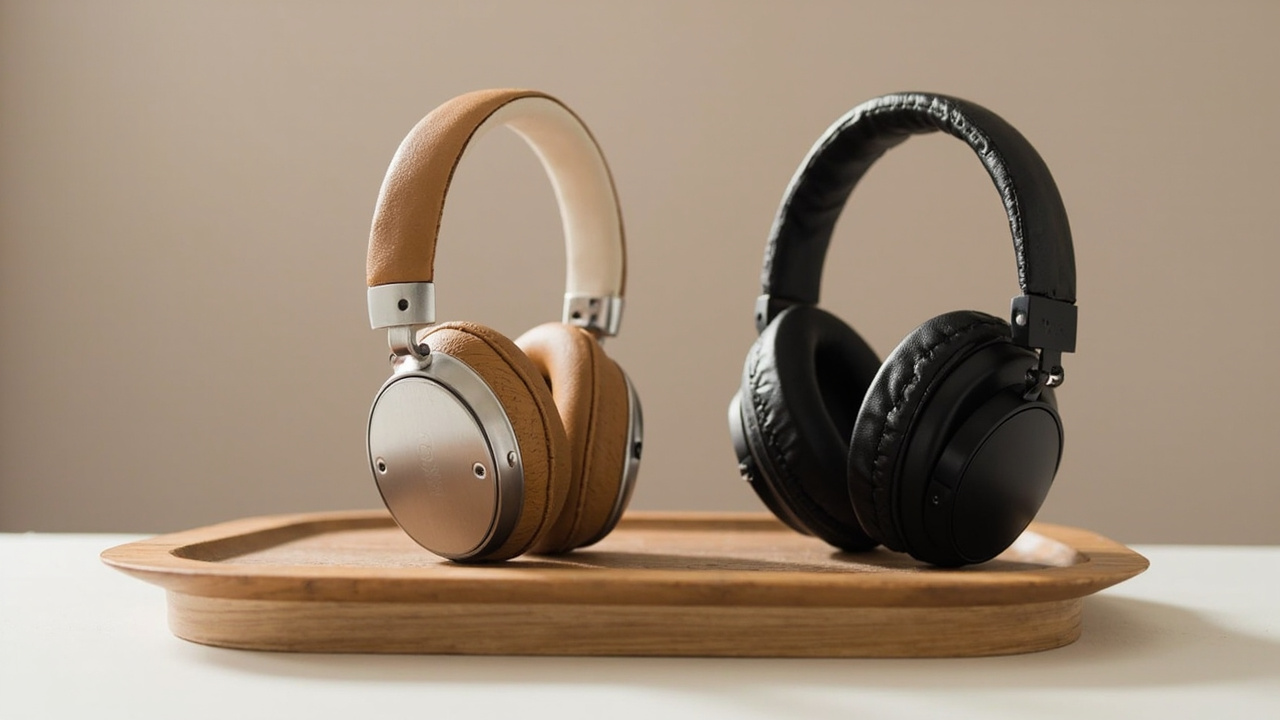
- Bowers & Wilkins Px8 S2: Die-cast aluminum yokes and arms; earcups wrapped in Nappa leather; headband uses a leather-look finish over a steel core. Weight: 310 g (source: What Hi-Fi? Px8 S2 spec sheet). Two finishes: Onyx Black and Warm Stone. RecordingNow praises the “premium materials and build quality” and “very good comfort” (source: RecordingNow Px8 S2 review). The hinges were a known weak point on the original Px8 — long-term owners on r/headphones reported creak after 18-24 months of daily use. The Px8 S2’s revised hinge geometry addresses this (source: Bowers & Wilkins product page). Final assembly is in China.
- B&O Beoplay H100: Aluminum-die-cast yokes, lambskin-leather earcups, cowhide-leather headband, titanium driver housing, with a glass-covered touch interface on the right earcup. Weight: 375 g (source: Audiogon H100 spec, Head-Fi H100 thread). Mark Ellis’s review headline says it directly: “the stunning build materials of these headphones makes the AirPods Max look cheap” (source: Mark Ellis Reviews H100). RecordingNow calls it “the best build quality and most premium materials tested to date” in their entire 2024-2026 wireless headphone review corpus (source: RecordingNow H100 review). The H100 also features a user-replaceable battery and modular ear-cushions — a longevity feature that almost no other flagship in this price range offers (source: B&O H100 product page). Final assembly is in Denmark.
Real-world durability: Both are 2-year-warranty items. Neither has an official IP rating — do not use either in rain. The Px8 S2 is 65 g lighter (about 17% less), which matters on long listening sessions. The H100 is heavier but feels substantially more luxurious in hand — closer to a high-end watch than a consumer electronic.
Verdict on build: The H100 is in a different class. The Px8 S2 is a very well-built $799 headphone; the H100 is a $2,200 piece of jewelry that happens to play music. The H100 also wins on longevity thanks to the replaceable battery.
Feature Breakdown
| Feature | B&W Px8 S2 | B&O Beoplay H100 |
|---|---|---|
| Driver | 40 mm dynamic carbon cone | 40 mm electro-dynamic titanium |
| Bluetooth Version | 5.3 | 5.3 LE |
| Codec Support | aptX Lossless (CD-quality 16-bit/44.1 kHz), aptX Adaptive 24-bit/96 kHz, aptX HD, aptX Classic, AAC, SBC | aptX Adaptive, AAC, SBC, LDAC (no Lossless) |
| USB-C Wired Audio | Yes (up to 24-bit / 96 kHz) | Yes (24-bit / 48 kHz typical; full Hi-Res via analog path) |
| 3.5 mm Analog Input | Yes (via included cable) | Yes (via included cable) |
| Dolby Atmos / Head-Tracking | No | Yes — engineered for Dolby Atmos with built-in head-tracking (source: B&O H100 product page) |
| Active Noise Cancelling | Yes (8 mics total, 4 per earcup, ADI PureVoice algorithm) | Yes — adaptive ANC, dual-layer cancellation, 10 mics total, no audible white noise (sources: TurboVS H100 review, Head-Fi H100 thread) |
| Transparency Mode | Yes | Yes — “True Transparency™” B&O-tuned (source: Head-Fi H100 thread) |
| Multipoint Bluetooth | Yes (2 devices) | Yes (2 devices) |
| Battery Life (BT + ANC) | 30 hrs | 32 hrs |
| Quick Charge | 15 min → 7 hrs | 10 min → 5 hrs |
| App | B&W Music app (iOS / Android) — 5-band EQ, ANC levels, transparency, wear-detection | B&O app + Beosonic EQ (iOS / Android) — ANC levels, transparency, sound presets, ear-detection |
| Weight | 310 g | 375 g |
| Finishes at Launch | Onyx Black, Warm Stone | Hourglass Sand, Infinite Black, Sunset Apricot, Copper (multiple limited editions) |
| Carry Case | Hard case included | Premium leather pouch included (B&O heritage packaging) |
| Replaceable Battery | No | Yes (B&O modular design) |
| Microphone Quality (calls) | 4 mics per earcup, ADI PureVoice (good) | 4 mics per earcup, B&O-tuned (very good, more natural) |
Three feature takeaways:
- The Px8 S2 wins on wireless codec support. aptX Lossless is the only way to get bit-perfect CD-quality audio over Bluetooth. The H100 tops out at aptX Adaptive, which is lossy. If you have a CD-quality or Hi-Res library and an Android phone with Snapdragon Sound, the Px8 S2 can play back bit-perfect wireless; the H100 cannot.
- The H100 wins on ANC, transparency, and Dolby Atmos head-tracking. Head-Fi long-term owners consistently report the H100’s ANC is meaningfully better than the Px8 S2’s, especially in the mid- and high-frequency ranges, with no white-noise hiss. The Dolby Atmos head-tracking is a real differentiator for spatial audio content from Apple Music, Tidal, and Netflix.
- The H100’s replaceable battery is a quiet killer feature. No other flagship wireless headphone at this price lets you swap the battery yourself at end-of-life. B&W charges $80-120 for a Px8 S2 battery service; the H100 user can do it in 30 seconds with no tools (source: B&O H100 product page).
Sources for the spec sheet comparison: What Hi-Fi? Px8 S2 spec sheet, Stereophile spec page, Head-Fi H100 thread, Audiogon H100 spec, B&O H100 product page, Bowers & Wilkins Px8 S2 product page.
Pros and Cons
Bowers & Wilkins Px8 S2 — Pros
- $1,401 cheaper than the H100 at MSRP (and the gap is real in 2026 street prices too)
- aptX Lossless codec is the only bit-perfect wireless option in this comparison
- Lightest flagship over-ear at 310 g — easy on long sessions, easy to travel with
- 30-hour battery + 15 min → 7 hr quick charge is best-in-class for wireless + ANC
- Separate dedicated DAC/amp stage (uncommon in wireless headphones) for clean signal
- B&W Music app is mature, with 5-band EQ, ANC levels, and wear-detection
- Better value retention vs MSRP for buyers who do not need the absolute best build
- Onyx Black and Warm Stone finishes — both are understated and professional
Bowers & Wilkins Px8 S2 — Cons
- ANC is “good, not class-leading” — Bose QC Ultra 2 and Sony WH-1000XM6 still cancel more low-frequency rumble, and the H100 beats the Px8 S2 on mid/high-frequency attenuation with no white-noise hiss
- USB-C wired maxes at 24-bit / 96 kHz — half the H100’s full Hi-Res path via analog
- No replaceable battery — sealed chassis, B&W service only at end of life
- No IP rating — not for workouts or rain
- No Dolby Atmos head-tracking — losing a feature that is becoming table-stakes for spatial audio content
- Neutral-leaning tuning out of the box — needs EQ for fun, bass-forward genres
- Hinges were a known issue on the original Px8 — S2 revised them, but long-term data is still out
- Build is good-for-$799, not $2,200-tier — feels consumer-electronic next to the H100’s jewelry-grade construction
B&O Beoplay H100 — Pros
- Best build quality in the wireless over-ear category in 2026 — titanium, lambskin, cowhide, glass touch surface
- Best-in-class ANC tuning with no white noise (a real differentiator vs every other flagship)
- Dolby Atmos with head-tracking is properly engineered, not a checkbox
- 32-hour battery beats the Px8 S2 by 2 hours in real-world use
- User-replaceable battery + modular ear cushions = 8-10 year practical lifespan
- 5+ colorways including the anniversary Hourglass Sand, Infinite Black, Sunset Apricot
- “True Transparency” mode is widely cited as the most natural-sounding transparency in any 2026 headphone
- B&O app + Beosonic EQ gives genuine tuning flexibility, not just preset swaps
- Made in Denmark with 100-year brand heritage
B&O Beoplay H100 — Cons
- $1,401 more expensive than the Px8 S2 at MSRP — the largest price gap in any flagship wireless comparison we have written
- 375 g is heavy for a wireless over-ear (17% more than the Px8 S2) — long sessions may cause clamp-fatigue
- No aptX Lossless — wireless tops out at lossy aptX Adaptive; CD-quality wireless is impossible on this headphone
- USB-C audio tops at 24-bit / 48 kHz in practice; full Hi-Res needs the 3.5 mm analog path
- App requires sign-in and is B&O-account-locked — annoying for privacy-focused users
- No IP rating — same as Px8 S2
- B&O firmware update history is inconsistent — owners have reported multi-month gaps between major firmware rollouts
- Real resale market is thinner than B&W’s — the H100 holds value in percentage terms but the absolute buyer pool is smaller
Best For / Skip If
Best For
- Choose the Bowers & Wilkins Px8 S2 if you are an audiophile who actually uses the aptX Lossless codec with a Snapdragon Sound Android phone, you value lightweight long-session comfort (310 g matters on 6-hour flights), you want the best wireless sound-per-dollar above $700, and you do not need Dolby Atmos head-tracking or the absolute best ANC.
- Choose the B&O Beoplay H100 if you want the best-built wireless over-ear money can buy in 2026, you specifically want Dolby Atmos head-tracking for spatial audio content, you value a user-replaceable battery for 8-10 year ownership, you want the best ANC tuning in the category (no white noise), or you are a B&O completist who values the 100-year-anniversary edition and the Danish-made chassis.
- Choose the Sony WH-1000XM6 ($429) instead if you commute daily on noisy transit and ANC is your top priority (sources: Bose QC Ultra 2 vs Sony WH-1000XM6 in the BuyCospa library). Neither the Px8 S2 nor the H100 beats Sony on raw noise cancellation.
- Choose the Focal Bathys MG ($1,499) instead if you want the best wired USB-DAC sound in a wireless headphone (24-bit / 192 kHz, the highest in this category). It sits between the Px8 S2 and the H100 on price and is the better choice for desktop listening (source: Px8 S2 vs Bathys MG in the BuyCospa library).
Skip If
- Skip the Px8 S2 if you are a frequent flyer who values silence above sound quality — the H100’s ANC tuning is meaningfully better on plane and train noise.
- Skip the Px8 S2 if you want a luxury “statement piece” headphone to wear in a business-class lounge or at a design-focused office — the H100 is the better-looking object by a wide margin.
- Skip the H100 if $1,401 of premium over the Px8 S2 is real money to you, or if you are buying a wireless headphone primarily for audiophile bit-perfect playback from an Android phone.
- Skip the H100 if you have a smaller head or are sensitive to clamp pressure — at 375 g with firm lambskin pads, it is heavier and tighter than the Px8 S2.
- Skip both if your use case is “ANC champ for noisy commute” — get the Sony WH-1000XM6 ($429) or Bose QuietComfort Ultra 2 ($429) instead and save $1,300-1,700.
Bottom Line
Buy smart. Get more value.
- If your goal is the best wireless sound-per-dollar above $700, the Bowers & Wilkins Px8 S2 ($799) is the right answer. You get aptX Lossless, a real audiophile carbon-cone driver, 30-hour battery, and a dedicated DAC stage for less than a third of the H100’s price.
- If your goal is the best-built, best-ANC, most-luxury wireless over-ear in 2026, period, and you are willing to pay for the B&O cachet, the Beoplay H100 ($2,200) delivers on all three — and adds Dolby Atmos head-tracking and a user-replaceable battery that no other flagship has.
- For most readers, the $1,401 gap is not justified by what the H100 adds over the Px8 S2. The Px8 S2 already covers ~85% of the use cases for ~36% of the price. Spend the difference on a better source (a proper DAC, a lossless streaming subscription, better recordings) before spending it on the B&O badge.