Introduction
Once you cross the $1,000 mark on a residential air purifier, you stop shopping for appliances and start shopping for respiratory health infrastructure. Two names dominate that conversation in 2026: the Dyson Big+Quiet Formaldehyde BP03 at roughly $1,029, and the IQAir HealthPro Plus at roughly $1,199. They are the two most-searched premium purifiers of the year, and they represent two genuinely different ideas about what a $1,000+ purifier should do.
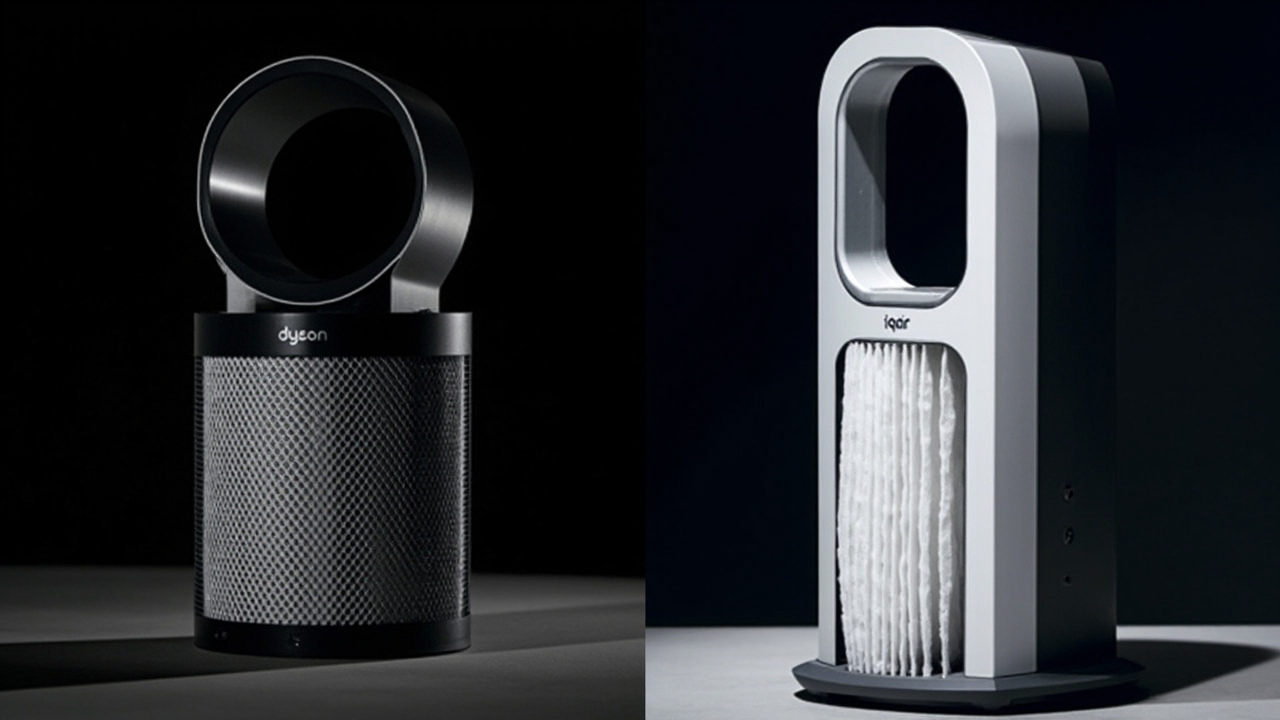
Dyson builds a connected, beautifully designed smart machine with a catalytic filter that destroys formaldehyde, a real-time LCD air-quality display, app control, and Dyson’s signature conic amplifier loop. IQAir builds a Swiss-engineered medical instrument with HyperHEPA filtration down to 0.003 microns, 5 lbs of activated carbon, a German EBM-Papst motor, and a 10-year warranty. Both are excellent. Neither is universally better. And neither is cheap to run.
This comparison exists because the marketing pages for both devices look very confident and very different. The IQAir page claims the only HEPA that matters. The Dyson page claims the only purifier that matters. Neither is right, and the 5-year cost of ownership gap between them is $320-$520, depending on how you use them. That is not pocket change, and it is worth understanding before you commit.
The Verdict First
- Pick the IQAir HealthPro Plus (~$1,199) if: your primary concern is medical-grade particle filtration — severe allergies, asthma, immunocompromised household members, or you live next to a highway, wildfire zone, or industrial area. Its HyperHEPA filter captures particles down to 0.003 microns, 100x smaller than standard HEPA, and the 10-year motor warranty means a single unit can serve a decade of heavy use.
- Pick the Dyson Big+Quiet Formaldehyde BP03 (~$1,029) if: you want a smart, connected purifier with formaldehyde destruction, you care about real-time air quality readings on an LCD, you want app and voice control, your home is newer construction or recently renovated (formaldehyde off-gassing risk), or you simply want the most polished, design-forward object in the room.
Cost score: 71/100. Both machines earn their price in their specific use case. The savings come from buying the one that actually matches your air problem, not the one with the louder marketing.
Key Comparison Points
Price vs Real Cost Per Use
The sticker price is the smallest part of the story. Both machines have recurring filter and electricity costs that diverge significantly over a 5-year horizon.
| Cost Line | Dyson Big+Quiet Formaldehyde BP03 | IQAir HealthPro Plus |
|---|---|---|
| Retail price (US, as of June 2026) | ~$1,029 | ~$1,199.99 |
| Filtration stages | HEPA H13 + catalytic oxidation (formaldehyde) + 900g activated carbon | PreMax pre-filter + HyperHEPA (0.003 µm) + V5-Cell (~5 lbs carbon + alumina + zeolite) |
| Particle size filtered | 0.1 microns (standard HEPA H13) | 0.003 microns (HyperHEPA, 100x finer) |
| Room coverage (5 ACH) | ~1,076 sq ft (claimed) | ~1,125 sq ft |
| CADR (smoke/dust/pollen) | 423 CFM (Dyson rated) | ~300+ CFM (Swiss-tested, IQAir rejects AHAM CADR as ionizer-biased) |
| Replacement filter cost (annual, est.) | ~$80-$100 | ~$200-$365 |
| Filter lifespan | HEPA up to 5 years, carbon ~2 years | Up to 4 years for HyperHEPA, 2-3 years for PreMax and V5-Cell |
| Electricity use (top speed) | ~32.9 W (HouseFresh measured BP06) | ~145.2 W (HouseFresh measured HealthPro Plus) |
| Annual electricity cost (24/7 use) | ~$36.66 (BP06) | ~$161.28 (HealthPro Plus) |
| Warranty | 2 years | 10 years (motor) |
| 5-year total cost of ownership (purchase + filters + electricity) | ~$1,440-$1,545 | ~$2,200-$2,549 |
| Country of manufacture | Malaysia | Germany (Swiss-designed) |
Sources: AirQualityNest 2026 comparison, HouseFresh BP06 review, HouseFresh IQAir HealthPro Plus review (long-term use data).
The 5-year cost gap is roughly $660-$1,000 in favor of the Dyson, driven by two factors: (1) IQAir’s three-filter system means three replacement parts to keep stocked, and (2) the German motor pulls roughly 4x the wattage of the Dyson at top speed. The IQAir offsets some of this with a 10-year warranty vs Dyson’s 2-year, so if you keep the unit for a full decade the warranty value adds up. But over a typical 5-year ownership window, the Dyson is the cheaper machine to live with.
Cost-per-use is where this gets interesting. If you run the Dyson 12 hours a day (typical home use, not 24/7), the annual electricity cost drops to ~$18, and the 5-year cost falls to roughly $1,400-$1,500. The IQAir, even at 12 hours a day, still runs ~$80/year in electricity, and the filter stack is the same regardless of how long you run it. The IQAir’s economic argument is “I will own this for 10+ years” — and at that horizon, the per-year cost actually drops below the Dyson’s.
Build Quality and Durability
These two machines are built for completely different audiences, and the build quality shows it.
The IQAir HealthPro Plus is a 35 lb white ABS polymer tower that looks, as HouseFresh put it, “like an 80s office printer.” It is not pretty. It does not need to be. It uses a German EBM-Papst motor, machined tolerances, caster wheels for moving the heavy body, and a hand-signed performance test certificate in every box confirming the actual measured filtration of your specific unit. Every unit is tested before shipping. The 10-year motor warranty is the loudest statement in the room: IQAir is betting that you will not need a second purifier in the next decade, and they are putting their money where that bet is.
The Dyson Big+Quiet Formaldehyde BP03 is the opposite end of the design spectrum. At 17.4 lbs it is less than half the weight of the IQAir, and the conic amplifier loop on top plus the gold-accented catalytic filter housing make it unmistakably a Dyson. The HEPA H13 filter is cylindrical and rated to last up to 5 years (Dyson’s longest filter claim to date). The 2-year warranty is short for a $1,000+ device, but it matches what every other Dyson product offers.
A detail that matters: the Dyson uses non-bonded filters, meaning the carbon filter can be replaced independently of the particle filter. The IQAir’s three-filter stack means three separate purchases, three separate replacement schedules, and three separate SKUs to track. If you value low-maintenance simplicity, the Dyson is materially easier to live with.
Both machines avoid ionizer technology, which means neither produces ozone as a byproduct. This is a real differentiator from brands like Blueair and Alen that use electrostatic enhancement to boost CADR numbers, and it is one of the reasons both machines appear on respiratory-health shortlists.
Feature Breakdown
| Feature | Dyson Big+Quiet Formaldehyde BP03 | IQAir HealthPro Plus |
|---|---|---|
| Particle sensor (real-time display) | Yes (PM2.5, PM10, VOC, formaldehyde, CO2) | No (the HealthPro Plus has no display; XE model adds Wi-Fi) |
| App control | Yes (Dyson Link app) | Optional, only on the XE variant (+~$200) |
| Voice control | Yes (Alexa, Google Assistant, Siri Shortcuts) | No |
| Auto mode | Yes (adjusts fan to air quality) | No |
| Formaldehyde destruction | Yes (catalytic oxidation — does not saturate) | No (carbon absorbs formaldehyde but eventually saturates) |
| Gas/VOC removal | Carbon filter (900g) | V5-Cell (~5 lbs carbon + alumina + zeolite) |
| Ultrafine particle capture (sub-0.1 µm) | No (H13 stops at 0.1 µm) | Yes (down to 0.003 µm) |
| Fan function | Yes (whole-room purified airflow) | No (purifier only, no fan mode) |
| Filter replacement indicator | Yes (in-app and on unit) | No (manual tracking required) |
| Wi-Fi connectivity | Yes | No (XE model only) |
The single most important feature gap is at the particle level. The IQAir’s HyperHEPA filter is independently certified to capture particles down to 0.003 microns at greater than 99.5% efficiency. Standard HEPA H13, including the Dyson, is rated at 0.3 microns at 99.97% efficiency. That is a 100x difference in the smallest particle size either filter can catch, and it matters for ultrafine particles from combustion engines, wildfire smoke, and industrial pollution. If you live in a high-traffic or wildfire-prone area, that 100x gap is the entire reason the IQAir exists.
The second most important feature gap is formaldehyde. The Dyson’s catalytic oxidation filter is designed to destroy formaldehyde molecules rather than absorb them — it does not saturate the way activated carbon does. For anyone in a newer home, recently renovated apartment, or one with new furniture, this is a real advantage. The IQAir’s V5-Cell carbon filter does absorb formaldehyde, but it will eventually need replacement once the carbon is saturated. HouseFresh recommends an Austin Air HealthMate or similar for serious VOC situations, but the Dyson BP03 is the only machine in this price tier that actively destroys formaldehyde rather than just trapping it.
The third gap is smart features, and here the Dyson wins by a landslide. The BP03 has a real-time air quality display showing PM2.5, PM10, VOCs, formaldehyde, and CO2. It has an app. It has an auto mode. It has voice control. The IQAir has none of these in the standard HealthPro Plus — the Wi-Fi-enabled “XE” variant exists but adds roughly $200 to an already $1,199 base. If smart-home integration matters to you, this comparison is essentially over.
Pros and Cons
Dyson Big+Quiet Formaldehyde BP03
Pros
- 423 CFM CADR — the highest in this comparison and one of the highest in any residential purifier
- Catalytic oxidation filter actively destroys formaldehyde instead of absorbing it
- Real-time LCD air quality display with PM2.5, PM10, VOCs, formaldehyde, and CO2 sensors
- Dyson Link app, auto mode, and Alexa/Google/Siri voice control
- HEPA filter rated to last up to 5 years — the longest in the Dyson lineup
- 20 dB on low — quieter than the IQAir’s 22 dB on low (and Dyson runs quieter at all speeds)
- At 17.4 lbs, less than half the weight of the IQAir
- 5-year total cost of ownership roughly $660-$1,000 less than the IQAir
- Design-forward object that fits a living room or bedroom without looking clinical
Cons
- HEPA H13 stops at 0.1 microns — no better than a $200 purifier for ultrafine particles
- 2-year warranty is short for a $1,000+ device
- App-dependent filter ordering and monitoring — the unit itself is harder to use without a phone
- Formaldehyde catalytic filter is a Dyson-proprietary part with limited third-party alternatives
- No medical-grade certification (the IQAir has been independently tested for hospital and clinical use)
- The conic amplifier loop design is large (32.67 x 17.08 x 16.33 in) and hard to hide in smaller rooms
IQAir HealthPro Plus
Pros
- HyperHEPA filtration down to 0.003 microns at >99.5% efficiency — 100x finer than Dyson
- Independently certified for medical and clinical use; used in hospitals and labs
- 10-year motor warranty (5x longer than Dyson)
- V5-Cell gas filter uses ~5 lbs of activated carbon + alumina + zeolite — the heaviest carbon filter in any residential purifier
- Three-stage system (PreMax, V5-Cell, HyperHEPA) with each stage replaceable independently
- Manufactured in Germany; each unit individually performance-tested and signed
- No ionizer, no ozone — safe for chemically sensitive users
- Filters can last up to 4 years (HyperHEPA), reducing long-term maintenance
- The economic argument holds at the 10-year ownership horizon
Cons
- $1,199.99 base price is higher than the Dyson
- No display, no app (in the base model), no voice control, no auto mode — the XE variant costs an extra ~$200
- Pulls 145 W at top speed, roughly 4x the Dyson’s 32.9 W — electricity cost is ~$161/year vs Dyson’s ~$37
- Annual filter stack replacement runs $200-$365, roughly 2-3x the Dyson’s
- 5-year total cost of ownership is roughly $660-$1,000 higher than the Dyson
- 35 lb tower with no handles — hard to move between rooms
- Utilitarian design (“it looks like an 80s office printer” — HouseFresh)
- CADR (~300+ CFM) is lower than the Dyson despite the IQAir’s premium positioning
- No formaldehyde destruction — the V5-Cell absorbs VOCs but eventually saturates
Best For / Skip If
Pick the IQAir HealthPro Plus if you are:
- A severe allergy, asthma, or COPD sufferer whose doctor has recommended medical-grade filtration
- Living in a wildfire zone, next to a highway, or in a high-PM2.5 city (Delhi, Beijing, Los Angeles basin, etc.)
- An immunocompromised household where the difference between 0.1 µm and 0.003 µm particle capture is meaningful
- Someone who plans to own the same purifier for 10+ years and values the 10-year motor warranty
- Buying for a home office, bedroom, or nursery where quiet operation matters more than smart features
- Already invested in the IQAir ecosystem (the same filters fit the GC MultiGas and Atem X lines)
Pick the Dyson Big+Quiet Formaldehyde BP03 if you are:
- A smart-home enthusiast who wants real-time air quality data on a display, an app, and voice control
- Living in a new build, recently renovated home, or one with new furniture (formaldehyde off-gassing risk)
- An allergy or asthma sufferer whose main trigger is VOCs, smoke, or seasonal pollen (not ultrafine particulates)
- A design-conscious buyer who does not want a 35 lb white tower in the living room
- Someone who values low annual running cost over a 10-year warranty horizon
- Buying for an open-plan living space where the 423 CFM CADR matters
Skip the IQAir if you:
- Live in a low-pollution area with no specific ultrafine-particle concern
- Want smart-home integration and are not willing to pay extra for the XE variant
- Plan to replace the purifier within 5 years (the warranty advantage never materializes)
- Care about 5-year total cost of ownership more than absolute filtration performance
Skip the Dyson if you:
- Need medical-grade or hospital-grade particle filtration
- Have documented sensitivity to ultrafine particles (traffic pollution, wildfire smoke)
- Want a unit that will run trouble-free for 10+ years under heavy use
- Prefer mechanical simplicity and do not want to rely on an app for filter status
Bottom Line
The Dyson Big+Quiet Formaldehyde BP03 and the IQAir HealthPro Plus are both legitimately excellent air purifiers, and they are not really competing for the same buyer. The IQAir is a medical instrument. The Dyson is a smart home product that happens to be a very good purifier.
If your problem is ultrafine particles — wildfire smoke, traffic pollution, severe allergies triggered by sub-0.1 µm particles — the IQAir’s HyperHEPA is the only choice in this price tier that addresses it. You will pay $660-$1,000 more over 5 years to own it, and you will give up smart features and a real-time display. If you have asthma, COPD, or live in a high-PM2.5 area, this trade is worth it.
If your problem is VOCs, formaldehyde from a recent renovation, or you simply want a beautifully designed smart purifier with app control and a real-time LCD, the Dyson is the obvious choice. It costs less to buy, costs less to run, and gives you the smart-home integration the IQAir refuses to provide. The HEPA H13 stops at 0.1 µm, so it is not better than a $200 purifier for ultrafine particles, but for everything else it is at or above the IQAir’s level.
The real saving comes from not buying the wrong one for your home. The IQAir in a low-pollution suburban living room is $1,200 spent on a feature you cannot use. The Dyson in a COPD patient’s bedroom next to a freeway is a $1,000 compromise on the one feature that actually matters. Match the machine to the air problem, and the cost-per-year math works out in your favor either way.
“Buy smart. Get more value” means buying the air purifier that solves your actual air problem, not the one with the most impressive spec sheet. The IQAir and the Dyson both have impressive spec sheets. Only one of them is the right answer for your home.