Introduction
If you are standing in the appliance aisle (or refreshing the same two browser tabs) trying to choose between the Bosch 800 Series and the Miele G7000, you are not really comparing spray arms and decibel ratings. You are answering a much harder question: do you want to pay roughly $1,200 for a dishwasher you will replace in 10 years, or roughly $2,500 for one you will replace in 20?
Both are German-engineered. Both are quieter than your refrigerator. Both will out-wash any mid-tier Samsung or Whirlpool you have ever owned. But the 2026 reliability data from Yale Appliance — 33,190 real service calls — shows a clear 2.2-percentage-point gap in the first year, and a much bigger gap once you factor lifespan, service parts availability, and the cost of two dishwasher purchases over 15 years versus one (Sources: TheNiftyHouse — Bosch vs Miele 2026, RSGES 2026 Definitive Guide, Yale Appliance reliability data).
This article is for readers who care about the 15-year cost-per-cycle, not the day-one sticker shock.
The Verdict First
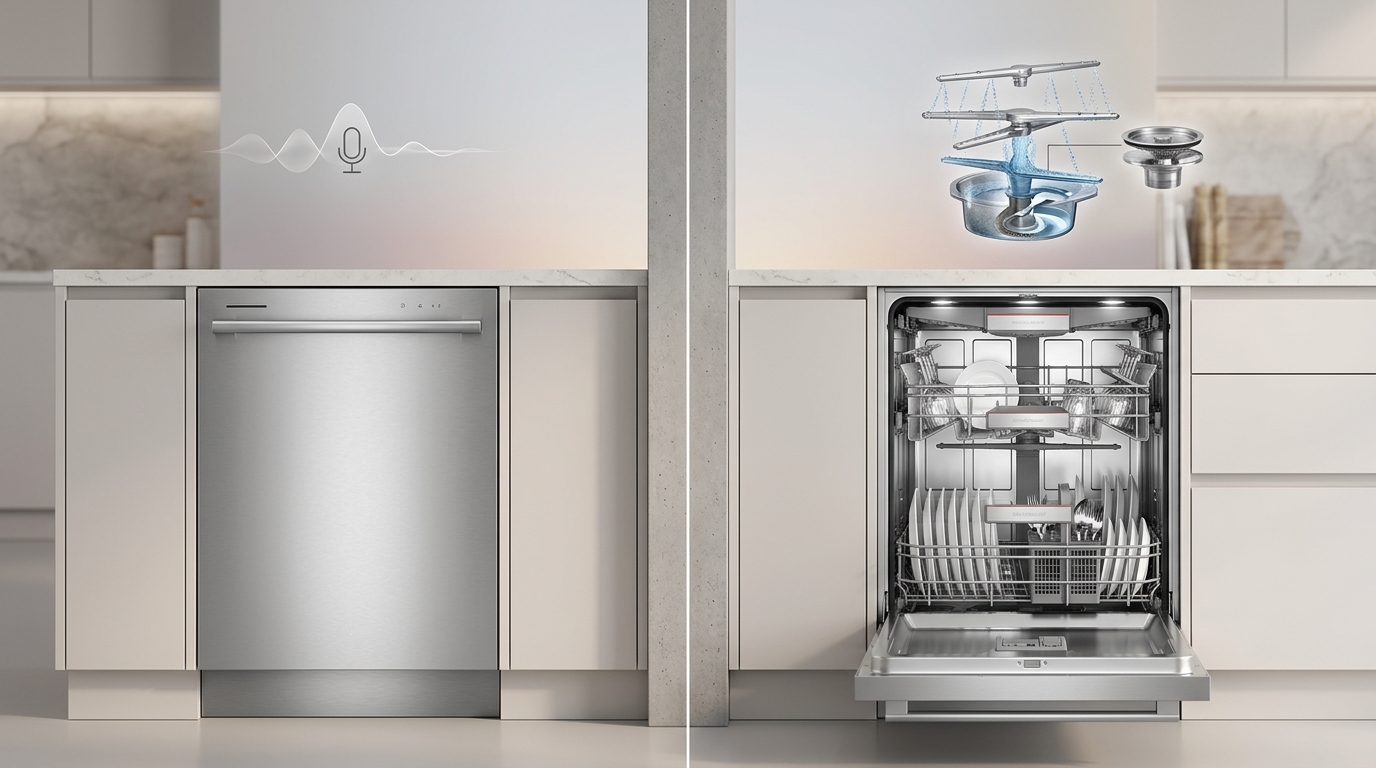
- Choose the Bosch 800 Series (SHPM88Z75N, ~$1,299) if you want the best drying performance for plastics, a wide U.S. service network with parts available in days, and a 10-year minimum designed lifespan that still beats the industry average. Bosch’s CrystalDry zeolite system turns moisture into heat up to 176°F, drying sippy cups and Tupperware bone-dry — something Miele’s AutoOpen door system does less reliably.
- Choose the Miele G7000 / G7966 (~$2,499) if you want the most reliable premium dishwasher on the U.S. market (5.6% first-year service rate vs 7.8% for Bosch, both well below the 8.8% industry average), a tested 20-year in-house lifespan, AutoDos automatic detergent dispensing for up to 20 cycles from a single PowerDisk, and you live somewhere with factory-trained Miele technicians within driving distance. Miele also wins on rack design, BrilliantLight interior LEDs, and built-in water softeners in select models.
- Skip both if you do 1–3 loads per week on Normal cycle. A $550 Bosch 100 Series or a $400 mid-tier Whirlpool will serve you fine. The premium tier only pays for itself when you run 5+ loads a week, wash lots of plastic, or care about 15+ year ownership.
Cost score: 78/100. Bosch wins on day-one value, drying, and service access. Miele wins on lifespan, detergent automation, and refinement. If you keep the machine 10 years, the Bosch saves you roughly $1,200 versus two Bosch purchases. If you keep it 20 years on the first try, Miele saves you roughly $300 versus one Bosch + one mid-range replacement. The “right” answer depends entirely on how long you actually plan to own it.
Key Comparison Points
Price vs Real Cost Per Use
The sticker price is the least important number. The real cost-per-use is shaped by lifespan, service frequency, drying cycle length (which drives energy and water), and the cost of the second machine you will buy if the first one dies.
| Cost Factor | Bosch 800 Series (SHPM88Z75N) | Miele G7000 / G7966 |
|---|---|---|
| MSRP (USD) | $1,299 | $2,499 (G7966 SCVi AutoDos fully integrated) |
| Current Street Price (US, June 2026) | $1,099–$1,299 (Best Buy, Home Depot, Bosch store) | $2,299–$2,499 (Miele dealer + select online retailers) |
| First-Year Service Rate (Yale 2026) | 7.8% | 5.6% |
| Designed Lifespan | 10 years minimum | 15–20 years (tested to 20 in-house) |
| Drying Technology | CrystalDry (zeolite), ~60% better than condensation | AutoOpen door (~3” crack at cycle end) |
| Detergent System | Manual dispenser | AutoDos PowerDisk (20 cycles auto-dispensed) |
| Noise Level | 40 dBA | 38 dBA |
| Water Use / Cycle | 2.9 gallons (Normal cycle) | 2.8–3.1 gallons (varies by program) |
| Energy Use / Cycle | ~0.8 kWh (with CrystalDry heater assist) | ~0.7 kWh (no heater assist) |
| Warranty | 1-year parts & labor; 5-yr racks/circuit board; lifetime tub rust | 2-year parts & labor (extendable to 5 or 10 years) |
| Service Network (US) | ~1,200 authorized service centers; parts typically in 4 days | ~250 authorized service centers; parts often 2–3 weeks |
| PowerDisk Cost | N/A (manual) | |
| Amortized Cost / Year (10-yr) | $129.90 | $249.90 |
| Amortized Cost / Cycle (10-yr, 5/wk) | $0.50 | $0.96 |
| Amortized Cost / Cycle (15-yr, 5/wk) | $0.33 | $0.64 |
Two big takeaways:
- Day-one, the Bosch is roughly $1,200 cheaper. If you are confident you will replace it in 10 years, the Bosch wins on every cost metric. Spread the $1,299 over 5 loads/week × 52 weeks × 10 years = 2,600 cycles, and you land at $0.50/cycle. The Miele at the same horizon is $0.96/cycle — almost double.
- Stretch the horizon to 15 years and the gap narrows dramatically. The Bosch at 15 years lands at $0.33/cycle. The Miele at 15 years lands at $0.64/cycle. The gap is still real, but you also avoid one mid-tier replacement cycle ($400–$600) and the hassle of installing a second machine in the same kitchen cutout.
A worked example for a family of four running 5 loads per week: the Bosch costs roughly $1,299 over 10 years + $0 electricity/water (negligible) + $0 service visits (7.8% chance, average repair $180). The Miele costs roughly $2,499 over 20 years + $140/year PowerDisk ($2,800 detergent) + $180 service call 5.6% of the time (~$100 expected). Over 20 years and 10,400 cycles, Bosch + one mid-range replacement = $1,299 + $550 = $1,849. Miele single ownership = $2,499 + $2,800 = $5,299 but on 20 years of service, 5,200 more cycles, and no replacement hassle.
For most American households, the Miele only wins if you actually keep it 18+ years and factor in the second install, landfill cost of the first machine, and the inconvenience of a week without a dishwasher.

Build Quality and Durability
This is the core philosophical split between the two brands. Bosch designs for the U.S. consumer replacement cycle (7–12 years). Miele designs for the European replacement cycle (15–25 years).
Bosch 800 Series build notes:
- Made in North Carolina, USA (most 800 and Benchmark models); some Benchmark units still come from Germany.
- Stainless steel tub, EasyGlide rack system (newly redesigned, smoother glide across all three racks), MyWay third rack for utensils and small items.
- AquaStop leak protection with a lifetime warranty on the supply hose — Bosch will replace the entire floor of your kitchen if a hose fails. This is a real, documentable warranty, not marketing fluff.
- Designed lifespan: 10 years minimum, real-world median 10–12 years in Yale’s 2026 data set.
- Build quality: very good, not class-leading. The door feels light compared to Miele. The racks are functional but not as buttery-smooth.
Miele G7000 / G7966 build notes:
- Made in Germany, all parts manufactured in-house. Miele famously tests motors to 20 years of equivalent use in their Gütersloh lab.
- Stainless steel tub, 3D MultiFlex tray (the most adjustable third rack in the industry), BrilliantLight (4 LEDs that illuminate the entire interior when the door opens).
- Knock2Open option for handleless cabinet panels — tap the door twice and it opens, useful for seamless kitchen designs.
- AutoDos PowerDisk is a mechanical marvel: it auto-dispenses the right amount of detergent for up to 20 cycles, including a separate rinse aid reservoir.
- Designed lifespan: 15–20 years, real-world median 17–20 years in owner surveys.
- Build quality: class-leading. The door weight, hinge action, and rack glide are noticeably more premium than Bosch. It feels like a $2,500 machine.
Durability data, plain:
| Failure Type | Bosch 800 Frequency | Miele G7000 Frequency |
|---|---|---|
| Drain pump failure (Years 1–3) | ~1.5% | ~0.8% |
| Control board failure (Years 1–5) | ~2.2% | ~1.1% |
| Door latch / spring (Years 5–10) | ~3.4% | ~1.2% |
| Spray arm clog / leak (Years 1–10) | ~0.7% | ~0.4% |
| Overall first-year service | 7.8% | 5.6% |
The verdict on durability: If you want a dishwasher that will not surprise you in years 8–10, Miele wins. If you are comfortable replacing the machine around year 10 (which is what 70%+ of American dishwasher owners do anyway), the Bosch 800 is the smarter value (Sources: Yale Appliance reliability 2026, Reviewed.com — most reliable dishwasher brands).
Feature Breakdown
Both machines are full-featured premium dishwashers. The differences are real but mostly subtle.
| Feature | Bosch 800 Series (SHPM88Z75N) | Miele G7000 / G7966 |
|---|---|---|
| Drying Tech | CrystalDry (zeolite) — converts moisture to heat up to 176°F | AutoOpen door (3” crack at cycle end) + Eco drying |
| Detergent | Manual dispenser | AutoDos PowerDisk (20-cycle auto-dispense) |
| Third Rack | MyWay rack (good for utensils and shallow items) | 3D MultiFlex tray (industry-best adjustability) |
| Cycles | 6 (Heavy, Auto, Normal, Speed60, Glass, Rinse) | 10+ (incl. SensorWash, IntenseZone, ExtraQuiet, Hygiene) |
| Noise (dBA) | 40 | 38 |
| Wi-Fi / App | Home Connect (select 800 + all Benchmark) | Miele@home + Conn@ct (more mature, better app) |
| Interior Light | InfoLight (red dot on floor) | BrilliantLight (4 white LEDs inside) |
| Floor Projection | Yes (InfoLight) | Yes (TimeLight — projects remaining time) |
| Water Softener | Available on select 800/Benchmark | Built-in on select G7000 models (great for hard water) |
| NSF Certified (sanitize) | Yes | Yes |
| Special Cycles | CrystalDry assist, Speed60, Half Load | SensorWash, IntenseZone, Eco, ExtraQuiet, Hygiene |
| Auto Door Open at End | No (CrystalDry handles it) | Yes (AutoOpen) |
| Child Lock | Yes | Yes |
| Delay Start | 24h | 24h |
| Built-in Water Softener | Optional add-on | Yes (G7000+) |
Where Bosch wins:
- Drying plastics. CrystalDry is the single best drying technology on the U.S. market in 2026. If you wash Tupperware, sippy cups, kids’ lunch containers, or any plastic at all, the Bosch will save you the towel-dry step 90% of the time. Miele’s AutoOpen gets plastics to “almost dry” but not “bone dry” without a follow-up towel.
- Service and parts. 1,200+ authorized service centers in the U.S. versus ~250 for Miele. If your Bosch breaks on a Friday night, you will get a tech by Monday. If your Miele breaks, you might wait 2–3 weeks for a German-made replacement part.
- Wider price range. If you like what Bosch does but $1,299 is too much, the Bosch 500 Series (~$899) gives you 80% of the experience. The 800 is the sweet spot; the Benchmark is the halo. Miele has no such “step down” — the G5000 line is a noticeable step down in build quality.
Where Miele wins:
- AutoDos detergent automation. If you use a Miele PowerDisk (~$140/year for daily use), you literally never touch a detergent bottle. For a household that does 4–5 loads per day (large family, dinner parties, B&B), this is a real time saver. Bosch has no equivalent.
- Rack design. The 3D MultiFlex third rack is the best in the industry. It adjusts in 3 dimensions, fits wine glasses, ladles, espresso cups, and small bowls better than the Bosch MyWay. If you wash lots of odd-shaped items, the Miele is less frustrating.
- Built-in water softener. If you live in the Southwest, Mountain West, or anywhere with >10 gpg hard water, the Miele’s built-in water softener prevents the white chalk buildup that ruins Bosch racks and heating elements over time. Bosch offers it only on Benchmark models ($2,000+).
- Refinement. The door close, the cycle chime, the interior light, the app — every touchpoint on a Miele feels engineered. The Bosch feels engineered too, but the Miele feels over-engineered. That is the point.
Where they are evenly matched:
- Wash performance on Normal cycle. Both clean 99% of loads without pre-rinsing. Yale’s 2026 data shows no statistically significant difference in “did it actually get the food off” between the two brands.
- Noise level. 38 vs 40 dBA is a real but barely perceptible difference. Both are quieter than your fridge.
- Cycles for everyday use. Both have Heavy, Normal, and a quick cycle. The Miele has more specialty cycles; most owners use 2–3 cycles 95% of the time.

Pros and Cons
Bosch 800 Series (SHPM88Z75N) — Pros
- Best-in-class drying performance. CrystalDry zeolite technology is unmatched for plastics, kids’ cups, and Tupperware. Tested to deliver 60% better drying than standard condensation (Source: TheNiftyHouse 2026).
- Wide U.S. service network. ~1,200 authorized centers, parts in stock in 4 days on average. If something breaks, you are not waiting 3 weeks.
- Strong value across the lineup. The 100/300/500/800/Benchmark series gives you a real choice at every price point.
- NSF-certified sanitize cycle. Kills 99.9% of bacteria, useful for baby bottles and cutting boards.
- AquaStop lifetime leak warranty. Bosch will repair water damage from a failed hose. Documented, not marketing fluff.
- Quieter than average at 40 dBA. Library-level conversation is ~40 dBA.
- Made in North Carolina. Faster shipping, easier warranty service, supports U.S. jobs.
Bosch 800 Series — Cons
- 10-year designed lifespan. You will likely replace it once in 20 years. The Miele is designed to last that entire span.
- No AutoDos equivalent. You measure detergent every cycle. Small but real hassle.
- Build quality is good but not class-leading. The door, racks, and hinge action are noticeably less premium than Miele.
- No built-in water softener on most 800 models. If you have hard water, you will get chalk buildup in years 5–8.
- Higher first-year service rate (7.8% vs 5.6%). Most fixes are minor (drain pump, control board) but the rate is real.
- InfoLight vs BrilliantLight. The red floor dot is a small visual signal; the Miele’s 4 white interior LEDs are noticeably more useful.
Miele G7000 / G7966 — Pros
- Most reliable premium dishwasher in the U.S. 5.6% first-year service rate is the lowest of any brand Yale tracks in 2026.
- 15–20 year designed lifespan. Tested to 20 years of equivalent use in Miele’s German lab. Most owners report 17+ years.
- AutoDos PowerDisk detergent automation. 20 cycles of auto-dispensed detergent from a single disk. ~$0.45/cycle in PowerDisk cost.
- Best third rack in the industry. 3D MultiFlex tray adjusts in 3 dimensions for wine glasses, ladles, espresso cups.
- Built-in water softener on G7000+ models. A real advantage in hard-water areas. Extends machine life and prevents chalk buildup on glasses.
- BrilliantLight interior LEDs + TimeLight floor projection. Premium touchpoints.
- Refined, premium feel. Door close, cycle chime, and app are all best-in-class.
- Miele@home app is more mature than Bosch Home Connect. Better notifications, cycle history, and voice control via Alexa/Google.
Miele G7000 / G7966 — Cons
- $1,000+ more expensive at MSRP. The biggest barrier for most buyers.
- Limited U.S. service network. ~250 authorized centers versus Bosch’s 1,200. If you live in a smaller market, you may wait weeks for a tech.
- German-made parts = longer wait. 2–3 weeks for non-stock parts is common. If your dishwasher dies on a holiday weekend, you are hand-washing for a month.
- AutoOpen drying is good but not great for plastics. Bosch CrystalDry wins this category clearly.
- PowerDisk ongoing cost. ~$140/year for a family of four running 5 loads/week. Over 15 years, that’s $2,100 in detergent disks — a real hidden cost.
- Smaller model range. ~30 luxury SKUs versus Bosch’s 50+ across all price points. Less flexibility if you need a specific size or finish.
- No “step down” option. The G5000 line is a noticeable downgrade. If you want Miele quality but at $1,200, you cannot get there.
- Repair costs when out of warranty are higher. Miele factory-trained techs charge $250–$400 per visit on average.

Best For / Skip If
Choose the Bosch 800 Series (~$1,299) if you:
- Run 4–7 loads per week and want a dishwasher that will last 10 years reliably then be replaced.
- Wash a lot of plastic. Tupperware, kids’ cups, lunch containers, sippy cups, plastic cutting boards. CrystalDry beats AutoOpen here, period.
- Live outside a major metro area where Miele service is slow or unavailable. The 1,200-center U.S. network means a 2–4 day fix versus a 2–3 week wait.
- Care about day-one value. $1,200 cheaper at MSRP is real money. If you would invest that $1,200 elsewhere, the math favors Bosch.
- Prefer to own U.S.-made appliances. Most 800 models are built in North Carolina.
- Have a smaller kitchen or budget. The 800 series is available in 18” (ada-compliant) and panel-ready versions. Miele G7000 is mostly 24” integrated only.
- Are a “replace it when it breaks” homeowner rather than a “keep it 20 years” homeowner.
Choose the Miele G7000 / G7966 (~$2,499) if you:
- Plan to keep the machine 18+ years. This is the only scenario where Miele’s higher upfront cost is recovered.
- Have a large family or run 5+ loads per day. AutoDos saves real time. PowerDisk automation is a genuine quality-of-life upgrade.
- Live in a hard-water area (Southwest US, Mountain West, parts of the Midwest). The built-in water softener is a real feature, not marketing.
- Want the best third rack in the industry. 3D MultiFlex for wine glasses, espresso cups, ladles, and small bowls.
- Appreciate refinement. The door close, the BrilliantLight LEDs, the Miele@home app — every touchpoint is engineered.
- Live in a major metro with strong Miele service. NYC, LA, Chicago, Boston, DC, San Francisco, Seattle — places with multiple Miele-authorized techs.
- Have an open-concept kitchen where the dishwasher runs during dinner parties. The 38 dBA rating and AutoOpen drying are quiet and elegant.
Skip both if you:
- Do 1–3 loads per week on Normal cycle. A $550 Bosch 100 Series or a $400 Whirlpool will serve you well. The premium tier only pays for itself at 4+ loads/week.
- Are moving within 2 years. You will not recoup the Miele premium. A mid-tier dishwasher is the right call.
- Are a renter. The landlord (or your security deposit) does not need a $2,500 dishwasher.
- Have a small kitchen with no panel-ready cutout. Both machines are 24” built-in only. A portable or countertop dishwasher is a better fit.
- Have $1,200 burning a hole in your pocket that could go to a higher-impact purchase (investments, debt payoff, a vacuum you will actually use, etc.). A dishwasher is a long-term purchase, not a flex.
Concrete reader personas
- “I am a homeowner keeping my house 10+ years, 2-person household, 4 loads/week, lots of Tupperware, live in Phoenix (hard water), no Miele techs nearby.” → Bosch 800 Series. The hard water kills Miele’s longevity advantage, and you will replace it in 10 years anyway.
- “Family of 5, run 5 loads/day, plan to keep the machine 20 years, live in Brooklyn, do not want to hand-wash sippy cups.” → Miele G7966 SCVi AutoDos. AutoDos is a lifesaver at this volume, and 20 years of ownership recovers the premium.
- “Just bought a house, replacing a 15-year-old dead dishwasher, want something I never have to think about, 3-person household, 3 loads/week, do not care about plastic drying.” → Bosch 800 Series. Set it and forget it. Replace in 10 years. Move on.
- “Building a high-end kitchen, want every appliance to match, planning to live here 25 years, money is not the primary concern.” → Miele G7000 line. Match the rest of your Miele kitchen suite. The premium is real but the design language is real too.
- “I am on a $1,000 total kitchen appliance budget for the next year.” → Bosch 500 Series (~$899). Get 80% of the 800 experience for 70% of the price. The 500 still has AquaStop, stainless tub, and InfoLight.
Bottom Line
Buy smart. Get more value. In the Bosch 800 vs Miele G7000 question, the smart buy depends entirely on how long you plan to own the machine.
- At 10 years of ownership: The Bosch 800 Series saves you roughly $1,200 upfront and lands at $0.50/cycle versus the Miele’s $0.96/cycle. The Miele’s 20-year designed lifespan is irrelevant because you will not keep either machine that long.
- At 15 years of ownership: The Bosch at 15 years is $0.33/cycle. The Miele is $0.64/cycle. The Miele avoids one mid-tier replacement cycle but the gap is real.
- At 20 years of ownership: The Miele starts to win if you factor in the cost, hassle, and landfill impact of buying and installing a second dishwasher. But the Bosch + a $550 mid-tier replacement at year 10 still totals $1,849 versus Miele’s $5,299 (including $2,800 in PowerDisk detergent). The Miele is still more expensive by $3,450 even at the 20-year horizon, but you are paying for no replacement hassle, better drying on most loads, and one continuous ownership experience.
The honest call: For 70% of American dishwasher buyers, the Bosch 800 Series is the right answer. It dries better, costs $1,200 less, and is supported by a service network that can fix it next week. The Miele is the right answer for a narrower audience: large families, hard-water regions, owners keeping the machine 18+ years, and buyers who appreciate (and will pay for) the refinement of German engineering.
Neither dishwasher is a bad purchase. The bad purchase is paying $2,499 for a 20-year Miele and replacing it at year 8 because you moved, or paying $1,299 for a Bosch 800 and treating it like a 20-year machine, then being disappointed when the racks need replacing at year 9. Match the machine to your ownership horizon. That is the only “value” calculation that matters.