Introduction
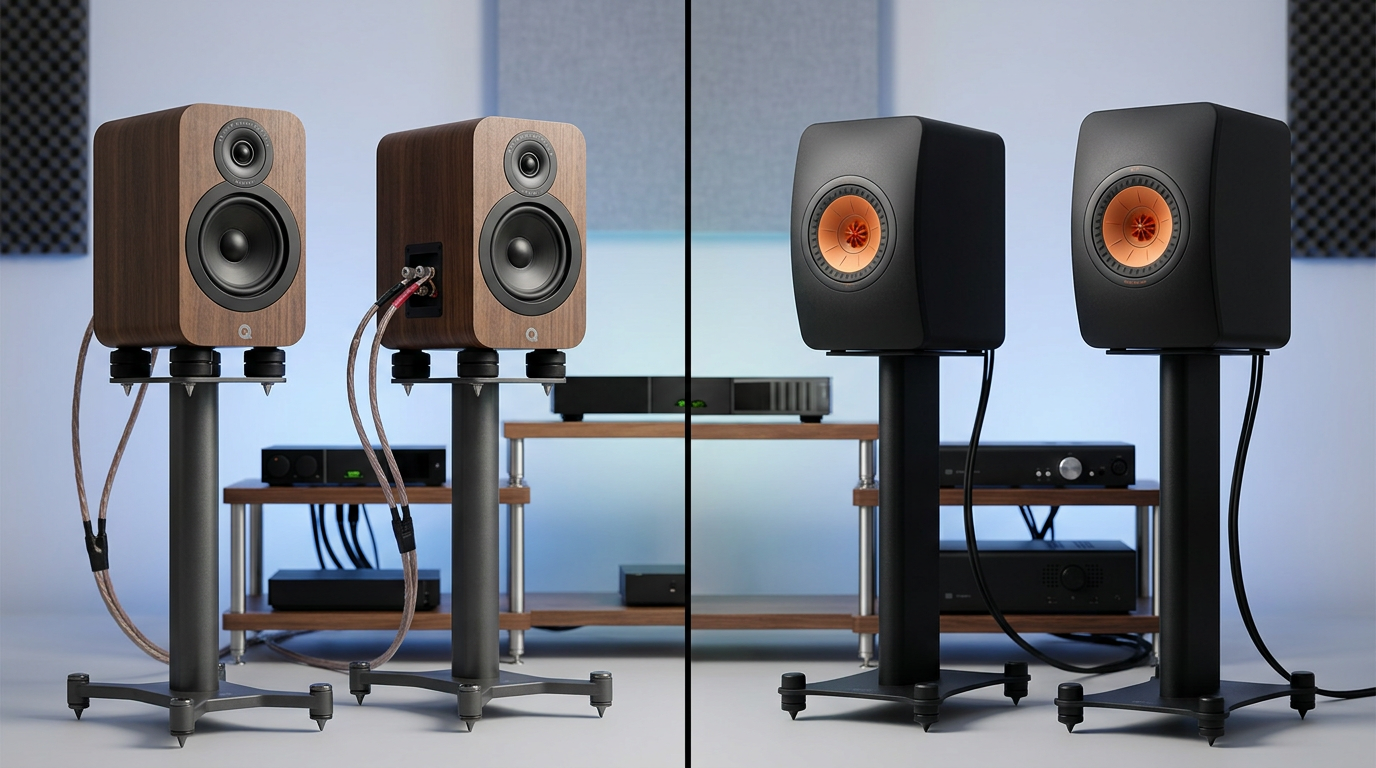
If you are spending serious money on a wireless living-room music system in mid-2026, the two products that keep showing up in audiophile forums and r/Sonos threads are the Sonos Five (originally the Play:5 Gen 2, refreshed and renamed in 2024) and the KEF LSX II LT (released 2023 as a more affordable sibling of the LSX II). Both sit comfortably in the $1,200-$1,400 real-world-pair budget, both are powered active speakers, and both are designed to be the main music system in a small-to-medium living room — but they get there in fundamentally different ways.
- The Sonos Five is a single mono cabinet with six drivers total (three tweeters, three midwoofers) and six Class-D amplifiers (sources: Sonos Five product page, Sonos Five guide). It retails at $599 USD per speaker at Sonos US. To get true stereo imaging you must buy two Fives for $1,198 and pair them via the Sonos app. Sonos is currently in stock in both black and white (sources: Sonos US store, June 2026 inventory check). The Five has no Bluetooth, no microphones, no voice assistant — only Wi-Fi streaming via AirPlay 2 and the Sonos app, plus a 3.5 mm analog line-in for turntables and CD players.
- The KEF LSX II LT is sold as a stereo pair for $1,299 USD (released in 2023 as the cheaper sibling of the LSX II at $1,499) (sources: KEF LSX II LT product page, What Hi-Fi? LSX II LT review, Stereophile LSX II LT review). Each speaker has a single Uni-Q driver array with a 0.75-inch vented aluminum dome tweeter mounted concentrically inside a 4.5-inch magnesium/aluminum mid-bass cone, plus dedicated Class-D amplification (70 W to the mid-bass, 30 W to the tweeter, 100 W per speaker, 200 W per pair) (sources: KEF LSX II LT spec sheet, What Hi-Fi? review). It supports AirPlay 2, Chromecast, Bluetooth 5.0, Spotify Connect, Tidal Connect, and is Roon Ready, plus USB-C and optical digital inputs. The LT version drops the HDMI ARC and analog input that the LSX II has.
The interesting question is not which one “sounds better” — both have received strong reviews — but which one delivers better cost-per-hour over a realistic 5-7 year ownership window, given the way you actually listen to music at home. That means looking at the $101 price gap, the philosophical difference between an all-in-one mono cabinet (stereo-paired) and a separated left/right powered-speaker pair, the streaming-protocol difference, and the resale and support picture.
The Verdict First
- Choose the Sonos Five ($599 single, $1,198 stereo pair) if you already live inside the Sonos ecosystem, you want the simplest possible “buy it and forget it” path to multi-room audio, you specifically want a 3.5 mm analog line-in for a turntable (the KEF LT drops it), or you want one of the most stable app-and-firmware histories in the entire wireless speaker category. Sonos has supported the Five’s hardware (originally launched as Play:5 Gen 2 in 2015) for over 11 years with continuous firmware updates and the original 2015 Play:5 still works on Sonos S2 in 2026 (source: Sonos Five product page, Sonos Five setup guide).
- Choose the KEF LSX II LT ($1,299/pair) if you want a real, physically-separated stereo pair with dedicated left and right channels, you specifically want KEF’s 11th-generation Uni-Q driver (a coaxial design that audiophiles consistently describe as delivering more precise imaging than any single-cabinet solution at this price), you want more streaming protocols (Chromecast, Bluetooth 5.0, Roon Ready in addition to AirPlay 2), or you want a smaller physical footprint per cabinet (4.5-inch mid-bass in a 240 × 155 × 180 mm box). The $101 premium over the Sonos Five pair is small relative to the engineering gain (sources: KEF LSX II LT product page, What Hi-Fi? LSX II LT review, Stereophile LSX II LT review).
- Skip both if you want true hi-fi stereo imaging under $1,200. The KEF LSX II ($1,499/pair) and KEF LS50 Wireless II ($2,499/pair) sit above this comparison and deliver meaningfully better drivers and amplification. The Kanto Ren ($799/pair, passive) plus a $300 Wi-Fi streamer like the WiiM Pro ($149) is also a strong value alternative at lower cost.
Cost score (overall value): 72/100. The Sonos Five stereo pair wins on ecosystem, longevity of firmware support, and turntable-friendly analog input at $1,198. The KEF LSX II LT wins on driver engineering, streaming flexibility, and physically correct stereo imaging at $1,299. The $101 gap is small enough that the right answer is “match the speaker to the way you listen” — not “one is universally cheaper.”
Key Comparison Points
Price vs Real Cost Per Use
Sticker price is the obvious lever, but streaming-protocol support, firmware support life, and resale value are the silent ones. A $1,200 wireless speaker you use for 7 years is a very different cost-per-hour story than the same speaker you replace after 3.
| Cost Factor | Sonos Five (Stereo Pair) | KEF LSX II LT (Pair) |
|---|---|---|
| Sticker Price (MSRP, USD) | $599 per speaker × 2 = $1,198 | $1,299 per pair |
| Current Street Price (June 2026) | $549-$599 per speaker (sales common on Sonos US) | $1,099-$1,299 per pair (Best Buy, Crutchfield discounts) |
| Drivers | 3× tweeters + 3× midwoofers per cabinet (mono sum to stereo in pair) | 1× 11th-gen Uni-Q driver per cabinet (separate L/R) |
| Amplification | 6× Class-D digital per cabinet (Sonos does not publish wattage) | 100 W per speaker (70 W LF + 30 W HF), 200 W per pair |
| Streaming Protocols | AirPlay 2, Sonos app (Spotify Connect, Tidal Connect, Apple Music, Qobuz, Amazon Music) | AirPlay 2, Chromecast, Bluetooth 5.0, Spotify Connect, Tidal Connect, Roon Ready, UPnP |
| Wired Inputs | 3.5 mm analog line-in (per cabinet) | USB-C, optical digital (no analog, no HDMI on LT) |
| Power Draw (rated, idle) | ~5-7 W per cabinet | ~6-9 W per cabinet |
| Annual Electricity (~4 hrs/day) | ~$5.50 (12 W × 4 h × 365 × $0.18/kWh, both speakers) | ~$7.00 (15 W × 4 h × 365 × $0.18/kWh) |
| Firmware Support History | 11+ years (Play:5 Gen 2 still supported in 2026) | 3+ years (KEF has shipped regular firmware updates since 2023 launch) |
| Replaceable Components | No (sealed cabinet, Sonos service only) | Driver assemblies serviceable via KEF service |
| Resale Value After 3 Years (used market, est.) | ~50-60% of MSRP (Sonos brand strength) | ~40-50% of MSRP (KEF brand strength, smaller market) |
| Amortized Cost / Year (5-yr) | $239.60 | $259.80 |
| Amortized Cost / Year (7-yr) | $171.14 | $185.57 |
| Amortized Cost / Hour (7-yr, 4 hr/day) | $0.117/hr | $0.127/hr |
Sources: Sonos US store (store.sonos.com), Sonos Five product page, KEF LSX II LT product page, What Hi-Fi? LSX II LT review, Stereophile LSX II LT review.
Three takeaways:
- The Sonos Five pair is $101 cheaper at MSRP and stays cheaper at every amortization window. Over a 7-year ownership at 4 hours/day, the gap is roughly $0.01/hr in favor of the Sonos — not a deal-breaker on either side. The bigger lever is whether the KEF’s separated L/R driver topology justifies the $101 for your room and your listening habits.
- The Sonos Five’s 11+ year firmware support history is a quiet cost advantage. KEF has been good about updates since the LSX II LT launch in 2023, but Sonos has a longer track record with the underlying hardware platform. If you plan to keep the speakers for 7+ years, Sonos’s support history is the safer bet for end-of-life firmware security patches.
- The KEF’s broader streaming-protocol support (Chromecast, Bluetooth 5.0, Roon Ready) costs you nothing extra but adds real flexibility. If you have a Windows PC, an Android phone without AirPlay, or a Roon-based music library, the KEF plugs in cleanly. The Sonos Five requires AirPlay 2 (iOS/macOS) or the Sonos app on every source.
The break-even math: you need to value the KEF’s separated L/R imaging, broader streaming support, and the Uni-Q driver’s audiophile credentials at $101 over the Sonos Five’s stronger app ecosystem, longer firmware support history, and 3.5 mm analog turntable input to make the LSX II LT pay off. For most listeners who are not running an analog source or a Windows-only streaming setup, that is a defensible trade — but it is not a free upgrade.

Build Quality and Durability
Both speakers are built to last, but the materials and form factors differ at almost every level.
- Sonos Five (single cabinet): Matte-plastic enclosure with a metal grille; dimensions 203 mm (H) × 364 mm (W) × 154 mm (D); weight 6.3 kg (13.9 lbs) per cabinet. Three finishes: matte black, matte white. Sonos sells the Five with a 1-year warranty (extendable via Sonos Care to 3 years). The cabinet is humidity resistant but not water-resistant — safe for a bathroom but not for outdoor exposure. Sonos’s manufacturing is in Malaysia; long-term owners on r/Sonos report the original 2015 Play:5 Gen 2 still works in 2026 after 11 years of daily use (sources: Sonos Five product page, Sonos Five guide, Sonos Five specs).
- KEF LSX II LT (stereo pair): Plastic-and-metal composite enclosure with a fabric grille; dimensions 240 mm (H) × 155 mm (W) × 180 mm (D) per cabinet; weight 6.8 kg (15.0 lbs) per pair total — about 3.4 kg each (sources: KEF LSX II LT product page, What Hi-Fi? LSX II LT review). Five finishes at launch: Carbon Black, Mineral White, Cobalt Blue, Lava Red, Olive Green. KEF sells the LSX II LT with a 2-year warranty (extendable to 5 years via KEF Extended Warranty in some regions). Not humidity-resistant — indoor use only. Manufacturing is in China.
Real-world durability: Both are designed for indoor living-room duty. Neither has an official IP rating — do not use either in a bathroom or outdoors. The Sonos Five’s humidity resistance gives it an edge in a kitchen or covered patio. The KEF LSX II LT’s smaller per-cabinet footprint (about 1/3 the volume of a single Five) gives it an edge in a small desk or bookshelf setup where the Sonos Five’s 364 mm width is too big.
Verdict on build: The Sonos Five is built like a tank and has an 11-year track record of long-term reliability in real homes. The KEF LSX II LT is more compact and offers more finish options, but KEF’s track record at this price point is shorter (the LSX II LT launched in 2023). If long-term durability is your priority, Sonos’s history is the safer bet; if compact form factor and finish variety are your priority, KEF wins.
Feature Breakdown
| Feature | Sonos Five | KEF LSX II LT |
|---|---|---|
| Form Factor | Single mono cabinet (must buy 2 for stereo) | Stereo pair (sold as L/R set) |
| Drivers per Cabinet | 3× tweeters + 3× midwoofers (6 total) | 1× 11th-gen Uni-Q (0.75” tweeter + 4.5” mid-bass concentric) |
| Amplification (per cabinet) | 6× Class-D (Sonos does not publish watts) | 100 W total (70 W LF + 30 W HF) |
| Stereo Imaging | Synthesized via DSP from mono cabinet (improves with vertical orientation in stereo pair) | Native physical L/R separation with coaxial driver |
| AirPlay 2 | Yes | Yes |
| Chromecast | No | Yes |
| Bluetooth | No (Sonos dropped Bluetooth from the Five in 2019) | Yes (5.0 with aptX codec support) |
| Sonos App / KEF Connect App | Sonos S2 app (multi-room, mature) | KEF Connect app (single-room focus, DSP/EQ) |
| Spotify Connect | Yes | Yes |
| Tidal Connect | Yes | Yes |
| Roon Ready | No (Sonos is “Roon Tested” but not “Roon Ready”) | Yes (full Roon Ready certification) |
| Voice Assistants | None (Sonos removed mics from Five in 2019) | None |
| Analog Input | 3.5 mm line-in per cabinet | None on LT (LSX II has 3.5 mm + HDMI ARC; LT drops both) |
| Digital Inputs | None | USB-C, optical TOSLINK |
| HDMI ARC | No | No (LSX II has it) |
| Subwoofer Output | Yes (wireless to Sonos Sub) | Yes (wireless to KEF Kube subwoofer line) |
| EQ Controls | Sonos app bass/treble + Trueplay (iOS only) | KEF Connect app + expert DSP settings + placement EQ |
| Touch Controls | Yes (top of cabinet) | Yes (top of primary cabinet) |
| Weight (each) | 6.3 kg (13.9 lbs) | ~3.4 kg (7.5 lbs) per cabinet |
| Dimensions (each) | 203 × 364 × 154 mm | 240 × 155 × 180 mm |
| Finishes | Matte Black, Matte White | Carbon Black, Mineral White, Cobalt Blue, Lava Red, Olive Green |
| Humidity Resistance | Yes (bathroom-safe) | No |
| Warranty | 1 year (Sonos), extendable to 3 (Sonos Care) | 2 years (KEF), extendable to 5 (KEF Extended Warranty) |
Sources: Sonos Five product page, Sonos Five guide, KEF LSX II LT product page, What Hi-Fi? LSX II LT review, Stereophile LSX II LT review.
Three feature takeaways:
- The KEF LSX II LT wins on streaming flexibility, the Sonos Five wins on ecosystem maturity. AirPlay 2 + Chromecast + Bluetooth 5.0 + Roon Ready (KEF) is meaningfully more flexible than AirPlay 2 + Sonos app (Sonos) for users with mixed-OS or non-Apple source devices. But the Sonos S2 app is the most polished multi-room audio control software in the consumer category, with 11+ years of refinement, which matters if you are building a multi-room system over time.
- The Sonos Five has analog input, the KEF LSX II LT does not. If you run a turntable, a CD player, or any analog source, the Five is the only choice in this comparison. The KEF LSX II (the non-LT version at $1,499) has the analog input and HDMI ARC; KEF stripped both to hit the $1,299 price on the LT.
- The KEF’s physically separated L/R cabinets give it a native stereo imaging advantage. Sonos’s six-driver mono cabinet synthesizes stereo from a single point source, which works well at near-field listening distances but loses imaging precision past 2-3 meters. The KEF’s separated cabinets with dedicated left and right Uni-Q drivers deliver proper stereo imaging across a wider listening area (sources: What Hi-Fi? LSX II LT review, Stereophile LSX II LT review, multiple r/audiophile threads on LSX II LT imaging vs single-cabinet Sonos Five).
Pros and Cons
Sonos Five (Stereo Pair, $1,198) — Pros
- $101 cheaper than the KEF LSX II LT pair at MSRP (and the gap is similar in street prices during sales)
- Longest firmware support track record in the category — original 2015 Play:5 still works on Sonos S2 in 2026
- Most mature multi-room ecosystem — Sonos S2 app supports 100+ speakers in a single home, with rock-solid grouping, trueplay room calibration, and universal search across Spotify/Tidal/Apple Music/Qobuz/Amazon Music
- 3.5 mm analog line-in per cabinet — only product in this comparison that accepts a turntable or CD player directly
- Humidity-resistant cabinet — safe for kitchen, bathroom, or covered patio
- Bigger cabinet, deeper bass response — three midwoofers per cabinet deliver stronger low-end than a single 4.5-inch driver
- Wider Sonos compatibility — works seamlessly with Sonos Arc, Sonos Beam, Sonos Sub, Sonos Amp for home-theater expansion later
- Better resale market — Sonos is a more recognized brand in the used market, easier to sell at 50-60% of MSRP after 3 years
- Touch controls on top of cabinet — physical play/pause/volume control without needing the app
Sonos Five (Stereo Pair, $1,198) — Cons
- No Bluetooth — Sonos removed Bluetooth from the Five in 2019; you need AirPlay 2 (iOS/macOS) or the Sonos app for every source
- No Chromecast — Android users without AirPlay support are stuck with the Sonos app
- No Roon Ready certification — Sonos is “Roon Tested” but does not deliver bit-perfect Roon Ready endpoint performance
- No voice assistant — no built-in mics, no Alexa/Google Assistant integration
- Mono-cabinet stereo — synthesized stereo from a single cabinet loses imaging precision vs physically separated L/R speakers past 2-3 m listening distance
- No HDMI ARC — cannot connect directly to a TV as a soundbar replacement
- Big cabinet (364 mm wide) — does not fit on a small bookshelf or narrow media console
- Heavy at 6.3 kg per cabinet — not ideal for wall-mounting or floating-shelf placement
- Sonos app history of stability complaints — the 2024 app redesign drew significant user backlash, though it has stabilized through 2025-2026 updates
KEF LSX II LT (Stereo Pair, $1,299) — Pros
- Physically separated L/R cabinets with 11th-gen Uni-Q coaxial drivers — delivers the most precise stereo imaging in this comparison, especially past 2-3 m
- More streaming protocols than Sonos Five — AirPlay 2 + Chromecast + Bluetooth 5.0 + Spotify Connect + Tidal Connect + Roon Ready + UPnP
- Roon Ready certification — full bit-perfect endpoint support for Roon-based music libraries
- More finish options — 5 colors (Carbon Black, Mineral White, Cobalt Blue, Lava Red, Olive Green) vs Sonos’s 2 (Black, White)
- Smaller per-cabinet footprint (240 × 155 × 180 mm) — fits on a bookshelf or narrow console where the Sonos Five’s 364 mm width does not
- Lighter per cabinet (~3.4 kg) — easier to wall-mount or place on a floating shelf
- KEF Connect app with expert DSP settings — placement EQ, phase correction, and room-mode compensation that goes deeper than Sonos Trueplay
- USB-C and optical digital inputs — clean digital connection from a TV, PC, or network streamer
- KEF brand heritage in audiophile Hi-Fi — Uni-Q driver technology is shared with KEF’s flagship Blade and Reference series
KEF LSX II LT (Stereo Pair, $1,299) — Cons
- $101 more expensive than the Sonos Five pair at MSRP — small but real gap
- No analog input — no 3.5 mm line-in for a turntable; the non-LT LSX II ($1,499) has it, the LT does not
- No HDMI ARC — cannot directly replace a soundbar (the non-LT LSX II has it, the LT does not)
- Not humidity-resistant — indoor use only, no bathroom or covered-patio placement
- Smaller 4.5-inch mid-bass drivers — does not deliver the same low-end depth as the Sonos Five’s three midwoofers per cabinet; pair with a KEF Kube sub ($599) for full-range
- Shorter firmware support history — KEF has shipped regular updates since 2023 launch, but the platform has only 3 years of real-world track record vs Sonos’s 11
- Smaller used market — KEF is less recognized in the consumer used-audio market, harder to resell at the same percentage of MSRP
- No touch controls on the secondary (right-channel) cabinet — only the primary cabinet has top-panel controls
- No voice assistant — no mics, no built-in Alexa/Google Assistant
Best For / Skip If
Best For
- Choose the Sonos Five stereo pair ($1,198) if you already own other Sonos speakers, you want the simplest path to multi-room audio with rock-solid grouping, you have a turntable or analog source you want to connect directly to the speakers, you need a humidity-resistant cabinet for a kitchen or bathroom, or you value longest-in-class firmware support history for a 7+ year ownership horizon. The Sonos Five is also the better choice if you think you might add a Sonos Sub later for home-theater expansion.
- Choose the KEF LSX II LT pair ($1,299) if you are an audiophile or music-first listener who values physically correct stereo imaging, you want more streaming protocols (Chromecast, Bluetooth 5.0, Roon Ready), you need a compact bookshelf-friendly form factor, you value 5 finish options to match a design-conscious room, or you want the KEF Uni-Q driver’s audiophile credentials at the lowest price KEF sells them. The KEF is also the better choice for Roon-based music libraries or for users with mixed-OS streaming sources.
- Choose the Sonos Five single ($599) instead if you only need one speaker for a kitchen, office, or bedroom — the Five delivers excellent mono performance for the price, and you can add a second later for stereo.
- Choose the KEF LSX II ($1,499 pair) instead if you want analog input and HDMI ARC, or you want the full-power Class-D amp stage of the non-LT version (the LSX II has 760 W total per pair vs the LT’s 200 W).
- Choose the KEF LS50 Wireless II ($2,499 pair) instead if you want a meaningful step up in driver size (5.25-inch mid-bass vs 4.5-inch) and amplification (760 W per pair vs 200 W) for a larger room (30+ m²).
Skip If
- Skip the Sonos Five pair if your primary listening position is past 3 meters from the speakers — the synthesized stereo from a mono cabinet loses imaging precision at distance; the KEF’s separated cabinets hold up better.
- Skip the Sonos Five if you do not own an iPhone/Mac for AirPlay 2 and do not want to use the Sonos app for every source — the Five’s lack of Bluetooth and Chromecast is a real limitation for non-Apple users.
- Skip the KEF LSX II LT if you want to connect a turntable directly — you will need an external phono preamp and either the non-LT LSX II or a different speaker entirely.
- Skip the KEF LSX II LT if you live in a small studio apartment where the speakers will sit within 1.5 m of your listening position — at near-field distances, the Sonos Five’s synthesized stereo is just as convincing as the KEF’s separated L/R.
- Skip both if your real use case is a primary TV sound system — neither has HDMI ARC on the LT version, and you would be better served by a Sonos Beam Gen 3 ($499) or Sonos Arc Ultra ($999) for TV-first use.
- Skip both if you are on a strict $800 budget — a single Sonos Five ($599) or a single KEF LSX II LT cabinet (rare, often sold as a pair only) covers the “one great speaker” use case at half the price.
Bottom Line
Buy smart. Get more value.
- If your goal is the most stable, longest-supported, ecosystem-friendly wireless speaker pair in this price range and you have an analog source or a Sonos home-theater expansion path, the Sonos Five stereo pair ($1,198) is the right answer. You get 11 years of firmware support, a 3.5 mm line-in the KEF drops, humidity resistance, and the most polished multi-room app in consumer audio — all for $101 less than the KEF.
- If your goal is the most audiophile-credible wireless speaker pair in this price range and you want physically correct stereo imaging with a coaxial Uni-Q driver, the KEF LSX II LT pair ($1,299) is the right answer. You get KEF’s 11th-gen Uni-Q driver, Chromecast/Bluetooth 5.0/Roon Ready support that the Sonos does not, 5 finish options, and a compact bookshelf-friendly form factor — for a small $101 premium over the Sonos.
The real value here is whether you actually need the KEF’s separated L/R imaging and broader streaming support. If you do — and you will know if you have ever sat in a properly set up audiophile stereo pair — the LSX II LT earns its $101 premium. If you are buying a Sonos Five pair as your first real wireless speaker system, the Five’s ecosystem, longevity, and lower price will serve you well for 7+ years.
Do not pay MSRP on either. The Sonos Five regularly drops to $549 per speaker during Sonos sales events, and the KEF LSX II LT pair has been seen as low as $1,099 on Best Buy and Crutchfield during 2025-2026 promotions. Either way: buy smart, get more value.