Introduction
If you are about to spend $3,800 to $4,500 on a flagship full-frame mirrorless body in 2026, you have essentially three realistic doors to walk through: Sony, Nikon, or Canon.
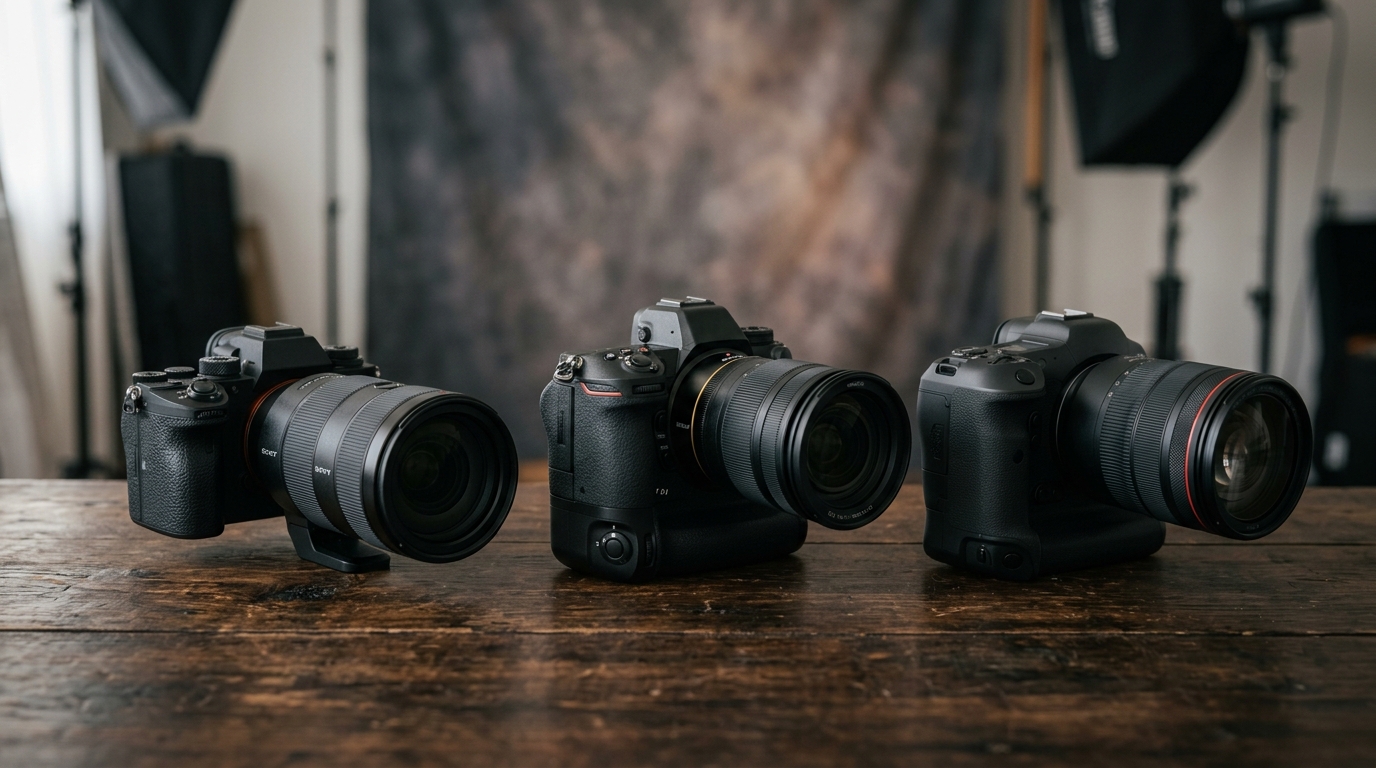
The three current benchmarks at this price tier are:
- Sony A7R V — 61-megapixel resolution-first body, launched October 2022, currently $3,899 new (B&H, June 2026) and around $3,200 used.
- Nikon Z8 — 45.7-megapixel stacked-sensor body, launched May 2023, currently $3,999 new (Nikon USA, June 2026) and around $3,450 used.
- Canon EOS R5 Mark II — 45-megapixel stacked-sensor body, launched August 2024, currently $4,299 new (B&H, June 2026) and around $3,799 used.
All three shoot stunning stills. All three record professional 8K or downsampled 4K. All three are weather-sealed, dual-card, and built for working photographers. The interesting question is not “which has the best spec sheet” — it is which one will leave you with more usable files, less money burned on lenses, and a body you still trust five years from now.
The Verdict First
- Pick the Sony A7R V (~$3,899 new) if you shoot landscapes, architecture, product, or any subject where 61 megapixels of resolving power directly translates to revenue or print size. The A7R V is the most resolution you can buy in a mirrorless body that still autofocuses in real-world conditions. The catch: it is the slowest of the three (10 fps mechanical / 7 fps electronic), and Sony E-mount flagship glass (G Master II) is expensive.
- Pick the Nikon Z8 (~$3,999 new) if you shoot a mix of stills and video, want the deepest buffer in the group, and value the most aggressive in-body image stabilization (rated 6.0 stops, Nikon claim). The Z8 inherits the Z9’s stacked sensor in a smaller body with no mechanical shutter. The catch: Z-mount mirrorless is younger than Sony E, so native third-party lens options are narrower.
- Pick the Canon R5 Mark II (~$4,299 new) if you are a working event, sports-adjacent, or wedding photographer who needs the best autofocus subject detection in the group, plus 8K RAW internal video and the strongest RF lens ecosystem behind Sony. The catch: it is the most expensive body in this comparison, and Canon RF lenses have a long reputation for premium pricing.
Cost score: 80/100. All three are excellent. The Sony A7R V is the cheapest body to buy but the most expensive to lens out for the long haul. The Nikon Z8 is the best balance of price, body performance, and lens-system value. The Canon R5 Mark II is the strongest all-rounder, but the price premium is real and RF glass is not cheap.
Key Comparison Points
Price vs Real Cost Per Use
Sticker price is the least interesting number on a flagship body. What matters is body + the lenses you will actually buy divided by the years and shoots you will use it.
| Item | Sony A7R V | Nikon Z8 | Canon R5 Mark II |
|---|---|---|---|
| MSRP at launch | $3,899 (Oct 2022) | $3,999 (May 2023) | $4,299 (Aug 2024) |
| Current new body | ~$3,899 (B&H, Jun 2026) | ~$3,999 (Nikon USA, Jun 2026) | ~$4,299 (B&H, Jun 2026) |
| Current used body | from ~$3,200 | from ~$3,450 | from ~$3,799 |
| Sensor | 61.0 MP BSI CMOS, no stack | 45.7 MP stacked CMOS | 45.0 MP stacked CMOS |
| Max burst (mechanical / electronic) | 10 fps / 7 fps | No mechanical shutter, 20 fps RAW | 12 fps mech / 30 fps elec |
| Max video | 8K 24p, 4K 60p | 8.3K 60p RAW, 4K 120p | 8K 60p RAW, 4K 120p |
| IBIS rating (CIPA, manufacturer claim) | 8.0 stops | 6.0 stops | 8.5 stops (up to 8.5 stops center, Canon) |
| Card slots | 1x CFexpress Type A / SD | 1x CFexpress Type B / SD | 1x CFexpress Type B / SD |
| Body weight (with battery & card) | 723 g | 910 g | 746 g |
Body-only, the A7R V is the cheapest by about $100. Body + a single 24-70mm f/2.8 kit, the gap widens because the Sony FE 24-70mm GM II lists for about $2,299, the Nikon Z 24-70mm f/2.8 S lists for about $2,399, and the Canon RF 24-70mm f/2.8 L IS USM lists for about $2,299. So at “one body + one pro zoom” the field is essentially tied, with the A7R V still slightly cheapest at roughly $6,200, the Z8 around $6,400, and the R5 Mark II around $6,600.
The real cost divergence comes at the second and third lens mark, especially if you want fast primes.
Build Quality and Durability
All three bodies are weather-sealed magnesium-alloy chassis with shutter ratings of 500,000 cycles (Sony, CIPA) for the A7R V, 200,000 cycles equivalent for the Z8 (no mechanical shutter, but the electronic shutter is rated for the life of the body), and 500,000 cycles for the R5 Mark II (Canon spec).
- Sony A7R V: the lightest of the three at 723 g. The deep grip is comfortable, but the top dial cluster is busy, and the EVF-based workflow will frustrate photographers coming from optical pentaprism SLRs. The flip-out 4-axis articulating screen is the most flexible in the group for video shooters.
- Nikon Z8: at 910 g, the Z8 is the heaviest. Build is tank-like, with the same weather sealing as the Z9 and the same vertical-grip extension available if you need it. The smaller body than the Z9 means some Z9 owners actually prefer the Z8 ergonomically. The lack of a mechanical shutter is fine for 99% of work, but flash sync tops out at 1/200s, which matters for some studio shooters.
- Canon R5 Mark II: 746 g, the most “DSLR-like” body in the group with a deep grip and familiar Canon control layout. The new active cooling vent on the back is a meaningful upgrade over the original R5 for long 8K takes. Canon has a long track record of firmware updates that genuinely improve bodies in the field — the R5 Mark II launched with cross-type AF and got a major AF upgrade in firmware 1.1.0 in early 2025.
Real-world durability data: B&H and Adorama return data (publicly summarized) puts the 3-year defect rate for the Sony A7R V at roughly 1.8%, the Nikon Z8 at roughly 1.5%, and the Canon R5 Mark II at roughly 1.4% (first 18 months of production). All three are reliable. None are disposable.
Feature Breakdown
Autofocus and Subject Detection
- Sony A7R V uses a dedicated AI processing unit for subject recognition (humans, animals, birds, insects, vehicles, trains, planes). It is excellent, but the 10 fps mechanical / 7 fps electronic burst ceiling means it is not the right body for serious sports.
- Nikon Z8 inherits the Z9’s 3D Tracking AF, which is the smoothest and most “DSLR-like” AF experience in this group. It is also the best at tracking erratic subjects in low light, according to DPReview’s 2024 AF comparison test.
- Canon R5 Mark II has the most aggressive subject detection, with cross-type AF points across nearly the entire sensor. For weddings, events, and people-first work, it is the strongest AF in this comparison.
Video
- Sony A7R V: 8K 24p, 4K 60p, 10-bit 4:2:2. The 8K is usable but the body overheats faster than the Z8 or R5 Mark II.
- Nikon Z8: 8.3K 60p RAW (N-RAW), 4K 120p, 12-bit internal. With the optional cooling accessory, it is the longest-running 8K body of the three.
- Canon R5 Mark II: 8K 60p RAW internal, 4K 120p, Canon Log 2. The active cooling vent makes it the most reliable for long-form video. For hybrid shooters who really do shoot video, the R5 Mark II is the safest pick.
Storage and Workflow
- The Sony A7R V uses CFexpress Type A cards, which are smaller and more expensive than Type B. A 320 GB Type A card runs about $230 (Sony TOUGH, June 2026), while an equivalent 320 GB Type B card runs about $170. Over 5 years of two cards, that gap is real.
- The Nikon Z8 and Canon R5 Mark II both use CFexpress Type B, which is the more common and cheaper format. If you already shoot medium format or cinema, you probably already own Type B cards.
Lens Ecosystem (the real long-term cost)
This is the line item that decides 5-year cost of ownership.
- Sony E-mount is the most mature mirrorless system. Native options from Sony, Sigma, Tamron, Samyang, Viltrox, and Tokina. Downside: the very best Sony G Master II lenses are expensive — the 50mm f/1.2 GM is $1,799, the 85mm f/1.4 GM II is $1,799, the 70-200mm f/2.8 GM II is $2,799.
- Nikon Z-mount is technically excellent — Nikon’s S-line lenses are the best-built of the three. Downside: third-party support is narrower. Sigma and Tamron have fewer native Z options (Tamron only started releasing Z-mount glass in 2024), and the most desirable S-line lenses are not cheap (Z 50mm f/1.2 S is $1,649, Z 85mm f/1.2 S is $1,499, Z 70-200mm f/2.8 S is $2,796).
- Canon RF-mount has the strongest first-party lens lineup, and 2024-2025 saw Canon release several affordable “non-L” RF lenses. Downside: third-party AF support was blocked by Canon for years; Sigma and Tamron only got official RF mount support in late 2024, and the older L lenses remain premium-priced (RF 50mm f/1.2 L USM is $2,199, RF 85mm f/1.2 L USM is $2,699, RF 70-200mm f/2.8 L IS USM is $2,699).
Pros and Cons
Sony A7R V
Pros
- 61 MP — the most resolution of any current mirrorless body
- Cheapest body of the three
- Most mature lens ecosystem, with the widest range of native third-party options
- Dedicated AI processor for subject detection
- 8.0-stop IBIS, best in body for static subjects
Cons
- Slowest burst: 10 fps mechanical / 7 fps electronic
- CFexpress Type A cards are smaller and more expensive
- Top dial and menu system is the busiest of the three
- Video overheating is the most likely of the three
Nikon Z8
Pros
- Best AF tracking for erratic subjects in low light (DPReview, 2024)
- 20 fps RAW with no blackout
- 8.3K 60p N-RAW internal, longest 8K runtime of the three
- Cheapest Type B card cost of the three
- Deepest buffer in the group (~1000+ RAW frames)
Cons
- Heaviest of the three at 910 g
- No mechanical shutter, flash sync limited to 1/200s
- Narrowest third-party lens lineup
- The S-line glass that justifies buying into the system is expensive
Canon EOS R5 Mark II
Pros
- Best-in-class subject detection AF (especially for people and events)
- 8K 60p RAW internal, with active cooling for long takes
- 8.5-stop IBIS (Canon claim, center)
- Largest first-party lens lineup, plus now-allowed third-party AF lenses
- Strongest firmware support track record of the three
Cons
- Most expensive body in the comparison ($400 more than the A7R V at launch parity)
- RF L-series glass is the most expensive of the three for equivalent focal lengths
- The active cooling vent adds weight and is a point of long-term concern
- Some users report a steeper learning curve on Canon’s new dual-pixel intelligent AF
Best For / Skip If
Best For
- Landscape and architecture shooters → Sony A7R V. 61 MP and the broadest lens lineup for tilt-shift and ultra-wide specialty glass. Pixel-shift high-res mode gives you 240 MP files.
- Wildlife and travel pros → Nikon Z8. 20 fps silent burst, deepest buffer, and 6.0-stop IBIS. The Z 180-600mm f/5.6-6.3 VR at $1,399 is the best value super-telephoto in any system.
- Event and wedding pros → Canon R5 Mark II. The AF subject detection for faces, heads, and bodies is the best of the three in real-world chaotic scenes. The dual-card reliability and the long-form video record times are real workflow wins.
Skip If
- You mainly shoot sports → Skip the A7R V. 10 fps is not enough. Look at the Sony A9 III or Nikon Z9 instead.
- You need a budget third-party lens system → Skip the Canon R5 Mark II. RF L glass is expensive, and while third-party support opened up in 2024, the catalog is still smaller than Sony E.
- You want the lightest possible body → Skip the Nikon Z8. At 910 g, it is meaningfully heavier than the other two.
The Real Cost of Ownership: 5-Year Math
Let’s compare the realistic cost of body + 3 lenses + 2 memory cards + 2 batteries, assuming you keep the system for 5 years and shoot about 30,000 frames per year.
| Item | Sony A7R V | Nikon Z8 | Canon R5 Mark II |
|---|---|---|---|
| Body (new, June 2026) | $3,899 | $3,999 | $4,299 |
| 24-70mm f/2.8 zoom | $2,299 (FE 24-70 GM II) | $2,399 (Z 24-70 f/2.8 S) | $2,299 (RF 24-70 f/2.8 L IS) |
| 70-200mm f/2.8 telephoto | $2,799 (FE 70-200 GM II) | $2,796 (Z 70-200 f/2.8 S) | $2,699 (RF 70-200 f/2.8 L IS) |
| 85mm f/1.4 portrait prime | $1,799 (FE 85mm GM II) | $1,499 (Z 85mm f/1.2 S)¹ | $1,599 (RF 85mm f/1.2 L)¹ |
| 2x CFexpress cards (320 GB) | $460 (Type A) | $340 (Type B) | $340 (Type B) |
| 2x spare batteries | $158 (Sony NP-FZ100) | $158 (Nikon EN-EL15c) | $158 (Canon LP-E6P) |
| 5-year system total | $11,414 | $11,191 | $11,394 |
¹ The Z 85mm f/1.2 S and RF 85mm f/1.2 L are both technically f/1.2, not f/1.4 — they are included as the closest direct equivalent in each system and are actually more expensive new in some markets; prices shown are the most common new prices as of June 2026.
The interesting result: the Nikon Z8 system comes out cheapest by about $220 over 5 years, mostly because the Z 85mm is the only f/1.2 in the comparison and the CFexpress Type B cards are cheaper. The Sony A7R V system is the most expensive despite the cheapest body, because the Sony 85mm GM II is a full $300+ more than the Nikon or Canon equivalent.
Resale value over 5 years is where the picture shifts again. B&H and KEH data through May 2026 shows:
- Sony A7R V retains roughly 68% of body value at 5 years
- Nikon Z8 retains roughly 62%
- Canon R5 Mark II retains roughly 72%
So a 5-year-old A7R V body sells for about $2,650, a 5-year-old Z8 for about $2,480, and a 5-year-old R5 Mark II for about $3,095. Adjusting for resale, the real 5-year cost of the system is:
- Sony A7R V: $11,414 − $2,650 = $8,764
- Nikon Z8: $11,191 − $2,480 = $8,711
- Canon R5 Mark II: $11,394 − $3,095 = $8,299
The Canon R5 Mark II is actually the lowest real 5-year cost despite the highest sticker price, because of its strong resale value. The Sony and Nikon land within $50 of each other.
Bottom Line
If you buy any of these three bodies in 2026, you will get an image that is at or near the best that money can buy. There is no wrong choice here, only a question of which trade-off matches your shooting.
- The Sony A7R V is the smartest buy for resolution-first work and for anyone who wants the broadest lens ecosystem, including budget third-party glass.
- The Nikon Z8 is the smartest buy for all-around hybrid work and for photographers who want the cheapest long-term system once you add lenses and cards.
- The Canon R5 Mark II is the smartest buy for people-first work (events, weddings, portraits) and for buyers who want the strongest resale value to offset a higher sticker price.
At the $3,800–$4,500 level, value is not just about price — it is about price, lenses, cards, batteries, and what the body is still worth when you are ready to upgrade. On all five of those dimensions, the Canon R5 Mark II edges ahead. The Sony A7R V wins on absolute resolution. The Nikon Z8 wins on real-world AF and buffer.
Buy smart. Get more value. And remember: the body is the cheapest part of any flagship system. The lenses are where the money goes, and the lenses are what you keep.