Introduction
If you are about to drop $1,700 to $3,000 on a serious mirrorless body in 2026, you have probably narrowed it down to two very different philosophies.
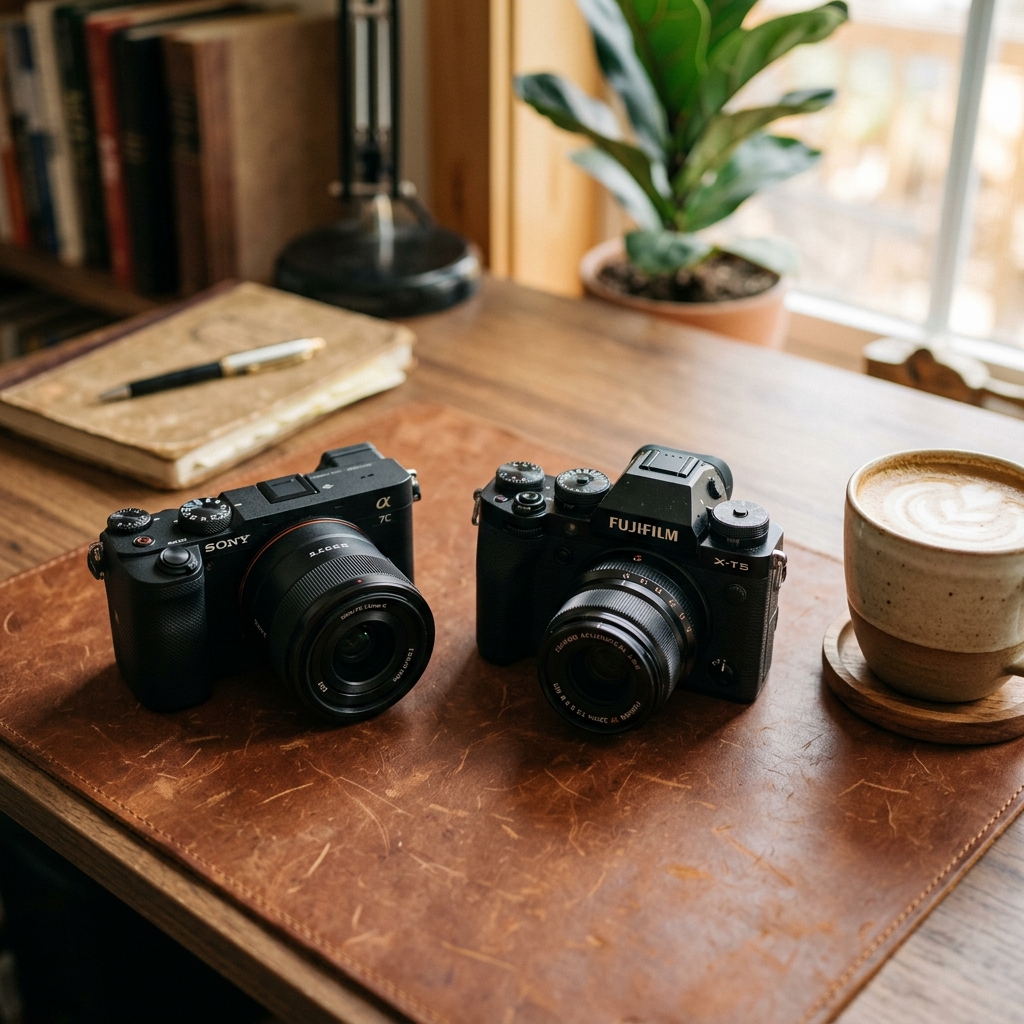
The Sony A7CR is a 61-megapixel full-frame camera shoehorned into a compact body. Launched in August 2023 at a recommended price of $2,999.95 (DPReview), it now sells new for about $2,500 on Amazon and around $2,318 on eBay (bestvaluecamera.com, May 2026).
The Fujifilm X-T5 is a 40-megapixel APS-C camera in a classic, dial-driven body. It launched in November 2022 at $1,699 MSRP (Pocket-lint) and currently sells for about $1,899 new on Amazon (bestvaluecamera.com, May 2026).
Both shoot stunning stills. Both record 10-bit 4:2:2 video. Both are loved by working photographers. The interesting question is not “which is better” — it is which one will leave you with more usable images, less money burned on lenses, and a body you still love five years from now.
The Verdict First
- Pick the Sony A7CR (~$2,500 new) if you need full-frame depth of field, shoot landscapes, architecture, product, or low-light events, and want the highest-resolution stills in the smallest full-frame body available. The catch: heavier and more expensive Sony E-mount lenses, and the compact body has limited heat dissipation for long 4K video takes.
- Pick the Fujifilm X-T5 (~$1,899 new) if you shoot travel, street, family, and documentary work, value out-of-camera color and film simulations, and want a body with physical dials you can operate without looking at the screen. The catch: APS-C sensor means more noise at high ISO and a real limit on how much you can crop.
Cost score (overall value): 82/100. Neither is cheap. The X-T5 is the cheaper buy up front (~$600 less) and stays cheaper once you account for the much smaller, lighter, and generally less expensive Fujifilm X-mount lens system. The A7CR wins on absolute image quality and low-light headroom. Long-term value depends almost entirely on which lens system you commit to.
Key Comparison Points
Price vs Real Cost Per Use
Sticker price is the least interesting number on a camera. What matters is the cost of the body plus the lenses you will actually buy, divided by the years and shoots you will use it.
| Item | Sony A7CR | Fujifilm X-T5 |
|---|---|---|
| MSRP at launch | $2,999.95 (Aug 2023, DPReview) | $1,699 (Nov 2022, Pocket-lint) |
| Current new (Amazon US) | ~$2,500 (bestvaluecamera.com) | ~$1,899 (bestvaluecamera.com) |
| Current used (eBay) | from ~$2,155 | from ~$1,250 |
| Sensor format | Full-frame (35.7 x 23.8 mm) | APS-C (23.5 x 15.6 mm) |
| Effective pixels | 61.0 MP (Sony spec) | 40.2 MP (Camera Decision) |
| Body weight | ~515 g (with battery, Sony spec sheet) | 557 g (Camera Decision) |
| IBIS | 7-stop sensor-shift (Sony) | 5-axis sensor-shift (Camera Decision) |
| Video max | 4K 60p 10-bit 4:2:2 | 6.2K 30p / 4K 60p 10-bit 4:2:2 |
| Battery (CIPA stills) | ~530 shots (Sony) | ~580 shots (Fujifilm NP-W235) |
| Continuous shooting | 8 fps mechanical | 15 fps mechanical / 13 fps electronic |
The real story is what happens after the body. A typical enthusiast kit ends up looking like this:
| Typical kit | Sony A7CR | Fujifilm X-T5 |
|---|---|---|
| Body | $2,500 | $1,899 |
| Walkaround standard zoom | Sony FE 24-70mm f/2.8 GM II — ~$2,299 | Fujifilm XF 16-55mm f/2.8 — ~$1,199 |
| Compact prime | Sony FE 35mm f/1.8 — ~$799 | Fujifilm XF 35mm f/1.4 R — ~$599 |
| Telephoto | Sony FE 70-200mm f/2.8 GM II — ~$2,799 | Fujifilm XF 50-140mm f/2.8 — ~$1,499 |
| Total typical kit (3 lenses) | ~$8,397 | ~$5,196 |
| 5-year cost (assume 1 body, 3 lenses, no resale) | ~$8,397 | ~$5,196 |
The Sony system costs about $3,200 more to get to the same three-lens “fast” setup. That gap comes from the simple fact that full-frame lenses are larger, heavier, and more expensive to design and manufacture. The A7CR body is a clever compromise (full-frame sensor in a small body), but the lenses you hang off it are still full-frame.
If you mostly buy slow zooms or vintage manual-focus glass, the gap narrows. If you actually shoot f/2.8 zooms and fast primes — the kit most people dream about — the X-T5 system is roughly 35-40% cheaper to own over 5 years.
Build Quality and Durability
Both cameras are weather-sealed magnesium-alloy bodies aimed at enthusiast and pro use. There are real differences, though.
| Spec | Sony A7CR | Fujifilm X-T5 |
|---|---|---|
| Body material | Magnesium alloy chassis | Magnesium alloy top/front/rear |
| Weather sealing | Yes (Sony) | Yes (Fujifilm) |
| Shutter life rating | ~200,000 actuations (Sony) | ~200,000 actuations (Fujifilm) |
| Storage | 1x SD (UHS-II) | 2x SD (UHS-II) |
| Viewfinder | 0.39” OLED, 2.36M-dot | 0.5” OLED, 3.69M-dot |
| Rear LCD | 3.0” vari-angle touchscreen, 1.04M-dot | 3.0” 3-way tilt touchscreen, 1.84M-dot |
| Size (W x H x D) | ~124 x 71 x 63 mm | 130 x 91 x 64 mm |
| Weight (with battery) | ~515 g | 557 g |
| Hot shoe / flash sync | Yes, 1/160s | Yes, 1/250s |
| Ports | USB-C, micro HDMI, mic, headphone | USB-C, micro HDMI, mic, headphone |
The X-T5 is physically larger and about 40 g heavier, but it gives you a real second SD slot (the A7CR’s single slot is the most common complaint in user reviews) and a much higher-resolution viewfinder. The A7CR is genuinely pocketable in a way no other 61MP full-frame camera is, which makes it a compelling travel body — if you pair it with small primes.
The X-T5’s 3-way tilting screen is a stills photographer’s tool: it is more discreet for street shooting than the A7CR’s flip-out vari-angle screen, which is what hybrid shooters want. Choose by the way you actually hold a camera.
Feature Breakdown
This is where the two diverge the most.
Sony A7CR highlights
- 61 MP full-frame BSI Exmor R sensor (62.5 MP total per Sony spec)
- Dedicated AI processing unit for real-time subject recognition (humans, animals, birds, insects, vehicles, trains, planes)
- 7-stop in-body image stabilization
- 4K 60p 10-bit 4:2:2 video with S-Log3 / S-Cinetone
- Active cooling is passive only — long 4K60 takes will hit thermal limits faster than the larger A7R V
- Compact body: the smallest 60+ MP full-frame mirrorless available in 2026
- Sony E-mount: ~80 native AF lenses, plus Sigma, Tamron, and third-party support
Fujifilm X-T5 highlights
- 40.2 MP X-Trans CMOS 5 HR APS-C sensor (no optical low-pass filter)
- 5-axis in-body image stabilization rated up to 7 stops with specific XF lenses
- 19 film simulation modes, including the much-loved Classic Chrome, Acros, and the newer REALA ACE
- 6.2K 30p open-gate / 4K 60p video (1.18x crop at 4K 60p)
- Subject-detection AF (humans, animals, birds, cars, motorcycles, planes, trains) via X-Processor 5
- 3-way tilting screen and 3.69M-dot OLED viewfinder
- Physical dials for ISO, shutter speed, and exposure compensation
- Fujifilm X-mount: ~40 native XF lenses, plus third-party Viltrox, Sigma, and Tokina
Where each camera wins:
- A7CR wins for: low-light ISO, shallow depth of field at equivalent framing, large prints (61 MP resolves detail no APS-C sensor can), landscape and architecture where resolution is the point, and anyone invested in Sony E-mount glass.
- X-T5 wins for: color science out of camera (Fujifilm’s film simulations save hours of editing), physical tactile controls, smaller and lighter lens system, faster continuous shooting, and a second SD card slot for backup on the spot.
Pros and Cons
Sony A7CR — Pros
- 61 MP is the highest-resolution full-frame sensor in a body this small
- Excellent real-time autofocus with dedicated AI processor
- 7-stop IBIS allows hand-holding at 1-2 second shutter speeds
- Compact body is genuinely travel-friendly
- Massive E-mount lens ecosystem (Sony, Sigma, Tamron, Zeiss)
- Stronger resale value than APS-C alternatives in absolute dollar terms
Sony A7CR — Cons
- Single SD card slot — no in-camera backup
- Passive cooling means 4K 60p recording times are limited (~30 min continuous in warm conditions)
- Full-frame Sony lenses are larger and significantly more expensive
- Flip-out vari-angle screen is bulkier than a tilt screen
- ~$600 more expensive than the X-T5 body alone
- Menu system is famously dense; first-time Sony users report a learning curve
Fujifilm X-T5 — Pros
- ~$600 cheaper body at current prices
- Industry-leading in-camera film simulations reduce editing time
- Two UHS-II SD slots for in-camera backup
- Tactile, dial-based controls that work without taking your eye off the viewfinder
- Significantly smaller, lighter, and cheaper lens lineup
- 15 fps mechanical burst is faster than the A7CR’s 8 fps
- 6.2K open-gate video is more flexible for cropping in post
Fujifilm X-T5 — Cons
- APS-C sensor has more noise at high ISO (clean usable up to ~ISO 6400, struggles at 12,800+)
- 40 MP is a lot for APS-C, but still ~33% fewer pixels than the A7CR
- Fujifilm X-mount lens ecosystem is smaller than Sony E-mount, especially for third-party options
- Autofocus subject detection is improving but still behind Sony in consistency for video
- Body is slightly larger and heavier than the A7CR
Best For / Skip If
Best For Sony A7CR
- Landscape, architecture, and product photographers who need 61 MP of detail for large prints or heavy cropping.
- Working pros in Sony E-mount who want a second body with the same autofocus and color science as their A7R V or A1.
- Low-light event shooters (weddings, concerts) who need full-frame high-ISO headroom.
- Hybrid shooters who prioritize photo over video and do not need long-form 4K60 takes.
Skip Sony A7CR If
- You mostly want a small, light travel camera — the body is small, but the lenses are still full-frame.
- You shoot long-form video interviews or run-and-gun documentary work. The single SD slot and passive cooling will frustrate you.
- Budget is tight. A 61 MP body is wasted on a slow kit zoom.
Best For Fujifilm X-T5
- Travel, street, and documentary photographers who want a small, discreet, dial-driven body and love the film simulations.
- Portrait and family photographers who want great color straight out of camera and rarely shoot above ISO 6400.
- Hybrid shooters who want 6.2K open-gate video for cropping flexibility.
- Buyers who care about total system cost — the X-mount system is meaningfully cheaper to build out.
Skip Fujifilm X-T5 If
- You regularly shoot in dim indoor or night conditions above ISO 6400.
- You already own a stack of Sony or Canon full-frame lenses and plan to adapt them.
- You print larger than 24x36 inches and care about resolving the finest detail at base ISO.
Bottom Line
Both the Sony A7CR and the Fujifilm X-T5 are legitimately great cameras in 2026. The question is what kind of photographer you are and how much of your budget is left for glass.
- If your priority is the highest image quality per dollar spent on the body itself, the Sony A7CR is the right call. 61 MP of full-frame detail in a compact body is a real engineering achievement, and Sony’s autofocus and lens ecosystem are the deepest in the industry.
- If your priority is the lowest total cost of ownership over 5 years and a camera that rewards daily carrying, the Fujifilm X-T5 is the smarter buy. The body is cheaper, the lens system is dramatically cheaper, the film simulations cut editing time, and the dual SD slots and dial-based controls are built for working photographers.
Buy smart. Get more value. The “better” camera is the one you actually carry, with lenses you can afford, that still excites you five years from now.