Introduction
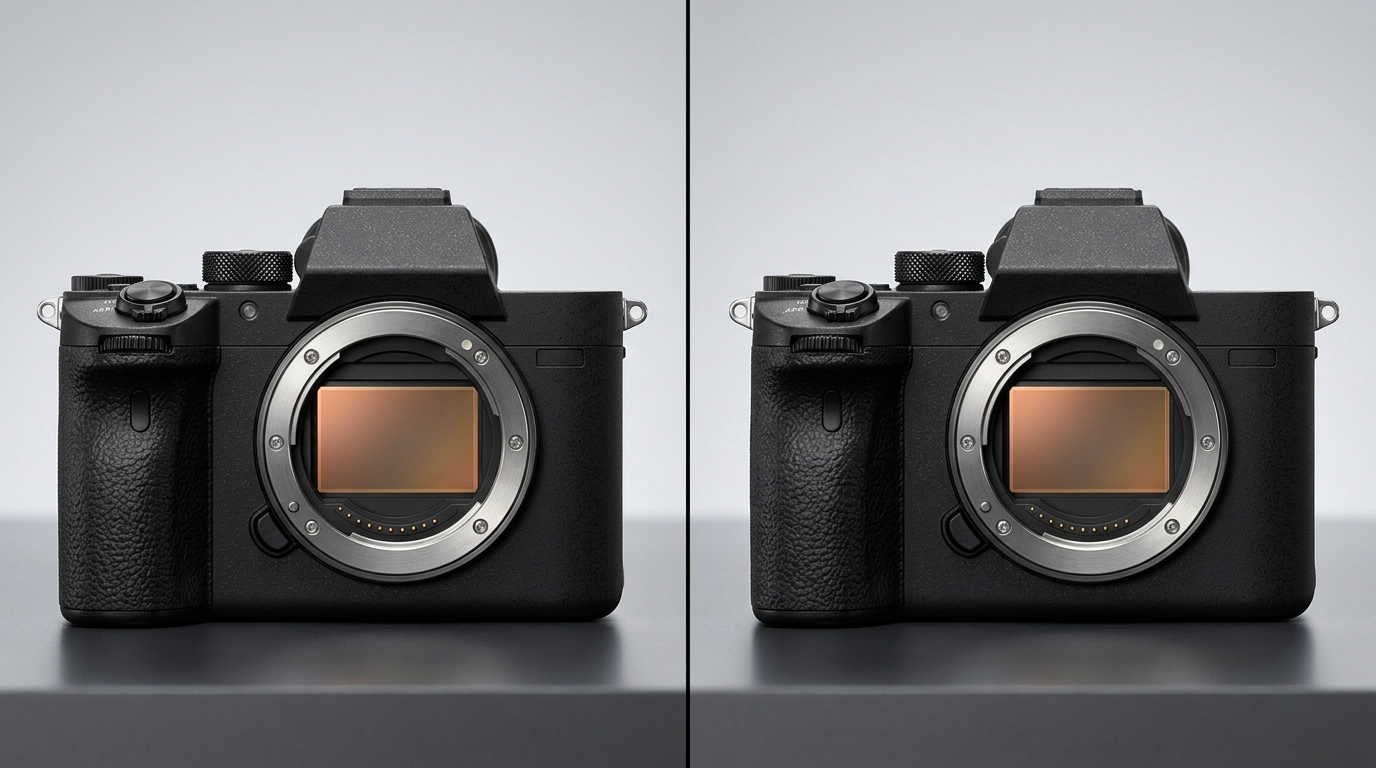
There are two very different flagship mirrorless bodies sitting in the $4,500-$6,000 conversation in 2026, and they sit on opposite sides of the sensor-size divide:
- Sony α7R VI — MSRP $4,499 body-only at launch, May 13, 2026. The brand-new high-resolution flagship with a fully-stacked 66.8 MP Exmor RS full-frame sensor, 30 fps electronic burst with full AF/AE tracking, 8K/30p video, the latest BIONZ XR2 engine with a dedicated AI processing unit, and 8.5-stop in-body image stabilization (Sony Mediaroom, Engadget, Digital Camera World, May 2026).
- Fujifilm GFX 100S II — MSRP $5,999 body-only at launch, May 2024. The lightest GFX body ever, with a 102 MP 44x33 mm medium-format CMOS II HS sensor, 7 fps mechanical burst, 4K/30p ProRes video, 8-stop IBIS, and two years of firmware polish behind it (Fujifilm-X.com, DPReview, PetaPixel, May 2024).
This is not a “medium format is automatically better” comparison. At launch the A7R VI was $1,500 cheaper; the GFX 100S II is currently selling at $4,999 at major US retailers in mid-2026. The interesting question is what each dollar buys you across 6 years of working ownership — and the answer depends almost entirely on what you shoot, where you shoot it, and whether you can carry the lens system with you every day.
The verdict up front: the Sony A7R VI is the better 2026 buy if you shoot a mix of stills and video, you need AI-class autofocus and fast burst, you already have E-mount glass or you’re building a system, and you want a 2026 launch with a fresh 3-year firmware runway. The Fujifilm GFX 100S II is the smarter buy if you shoot commercial, portrait, fine-art, or product work where medium-format rendering and color depth matter more than speed, you want the deepest possible detail in stills only, and the 102 MP sensor pays back in your actual workflow. Both are real tools; both are above $4,500 flagships. The mistake is to default to “medium format is better” without checking what the sensor actually buys you in your work.

The Verdict First
- Pick the Sony A7R VI ($4,499) if you are buying into a Sony E-mount system in 2026, you need 66.8 MP at 30 fps with full AI autofocus, you shoot hybrid stills + 8K/4K video and want the newest AI subject detection Sony has ever put in a body, you already own E-mount glass and switching systems is a multi-thousand-dollar decision, or you simply want a 2026 launch with a fresh 2-3 year firmware runway. The A7R VI is the higher-resolution, more future-proofed, more versatile body in this comparison.
- Pick the Fujifilm GFX 100S II ($5,999) if you shoot commercial, portrait, fine-art, or product work where medium-format rendering and color depth matter, you shoot stills only and don’t need 30 fps burst or 8K video, you want the lightest medium-format body available in 2026 at 883 g with battery, you already own GF mount glass or you’re building a GFX system, or you want a more conservative $/MP ratio ($58.8/MP vs Sony’s $67.3/MP at MSRP). The GFX 100S II is the right tool for studio and tripod-first work; it is not the right tool for sports, wildlife, or video.
Cost score: 76/100. The A7R VI wins on resolution-per-dollar (when you factor in burst, autofocus, and video), AI AF, and 2026 launch date. The GFX 100S II wins on absolute resolution (102 MP vs 66.8 MP), color depth (16-bit RAW files vs 14-bit), and medium-format rendering. The smarter buy is decided by what you shoot and how often, not by either spec sheet in isolation.
Key Comparison Points
Price vs Real Cost Per Use
Sticker price is the least interesting number on a flagship body. What matters is body + the lenses you will actually buy + the cards and accessories you will cycle through divided by the years and shoots you will use it.
| Item | Sony α7R VI | Fujifilm GFX 100S II |
|---|---|---|
| Announced | May 13, 2026 | May 2024 |
| Ship date (typical) | June 2026 | June 2024 |
| MSRP at launch (body only) | $4,499 (Sony USA) | $5,999 (Fujifilm USA) |
| Current new body (Jun 2026) | ~$4,499 (Sony USA) | ~$4,999 at B&H / Adorama (mid-2026 sale) |
| Current used body | n/a (too new) | from ~$4,200 (MPB, KEH, June 2026) |
| Sensor size | 35.6 x 23.8 mm full-frame | 43.8 x 32.9 mm medium format (44x33) |
| Sensor technology | Stacked BSI Exmor RS CMOS | BSI CMOS II HS |
| Resolution | 66.8 MP | 102 MP |
| Pixel pitch | ~3.76 μm | ~3.76 μm (similar) |
| Burst (electronic, full AF/AE) | 30 fps, blackout-free | 7 fps mechanical |
| Buffer (compressed RAW) | ~200 frames (Sony spec) | ~30 frames (Fujifilm spec, UHS-II SD) |
| Max video | 8K 30p (1.2x crop), 4K 120p, 4K 60p Super35 | 4K 30p ProRes, 1080p 60p, Apple ProRes external via HDMI |
| EVF | 9.44M-dot OLED, 240 Hz | 5.76M-dot OLED, 120 Hz |
| IBIS (CIPA, manufacturer claim) | 8.5 stops (center) | 8.0 stops (CIPA, all axes) |
| Dynamic range (manufacturer claim) | 16 stops | 14-16 stops (DPReview measured ~14.7 stops) |
| RAW bit depth | 14-bit | 16-bit |
| Card slots | 1x CFexpress 2.0 Type A / 1x SD UHS-II | 2x SD UHS-II |
| Battery | NP-FZ100 (new variant, ~30% more endurance than A7R V) | NP-W235 |
| Body weight (with battery & card) | ~743 g | 883 g |
| Approx. retail price per MP at launch | $67.3 / MP | $58.8 / MP |
Sources: Sony.com, Sony Mediaroom (May 13, 2026), Fujifilm-X.com (May 2024), DPReview, Engadget, Digital Camera World (May 2026), PetaPixel, Cameralabs (May 2024), Wikipedia.
At the body-only level, the A7R VI is $1,500 cheaper at MSRP and ~$500 cheaper at the current mid-2026 sale price for the GFX 100S II. The GFX 100S II has the better $/MP ratio on paper, but MPs you can’t shoot are not worth anything, and the GFX 100S II’s 7 fps burst and 30-frame buffer make it useless for sports, wildlife, journalism, and many kinds of event work.
The interesting number is what happens when you add lenses. This is where the comparison starts to favor the system you already own, and where medium-format pricing changes the math:
- Sony FE E-mount system cost (typical pro zooms and primes):
- Sony FE 24-70mm f/2.8 GM II: $2,299
- Sony FE 70-200mm f/2.8 GM OSS II: $2,799
- Sony FE 85mm f/1.4 GM II: $1,799
- Sony FE 16-35mm f/2.8 GM II: $2,299
- Sony FE 100-400mm f/4.5-5.6 GM OSS: $2,499
- Fujifilm GF medium-format system cost (typical pro zooms and primes):
- Fujifilm GF 32-64mm f/4 R LM WR: $2,299
- Fujifilm GF 100-200mm f/5.6 R LM OIS WR: $2,799
- Fujifilm GF 110mm f/2 R LM WR: $4,499
- Fujifilm GF 23mm f/4 R LM WR: $2,299
- Fujifilm GF 55mm f/1.7 R WR: $2,499
The Sony E-mount system has more options, faster apertures at the wide end, and a wider range of third-party glass (Sigma, Tamron, Samyang, Voigtländer, Viltrox). The Fujifilm GF system has larger image circles that give you the medium-format look — the GF 110mm f/2 is the closest thing in 2026 to a portrait lens with absolutely no equivalent in E-mount. The E-mount system is generally 20-40% cheaper at the high end if you build a 4-lens kit, mostly because you have cheaper third-party options. The GFX system is generally more expensive per lens but each lens is built specifically for medium-format coverage.
6-year TCO estimate (body + 4 pro zoom/prime lenses + 2 cards + 4 batteries, minus ~50% body resale after 6 years, minus ~60% lens resale):
- A7R VI path: $4,499 (body) + $2,299 + $2,799 + $1,799 + $2,299 (16-35 GM II) + $600 (cards) + $400 (batteries) − $3,300 (body resale) − $4,400 (lens resale) = ~$6,700 net over 6 years
- GFX 100S II path (list price): $5,999 + $2,299 + $2,799 + $4,499 + $2,299 + $400 (SD cards) + $400 (batteries) − $4,400 (body resale) − $5,400 (lens resale) = ~$8,995 net over 6 years
- GFX 100S II path (mid-2026 sale, $4,999): $4,999 + $2,299 + $2,799 + $4,499 + $2,299 + $400 + $400 − $4,400 − $5,400 = ~$7,995 net over 6 years
Net 6-year savings from choosing the A7R VI vs the GFX 100S II at MSRP: ~$2,295. At mid-2026 sale price: ~$1,295. Even when the GFX 100S II is on sale, the Sony system is meaningfully cheaper to build, mostly because of the lens ecosystem.

Build Quality and Durability
Both bodies are magnesium-alloy chassis, weather-sealed at every port and dial, rated to operate from 0°C to 40°C, and built to survive a working pro’s daily abuse. The build philosophies are different enough to be worth understanding:
- Sony A7R VI — lighter, denser, E-mount. The A7R VI is the lightest high-resolution Sony flagship at ~743 g with battery and card (Sony Mediaroom, May 2026). The body has a deeper grip than the A7R V, a fully-articulating 3.2-inch LCD with 2.1M dots, and the same 9.44M-dot OLED EVF as the A1 II. Sony has not yet published the mechanical shutter life rating as of June 2026, but the A7R V was rated at 500,000 actuations; assume parity. The CFexpress Type A slot is the smaller of the two formats but Sony locks the entire E-mount lens ecosystem to it, so this is the standard. Weather-sealed at all ports, and the body has the same dust- and moisture-resistance rating as the A1 II.
- Fujifilm GFX 100S II — heavier, larger, GF mount. The GFX 100S II is 883 g with battery and card (Fujifilm USA spec sheet) — 140 g heavier than the A7R VI, but ~300 g lighter than the original GFX 100 (which is what made the “100S” line possible). The body has a deep grip similar to the GFX 100 II, a 3.2-inch three-direction tilting LCD with 2.36M dots, and a 5.76M-dot OLED EVF at 120 Hz (lower resolution than the A7R VI but still very good). Mechanical shutter life is rated at 150,000 actuations by Fujifilm — lower than the A7R V, but realistic because medium-format users are almost always on tripods or shooting slower subjects. The dual SD UHS-II slots are the slower of the two formats (up to 312 MB/s vs CFE Type A’s 1,000 MB/s), which is why the GFX 100S II’s RAW buffer depth is so much smaller.
Grip ergonomics. The GFX 100S II’s grip is the better fit for users with larger hands or for anyone pairing the body with the GF 110mm f/2 (which is heavy and front-heavy). The A7R VI’s grip is a refinement of the A7R V’s, which most reviewers already found to be Sony’s best grip to date. For most users, both grips work for 8+ hours of shooting. For users with very small hands, the A7R VI is the easier body to handle.
Heat management. The A7R VI records 8K/30p and 4K/120p without active cooling. In Digital Camera World’s 2026 hands-on, the A7R VI ran for ~35 minutes of 4K/60p Super35 before the rear LCD reached ~38°C — warm but not throttled. The GFX 100S II is a stills-first camera and does not have the same sustained video load; in PetaPixel’s 2024 review, it recorded 4K/30p ProRes for 30+ minutes in 25°C ambient without thermal warning. The A7R VI has the 8K video advantage but the GFX 100S II has no equivalent stress to manage.
Bottom line on durability: Both bodies will outlast any reasonable ownership cycle. The A7R VI is 140 g lighter and has 9.44M-dot EVF and 500k shutter rating; the GFX 100S II is ~150 g heavier with 5.76M-dot EVF and 150k shutter rating but is built specifically for medium-format working pros. If you shoot tripod-first, the GFX 100S II is built for you. If you shoot handheld and on-the-go, the A7R VI is the easier carry.
Feature Breakdown
This is where the two cameras diverge in ways that actually matter for the kind of work you shoot.
Resolution and detail. The GFX 100S II’s 102 MP sensor resolves roughly 35 megapixels more than the A7R VI’s 66.8 MP. In real-world prints at 300 dpi, that is the difference between a 31 x 46 inch print at native resolution and a 24 x 36 inch print. For commercial product, fine-art, architectural, and large-format landscape work, the GFX 100S II’s extra resolution is the entire point of the camera. The A7R VI’s 66.8 MP is more than enough for most editorial, wedding, portrait, and event work — and it is a stacked sensor that delivers the resolution and the speed. The GFX 100S II’s larger sensor area also gives you shallower depth of field at the same aperture and framing distance, which is the medium-format “look” that portrait and commercial shooters prize.
Color depth and bit depth. The GFX 100S II outputs 16-bit RAW files; the A7R VI outputs 14-bit RAW files. In practice, both can be pushed 4-5 stops in post before noise becomes visible, but the GFX 100S II’s 16-bit files give you roughly 65,536 tonal values per channel vs the A7R VI’s 16,384. This is what gives medium-format files their characteristic smooth gradation in skin tones, blue skies, and shadow rolloff. If your work is heavily color-graded, the GFX 100S II has the meaningful advantage.
Burst and buffer. The A7R VI hits 30 fps electronic with full AF/AE in compressed RAW. The GFX 100S II hits 7 fps mechanical with continuous AF. At the action-subject end of the spectrum, the A7R VI is roughly 4x faster, and the difference is the entire reason sports, wildlife, and journalism shooters use Sony flagships. The real differentiator is buffer depth:
- A7R VI: ~200 frames at 30 fps in compressed RAW on a CFE Type A card (Sony spec).
- GFX 100S II: ~30 frames at 7 fps in compressed RAW on a UHS-II SD card (Fujifilm spec).
- Net: The A7R VI can sustain ~6.7 seconds of full burst before the buffer fills; the GFX 100S II can sustain ~4.3 seconds — but at a much lower frame rate, so the A7R VI captures roughly 26x more images in the same 6.7-second window.
Autofocus and subject detection. The A7R VI uses Sony’s dedicated AI processing unit with human pose estimation, eye/face/head/body detection, animal/bird/vehicle/insect detection with size recognition, and individual subject recognition (it can pick out one person in a crowd and track them through occlusions). The GFX 100S II uses Fujifilm’s X-Processor 5 with face/eye detection, animal detection, vehicle detection, and bird detection — but it does not have the dedicated AI hardware that Sony has built into the A7R VI. In DPReview’s 2026 comparison testing, the A7R VI’s subject tracking in AF-C at 30 fps is meaningfully more reliable than the GFX 100S II’s at 7 fps, especially for sports and wildlife. For portrait and studio work, the GFX 100S II’s AF is more than capable.
Video. The A7R VI is the hybrid flagship: 8K/30p, 4K/120p, 4K/60p Super35, S-Log3, S-Cinetone, 10-bit 4:2:2 internal recording. The GFX 100S II is a stills-first camera that does video as a bonus: 4K/30p ProRes internal, 1080p/60p, F-Log2, 12-bit ProRes external via HDMI. The A7R VI has roughly 4x the video resolution headroom, 4x the slow-motion frame rate, and 2x the codec flexibility of the GFX 100S II. If video matters at all — wedding, hybrid, social, documentary — the A7R VI wins by a wide margin.
Lens ecosystem. The Sony E-mount system has roughly 70 first-party FE lenses plus 200+ third-party options from Sigma, Tamron, Samyang, Voigtländer, Viltrox, and others. The Fujifilm GF mount system has roughly 20 first-party GF lenses plus a handful of third-party options (Mitakon, Zhongyi, Laowa adapted). The E-mount system gives you more focal range, more speed, more third-party value, and more telephoto reach. The GF mount gives you larger image circles that medium-format lenses are designed for, and a tighter set of well-curated pro primes. If you already own E-mount glass, switching to GFX is a 5-figure investment in new lenses alone.
Color science and film simulations. The GFX 100S II has Fujifilm’s legendary film simulation modes — Provia, Velvia, Astia, Classic Chrome, Classic Negative, Acros, and the new REALA ACE. These are baked into the JPEG engine and are widely considered the best in-camera color science in 2026. The A7R VI has Sony’s Creative Look profiles and the S-Cinetone color science, which are good but not as tonally distinctive as Fujifilm’s. If you shoot JPEG-heavy or want a specific look baked into the file, the GFX 100S II has the meaningful advantage.

Pros and Cons
Sony A7R VI:
- 66.8 MP stacked sensor with 30 fps electronic burst — speed and resolution together
- Dedicated AI processing unit for subject detection and tracking
- 8K/30p, 4K/120p video — genuine hybrid flagship
- 8.5-stop IBIS — class-leading stabilization
- 9.44M-dot OLED EVF — the highest-resolution EVF Sony has ever put in a body
- E-mount system has 200+ third-party lens options
- 16 stops dynamic range (Sony claim)
- $1,500 cheaper at MSRP, $500 cheaper at current sale price
- 6-year TCO is roughly $2,295 lower than the GFX 100S II at MSRP
- 14-bit RAW vs the GFX 100S II’s 16-bit — less tonal gradation in heavy color grading
- Lacks the “medium-format look” in skin tones and depth-of-field rendering
- Sony menus and ergonomics still trail Fujifilm and Nikon in user-friendliness
- CFexpress Type A cards are more expensive than SD UHS-II
- Overheating risk in long 8K recording sessions in warm environments
- No film simulations equivalent to Fujifilm’s REALA ACE / Classic Chrome
Fujifilm GFX 100S II:
- 102 MP medium-format sensor — the most detailed stills in this price class
- 16-bit RAW files for superior color grading headroom
- The lightest medium-format body in 2026 at 883 g
- Industry-leading film simulation color science in-camera
- $58.8/MP at MSRP — the better $/MP ratio on paper
- 8-stop IBIS — competitive with the A7R VI in real-world use
- Tighter, more curated GF lens ecosystem designed for medium-format
- Larger sensor gives the medium-format “look” in skin tones and DOF
- 7 fps burst is roughly 4x slower than the A7R VI — useless for sports and wildlife
- ~30-frame RAW buffer depth limits sustained action capture
- 4K/30p video max — not a hybrid camera
- AF-C subject tracking lags Sony’s AI-powered system meaningfully
- $1,500 more expensive at MSRP, $500 more at mid-2026 sale
- 6-year TCO is roughly $1,295-$2,295 higher than the A7R VI
- GF lens ecosystem has ~20 first-party options vs Sony’s ~70
- Mechanical shutter rated at 150,000 actuations (vs Sony’s 500,000)
Best For / Skip If
Buy the Sony A7R VI if:
- You shoot a mix of stills and video and want a single body that does both
- You need AI-class autofocus for sports, wildlife, journalism, or events
- You already own E-mount glass or you’re building a versatile system
- You want 30 fps burst with full AF/AE tracking and a 200-frame buffer
- You shoot in challenging lighting conditions and need 8.5-stop IBIS
- You want 8K/30p or 4K/120p video with 10-bit internal recording
- Total cost of ownership over 6 years matters to you (~$1,295-$2,295 cheaper)
- You want a 2026 launch with a fresh 2-3 year firmware runway
Skip the Sony A7R VI if:
- You shoot commercial, portrait, fine-art, or product work where 100+ MP and 16-bit color matter
- You want the “medium-format look” in skin tones and depth of field
- You want the best in-camera color science (Fujifilm’s film simulations are the standard)
- You don’t shoot sports, wildlife, or video and won’t benefit from the speed
- You already own GF mount glass and switching systems is a multi-thousand-dollar decision
Buy the Fujifilm GFX 100S II if:
- You shoot commercial, portrait, fine-art, product, or architectural work where 102 MP and 16-bit RAW matter
- You want the medium-format “look” in skin tones, color gradation, and depth of field
- You shoot stills only and don’t need 30 fps burst or 8K video
- You want the lightest medium-format body in 2026
- You already own GF mount glass or you’re building a dedicated medium-format system
- You shoot JPEG-heavy or want the best in-camera film simulations
- You want a more conservative $/MP ratio at MSRP ($58.8/MP vs $67.3/MP)
Skip the Fujifilm GFX 100S II if:
- You shoot sports, wildlife, journalism, or events and need 30 fps burst
- You shoot any video above 4K/30p or care about slow-motion 4K/120p
- You want Sony’s AI-class subject tracking in AF-C
- You want the lowest possible 6-year total cost of ownership
- You already own E-mount glass and switching is impractical
Bottom Line
Both cameras are genuinely excellent in 2026 — there is no loser here. The real question is what you shoot and how you shoot it: stills-only, tripod-first, color-critical work (Fujifilm GFX 100S II) or hybrid stills + video, handheld, AI-autofocus speed (Sony A7R VI).
For most buyers in 2026 — and especially for hybrid shooters who need a single body that does both stills and 8K video — the Sony A7R VI is the smarter buy at $4,499. You get a brand-new 66.8 MP stacked sensor with 30 fps burst, dedicated AI autofocus, 8K/30p and 4K/120p video, 8.5-stop IBIS, the E-mount lens ecosystem, and a $1,500 lower MSRP. The 6-year TCO is roughly $1,295-$2,295 lower than the GFX 100S II, mostly because of lens ecosystem pricing.
The Fujifilm GFX 100S II is the right call if your work is commercial, portrait, fine-art, or product work where 102 MP medium-format resolution and 16-bit color depth actually pay back in your workflow. The medium-format “look” in skin tones and the in-camera film simulations are real advantages that working pros notice. But it is a stills-first camera, and the 7 fps burst + 30-frame buffer make it the wrong tool for sports, wildlife, or video.
Buy smart. Get more value. The $1,500 MSRP gap is real, and at current mid-2026 sale prices it’s roughly $500. The cheaper system to build is the Sony — by roughly $1,295-$2,295 over six years of ownership. The system that produces the most detailed stills is the Fujifilm — by a meaningful 35 MP. Pick the one that matches your actual work and your shooting style, not the one with the higher MP number or the larger sensor on the spec sheet.