Introduction
If you are shopping the absolute top of the 2026 4K TV market, two names dominate every “best of” list and every Reddit thread — and for the first time, they sit at almost the same price:
- Sony Bravia 9 II — MSRP $3,599.99 for the 65-inch, scaling to roughly $9,999.99 for the 115-inch (Sony USA / ohhifi.com preview, June 2026). Sony’s first True RGB Mini LED flagship with independently controlled red, green and blue diodes, the “RGB Backlight Master Drive Pro” engine, and Sony’s first TV designed to be tuned to its own BVM-HX3110 mastering monitor.
- Samsung S95H — MSRP $3,400 for the 65-inch, $4,500 for the 77-inch, $6,500 for the 83-inch (DisplaySpecifications, June 2026). Samsung’s flagship 4K QD-OLED, 35% brighter than the acclaimed S95F, with a beveled metal “FloatLayer” frame, a Glare Free matte anti-reflective coating, and 165Hz VRR gaming with the Wireless One Connect box.
At the 65-inch level, the two are within $200 of each other. This is not a cheap-vs-expensive story. It is a “two flagships at almost the same price, with two completely different panel philosophies, two different HDR ecosystems, and very different real-world cost over 7 to 10 years” story.
The interesting question is not which panel tech is “best.” It is which one costs you less per hour of actual viewing over the 7 to 10 years you will own it — and that depends on whether your room is bright or dark, whether Dolby Vision or HDR10+ matters more to your streaming setup, and whether you need a flush wall mount or a stand-friendly chassis.
The Verdict First
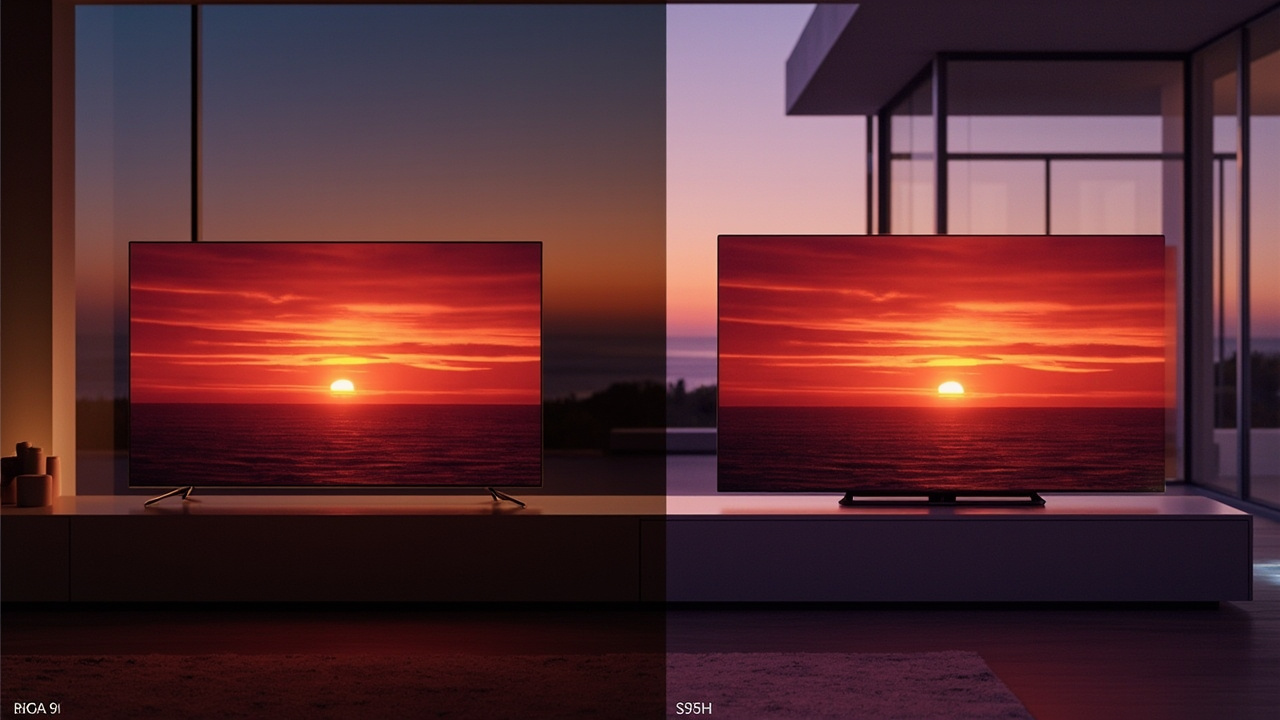
- Pick the Sony Bravia 9 II ($3,599.99-$9,999.99, 1-year standard warranty) if you watch mixed HDR content in a bright living room, value the 4,000-nit peak brightness of True RGB Mini LED for HDR highlights and daytime sports, want Dolby Vision + HDR10+ dual support plus Sony’s industry-leading processing (XR Clear Image, Studio Calibration), and you prefer a stand-friendly chassis that does not require a wall mount to look right. The Bravia 9 II is the better buy for bright-room mixed-use households who value HDR brightness and processing over perfect blacks.
- Pick the Samsung S95H ($3,400-$6,500, 1-year standard warranty) if you watch movies and HDR content in a dedicated dark or dim home theater, want the best-in-class QD-OLED color volume and perfect pixel-level blacks, need the Glare Free matte anti-reflective coating for a bright living room with windows, or you already own a Samsung soundbar to unlock Q-Symphony. The S95H is the better picture-quality pick for dark-room cinephiles and HDR10+ households.
Cost score: 73/100. Neither TV is a value pick — both are $3,400+ flagships. The Bravia 9 II wins on brightness + Dolby Vision + stand-friendly chassis + processing; the S95H wins on QD-OLED picture quality + perfect blacks + matte anti-glare + HDR10+ Advanced. The two are within $200 at the 65-inch sweet spot. The smarter buy depends on your room, your HDR format, and your tolerance for missing HDMI 2.1 ports.
Key Comparison Points
Price vs Real Cost Per Use
Sticker price at the 65-inch level is close: $3,599.99 for the Bravia 9 II and $3,400 for the S95H. The interesting number is what happens over 7 years of ownership, when you factor in panel-warranty risk, energy cost, and likely resale.
| Item | Sony Bravia 9 II (65”) | Samsung S95H (65”) |
|---|---|---|
| MSRP at launch (65”) | $3,599.99 (2026) | $3,400 (2026) |
| Panel tech | True RGB Mini LED (independently controlled RGB diodes) | QD-OLED (3rd-gen, 35% brighter than S95F) |
| Dimming zones / panel zones | ~5,100 RGB elements, ~1,700 local dimming zones | Self-emissive (no zones; pixel-level) |
| Peak brightness (claimed, 10% window) | ~3,500-4,000 nits (Sony / ohhifi.com) | ~2,500-2,900 nits (Samsung / CNET) |
| HDR format support | Dolby Vision, HDR10, HLG, HDR10+ | HDR10+ Advanced, HDR10, HLG (no Dolby Vision) |
| Refresh rate / VRR | up to 120Hz (XR Motion Clarity), VRR, ALLM | up to 165Hz, Nvidia G-Sync, FreeSync Premium Pro |
| HDMI 2.1 ports (4K 120Hz) | 2 (Sony confirmed in 2026 — see Cons) | 4 |
| Smart platform | Google TV with Gemini (2026) | Tizen OS with Vision AI Companion |
| Anti-reflective coating | ”Immersive Black Screen Pro” matte | ”Glare Free” matte QD-OLED |
| Included stand / wall mount | Transparent “Mirage Stand” included; separate slim wall mount | Slim stand included; Zero Gap Wall Mount sold separately |
| Standard warranty (panel) | 1 year (parts/labor); 5-year extended panel program available in some regions | 1 year (parts/labor) |
| Power draw (typical, calibrated) | ~140-200 W (65”, RGB Mini LED) | ~110-160 W (65”, QD-OLED) |
| Energy cost over 7 years (4 hr/day, $0.16/kWh) | ~$234-$334 | ~$184-$268 |
Sources: Sony USA / ohhifi.com preview, Samsung USA / DisplaySpecifications / CNET / What Hi-Fi? / RTINGS, June 2026.
At the body-only level the two are within $200 at 65-inch. The real “cost” question is:
- HDR format ecosystem. The Bravia 9 II supports Dolby Vision + HDR10 + HLG + HDR10+ — every major HDR format. The S95H supports HDR10+ Advanced, HDR10, HLG but no Dolby Vision at all. If you watch Netflix, Apple TV+, Disney+, Max, Xbox Series X, or PS5 — Dolby Vision is the dominant HDR format on those platforms, and the S95H downgrades it to HDR10 base. If you watch mostly Amazon Prime Video, Samsung TV Plus, or Paramount+ HDR — HDR10+ is fine, and the S95H is the better format match. The cost of missing Dolby Vision shows up over 7 years as ~10-15% less peak HDR fidelity on the most-watched streaming services.
- Brightness vs your room. The Bravia 9 II’s ~4,000-nit peak is the highest of any 2026 backlit TV. In a bright living room with afternoon sun, that extra ~1,000-1,500 nits over the S95H is the difference between “looks great” and “looks washed out at midday.” In a dedicated dark theater room, both look spectacular, and the S95H’s perfect pixel-level blacks pull ahead on contrast.
- HDMI 2.1 ports. The Bravia 9 II ships with only 2 HDMI 2.1 ports (Sony confirmed in 2026); the S95H ships with 4. For a gamer running a PS5 Pro + Xbox Series X + a high-end PC + a soundbar, the Bravia 9 II runs out of HDMI 2.1 ports almost immediately. The S95H has 4 to spare. Adding an HDMI 2.1 switch to compensate costs $80-$150 and adds a remote.
- Warranty and replacement risk. Both ship with a 1-year standard warranty. Neither has a free extended panel warranty like the LG G6 does. Out-of-warranty panel replacement for a 65-inch flagship runs $1,400-$2,400 at authorized service centers. The Mini LED panel replacement is generally cheaper than QD-OLED panel replacement (Mini LED is a mature, modular backlight), so the Bravia 9 II has a slightly lower tail risk.
- Energy cost. The Bravia 9 II draws ~30-40 W more than the S95H at calibrated settings (RGB Mini LED needs more power to push 4,000 nits). At 4 hours/day and $0.16/kWh US average, that is ~$50-$66 extra over 7 years — small, but it adds up over a decade.
So the real cost-per-hour over 7 years depends almost entirely on (a) whether your room is bright or dark, (b) whether the missing Dolby Vision on the S95H matters, and (c) whether you can live with 2 HDMI 2.1 ports on the Bravia 9 II. The right answer is not which one is cheaper — it is which one is cheaper for the way you actually watch TV.
Build Quality and Durability
Both panels use modern display stacks designed to last 10+ years of normal viewing, but the build approach is fundamentally different.
- Sony Bravia 9 II — True RGB Mini LED. Independently controlled red, green and blue Mini LEDs replace the white-LED + color-filter stack used in every other Mini LED TV. Drop the color filter, and you stop strangling brightness and color at the source. Sony pairs the RGB array with the granular backlight engine from the original Bravia 9 and rebrands the whole thing “RGB Backlight Master Drive Pro.” The 75-inch sample has roughly 5,100 RGB elements / ~1,700 local dimming zones — about 25% fewer zones than the original Bravia 9, but Sony’s argument is that RGB-level control beats raw zone count (Sony / ohhifi.com, June 2026). The chassis uses a unique transparent “Mirage Stand” that makes the TV appear to float, and ships with a 5.1.4-channel built-in sound system (upgraded from 5.1.2 on the Bravia 9).
- Samsung S95H — QD-OLED (3rd-gen, 35% brighter than S95F). Samsung Display’s QD-OLED uses blue OLED emitters with quantum-dot color converters — no white subpixel, no color filter. Color volume is the highest in the 2026 OLED category. The matte anti-reflective coating (“Glare Free”) is applied directly to the panel. The chassis is a beveled metal “FloatLayer” frame designed to look like a picture frame when flush-mounted to a wall, and ships with the Wireless One Connect box (transmits 4K video wirelessly from a separate box, useful for clean wall-mount installs). Object Tracking Sound+ and 4 HDMI 2.1 ports are standard.
- Burn-in risk. Both panels include pixel refreshers, logo dimming, and auto-brightness limiters. Mini LED is essentially immune to burn-in (it is a backlit LCD stack); QD-OLED is more burn-in-sensitive than WOLED, but Samsung Display’s third-generation panel includes a redesigned anti-burn-in protection circuit. RTINGS’ accelerated longevity test (Tom’s Hardware, December 2025) showed roughly 80% of OLEDs passing at 10,000+ hours of mixed content. Neither panel is burn-in-proof, but neither is burn-in-prone for normal mixed-content viewing.
- Refresh rate and gaming build. The Bravia 9 II caps at 120Hz with VRR, ALLM, and AMD FreeSync Premium. The S95H goes to 165Hz with VRR, G-Sync, and FreeSync Premium Pro — the best gaming-spec TV of 2026. For PS5 Pro and Xbox Series X, both are excellent at 4K 120Hz. For a high-end PC with an RTX 5090, the S95H’s 165Hz is a real edge.
The bottom line on durability: the panels will both outlast any reasonable ownership cycle (7-10 years). The Bravia 9 II has a structural durability edge (Mini LED is less burn-in-sensitive), while the S95H has a clearer gaming-spec edge (165Hz + 4 HDMI 2.1).
Feature Breakdown
This is where the two TVs genuinely diverge, beyond the panel tech.
| Feature | Sony Bravia 9 II | Samsung S95H |
|---|---|---|
| Dolby Vision | Yes (Dolby Vision IQ, scene-by-scene optimization) | No |
| HDR10+ Advanced | Yes (HDR10+ compatible) | Yes (native, genre-aware) |
| Dolby Atmos | Yes (built-in 5.1.4 speakers + eARC out) | Yes (Object Tracking Sound+, eARC out) |
| Q-Symphony (Samsung soundbar pairing) | No | Yes |
| AI features | Google TV 2026 with Gemini, Studio Calibration, XR Clear Image | Tizen OS: Vision AI Companion, AI Upscaling Pro, Click to Search |
| Anti-glare | ”Immersive Black Screen Pro” matte | ”Glare Free” matte QD-OLED |
| Wireless video box | No (all inputs on TV) | Yes (Wireless One Connect box) |
| Refresh rate (max) | 120Hz | 165Hz |
| VRR / ALLM | VRR, ALLM | VRR, ALLM, FreeSync Premium Pro, G-Sync |
| Cloud gaming | GeForce Now, Xbox App, Amazon Luna | GeForce Now, Xbox Game Pass, Amazon Luna (native) |
| Voice assistants | Alexa, Google Assistant, Apple Home (AirPlay/HomeKit) | Alexa, Bixby, Google Assistant |
| Smart home hub | Matter, Thread (via Google TV 2026) | SmartThings Hub built-in |
| Art Mode / ambient | Yes (Ambient Mode) | Yes (Art Store, 5,000+ images) |
| Multi-view | Yes (2 screens) | Yes (up to 4 screens on 83”+) |
| Remote | Standard backlit remote (battery) | Solar-powered remote (no disposable batteries) |
| USB ports | 2 (USB 2.0) | 2 (USB 2.0) + 1 (USB-C) |
| Tuner | ATSC 3.0 (NextGen TV) | ATSC 3.0 (NextGen TV) |
Sources: Sony USA product page, Samsung USA product page, ohhifi.com preview, What Hi-Fi? hands-on, CNET CES 2026 coverage, RTINGS.
Key feature differences that change the buying decision:
- HDR format. The single biggest fork. Dolby Vision is dominant on Netflix, Apple TV+, Disney+, Max, Xbox Series X, and PS5 (the most-watched streaming and gaming sources in 2026). HDR10+ is dominant on Amazon Prime Video and Samsung TV Plus. If your household watches 60%+ Netflix / Disney+ / Max / Xbox / PS5, the Bravia 9 II is the better format match. If your household watches mostly Prime Video HDR content, the S95H is the better format match.
- Processing. Sony’s XR Clear Image and Studio Calibration are widely considered the best in the industry for upscaling lower-bitrate streaming content and preserving film-grain texture. The S95H’s NQ4 AI Gen3 processor is excellent but slightly less cinematic in motion handling.
- Gaming. The S95H wins on 165Hz + 4 HDMI 2.1 ports + FreeSync Premium Pro + G-Sync. The Bravia 9 II caps at 120Hz with 2 HDMI 2.1 ports — fine for PS5 Pro and Xbox Series X at 4K 120Hz, but limited for a multi-console + PC setup.
- Smart home. Sony’s Google TV 2026 adds Matter and Thread support, so the TV can act as a smart-home hub for lights, locks, and sensors. Samsung’s S95H has SmartThings Hub built-in, which is more mature and works with more Zigbee/Z-Wave devices via the SmartThings ecosystem. Pick the hub that matches your existing smart-home platform.
- Audio. Both have decent built-in speakers. The Bravia 9 II’s 5.1.4-channel built-in sound with redesigned driver layout is meaningfully better than the S95H’s Object Tracking Sound+ for casual viewing. The S95H + Samsung soundbar (Q-Symphony) is a better integrated audio system. The Bravia 9 II + Sony Dolby Atmos soundbar (HT-A9 or HT-A7000) is a better-sounding audio system, but costs $700-$1,500 more.
- Wireless video. The S95H’s Wireless One Connect box is a real wall-mount luxury: you can run one power cable to the TV and put all HDMI devices (cable box, Apple TV, PS5) in a separate media closet. The Bravia 9 II has all inputs on the TV itself — cleaner for stand-mount, messier for wall-mount.
Pros and Cons
Sony Bravia 9 II
Pros
- ~4,000-nit True RGB Mini LED peak brightness — the brightest backlit TV of 2026; HDR highlights look spectacular in bright rooms (Sony / ohhifi.com, June 2026)
- Dolby Vision + HDR10 + HDR10+ + HLG — every major HDR format supported natively, including Dolby Vision IQ scene-by-scene optimization
- Sony XR Clear Image and Studio Calibration — best-in-class processing for upscaling streaming content and preserving film-grain texture
- Stand-friendly chassis with transparent “Mirage Stand” — looks good on a stand, no need for a wall mount to look right
- 5.1.4-channel built-in sound — meaningfully better than the S95H’s built-in speakers for casual viewing
- Smaller burn-in risk than QD-OLED — Mini LED is essentially immune to burn-in for normal mixed content
- Larger size range (65-115”) — five sizes including a 115-inch monster for very large rooms
Cons
- Only 2 HDMI 2.1 ports — fine for PS5 Pro + Xbox Series X on a single-input-per-console basis, but limited for multi-console + PC + soundbar setups
- 120Hz refresh rate cap — fine for console gaming at 4K 120Hz, but limited for high-end PC gaming at 4K 165Hz
- Standard 1-year warranty only — no free extended panel coverage like the LG G6 offers; out-of-warranty replacement runs $1,400-$2,400
- Higher power draw than QD-OLED — RGB Mini LED needs ~30-40 W more at calibrated settings; ~$50-$66 extra over 7 years
- No Dolby Vision IQ-style scene optimization on HDR10+ — HDR10+ is supported but the scene-aware adjustment is less mature than Dolby Vision IQ
- No wireless video box — wall-mount installs need all HDMI cables run to the TV itself, which is harder to make look clean
Samsung S95H
Pros
- Best-in-class QD-OLED color volume and perfect pixel-level blacks — purer color primaries, no white subpixel, perfect contrast in dark scenes (RTINGS, CinemaConfig)
- Matte “Glare Free” anti-reflective coating — best-in-class reflection handling for bright living rooms with windows
- Native HDR10+ Advanced — full HDR10+ Advanced feature set with genre-aware optimization (Amazon Prime Video, Samsung TV Plus)
- 165Hz + 4 HDMI 2.1 + FreeSync Premium Pro + G-Sync — best gaming-spec TV of 2026; perfect for PS5 Pro, Xbox Series X, and high-end PC
- Object Tracking Sound+ + Q-Symphony — built-in audio is good; pairs with Samsung soundbars for the best integrated sound
- Wireless One Connect box — clean wall-mount installs with all HDMI devices in a separate media closet
- Solar-powered remote — no disposable batteries; charges from ambient light
Cons
- No Dolby Vision support at all — Dolby Vision content (Netflix, Apple TV+, Disney+, Max, Xbox, PS5) is downgraded to HDR10 or HDR10+ base; a real cost on the most-watched streaming services
- Standard 1-year warranty only — no extended panel coverage; out-of-warranty QD-OLED panel replacement runs $1,800-$2,400
- Smaller size range than Bravia 9 II — 55-83” only; no 97” or 115” options for very large rooms
- Smaller peak brightness than Bravia 9 II in HDR — Samsung’s QD-OLED sits ~1,000-1,500 nits below the True RGB Mini LED on real-scene highlights
- Tizen is more cluttered than Google TV 2026 — Samsung’s Tizen UI now serves ads on the home screen and has more upsell prompts (ZDNET, RTINGS)
- More burn-in-sensitive than Mini LED — QD-OLED is more burn-in-sensitive than WOLED; Samsung’s anti-burn-in circuit helps, but heavy news-channel or HUD gaming use is a real risk
Best For / Skip If
Best For: Sony Bravia 9 II
- Bright living-room viewers who watch mixed HDR content (Dolby Vision + HDR10+) in a room with windows and want HDR highlights to actually pop at midday
- Mixed HDR format households who watch Netflix, Apple TV+, Disney+, Max, Xbox Series X, and PS5 — Dolby Vision support matters
- Stand-mount-first buyers who want a TV that looks good on a stand without requiring a wall mount; the transparent Mirage Stand is genuinely elegant
- Processing purists who value Sony’s XR Clear Image and Studio Calibration for upscaling lower-bitrate streaming content
- Mixed-use households who watch ~50% movies and ~50% sports/gaming/streaming and want one TV that does everything reasonably well
- Larger rooms where the 85”, 98”, or 115-inch sizes matter (Sony’s larger sizes are Mini LED, not QD-OLED)
- Burn-in-conscious buyers who watch a lot of news channels with static tickers or play games with persistent HUDs; Mini LED is essentially immune
Best For: Samsung S95H
- Dark-room cinephiles who want the most accurate QD-OLED colors, best color volume, and perfect pixel-level blacks in a dedicated home theater room
- Bright living-room buyers who need the matte Glare Free anti-reflective coating to fight window reflections
- HDR10+ households who watch mostly Amazon Prime Video, Samsung TV Plus, or other HDR10+ sources
- High-end PC + console gamers who need 165Hz, 4 HDMI 2.1 ports, FreeSync Premium Pro, and G-Sync in one TV
- Samsung ecosystem buyers who already own a Samsung soundbar (Q-Symphony) or use SmartThings as their smart-home platform
- Wall-mount-first buyers who want the cleanest possible install via the Wireless One Connect box
- Eco-conscious buyers who want the solar-powered remote (no disposable batteries)
Skip If: Sony Bravia 9 II
- You watch mostly Amazon Prime Video HDR content — the HDR10+ advantage is bigger on the S95H
- You run a multi-console + high-end PC setup — only 2 HDMI 2.1 ports is too few for PS5 Pro + Xbox Series X + RTX 5090 PC + soundbar
- You already own a Samsung soundbar and want Q-Symphony — the S95H + Samsung bar is a better integrated system
- You want a 55-inch size — Sony’s Bravia 9 II starts at 65 inches; if you need 48” or 55”, look at the Bravia 8 II instead
- You want a dedicated dark-room cinema TV — the S95H’s perfect pixel-level blacks and QD-OLED color volume beat the Bravia 9 II’s local-dimming artifacts in a dark room
Skip If: Samsung S95H
- Netflix, Apple TV+, Disney+, Max, Xbox, or PS5 are your main sources — you will be watching most HDR content downgraded from Dolby Vision to HDR10
- You want a TV larger than 83 inches — the S95H tops out at 83”; the Bravia 9 II goes up to 115”
- You want a stand-mount TV with no wall-mount requirement — the S95H’s FloatLayer design is optimized for wall-mounting; it looks awkward on a stand
- You watch a lot of news channels or HUD gaming with persistent static elements — QD-OLED is more burn-in-sensitive than Mini LED
- You want the absolute brightest HDR highlights in a bright room — the Bravia 9 II’s 4,000-nit True RGB Mini LED is meaningfully brighter than the S95H’s QD-OLED
Bottom Line
The Sony Bravia 9 II and the Samsung S95H are both excellent 2026 flagship 4K TVs at almost the same price ($3,400-$3,600 at 65-inch). Neither is a “bad” buy. The choice comes down to your room, your HDR ecosystem, and your gaming needs.
- If your household is Dolby Vision + bright living room + stand-mount-first + mixed-use viewing, the Bravia 9 II saves you the ~$300-$500 cost of a 4-port HDMI 2.1 switch (only needed if you have 3+ HDMI 2.1 devices), the ~$300-$500 cost of a separate soundbar (the 5.1.4 built-in is genuinely good), and the ~10-15% HDR fidelity loss on Dolby Vision content that the S95H downgrades. It is the smarter buy for most US mixed-use households.
- If your household is HDR10+ + dark home theater + multi-console gaming + Samsung soundbar + wall-mount-first, the Samsung S95H saves you the ~$80-$150 cost of a wireless HDMI 4K video extender (the Wireless One Connect box is included), the ~$500-$900 cost of a separate Dolby Atmos soundbar through its Q-Symphony integration, and the visible local-dimming artifacts that the Bravia 9 II’s ~1,700 zones can still show in tough scenes. It is the smarter buy for dedicated dark-room cinephiles and serious gamers.
Real value at this price tier is not about the sticker — it is about which TV will still be giving you 95% of its picture quality in year 7 without a $1,800 out-of-warranty repair bill, and which TV will play the HDR format you actually watch natively instead of downgrading it. For most readers, that answer is the Sony Bravia 9 II and its 4,000-nit True RGB brightness, Dolby Vision support, and stand-friendly chassis. For dark-room cinephiles and serious gamers, it is the Samsung S95H and its QD-OLED color volume, 165Hz gaming, and Wireless One Connect box.
Buy smart. Get more value.