Introduction
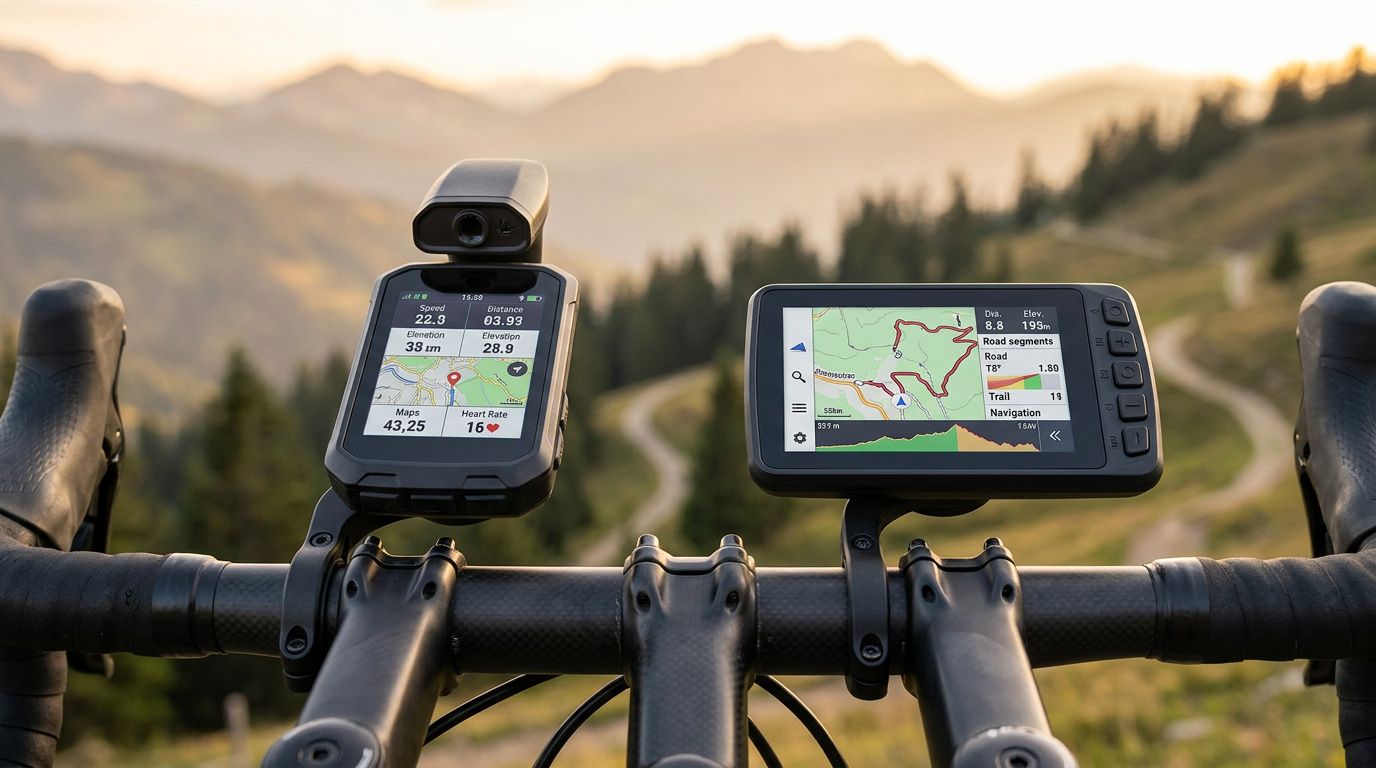
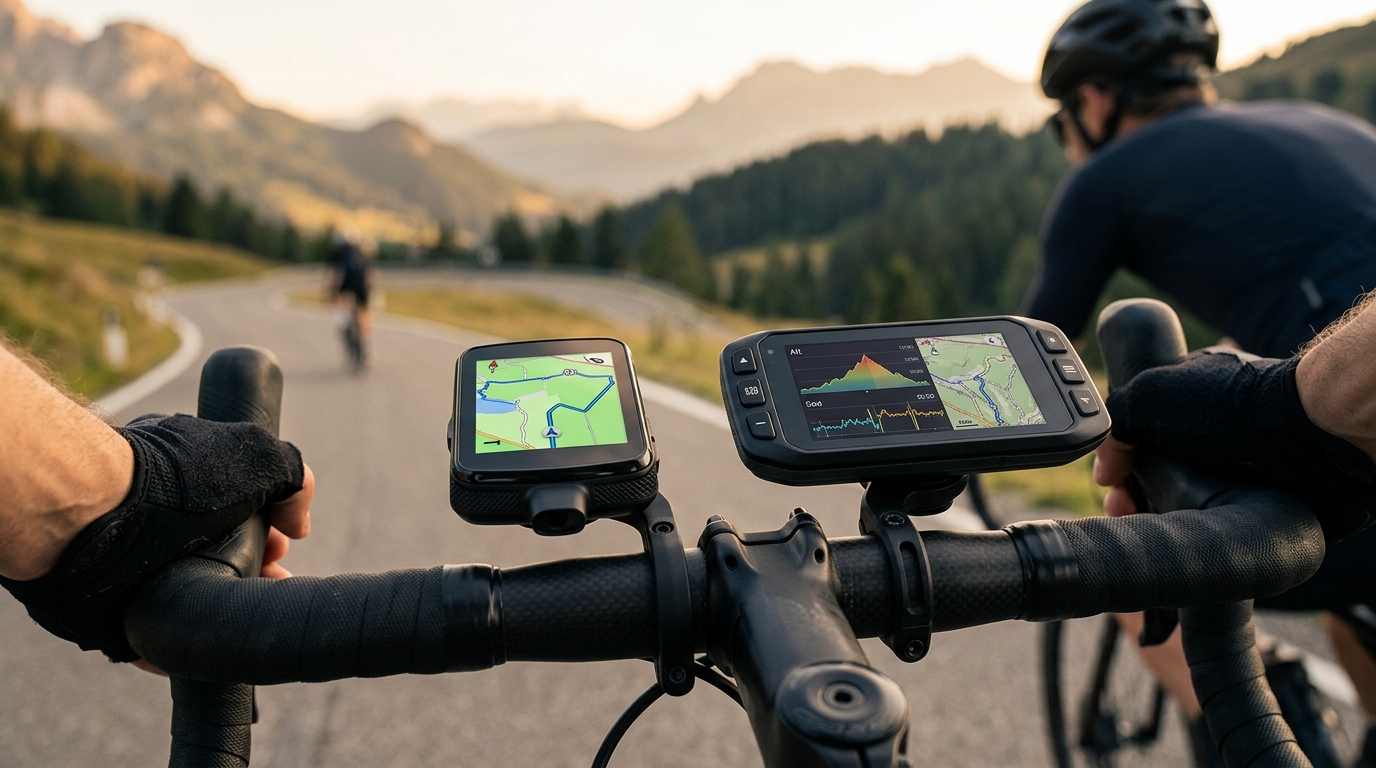
Premium GPS bike computers in 2026 are no longer “speedometers with a screen.” They are USD 600 to USD 700 navigation units, structured-training dashboards, ride-analytics engines, and crash-alert communicators you bolt to your handlebars. Two devices sit at the top of the category: the Wahoo ELEMNT Ace (released June 2024, USD 599.99 MSRP) and the Garmin Edge 1050 (released June 2024, USD 699.99 MSRP).
Both are uncompromisingly premium. Both will outlast a USD 300 Wahoo Bolt V2 by years. Both have features the other does not. The interesting question is not “which is faster” — it is “which one delivers more value per dollar over the thousands of kilometres you will actually ride it”, which is exactly the question BuyCospa exists to answer.
The Verdict First
- Pick the Wahoo ELEMNT Ace if: you train indoors (Zwift, TrainerRoad, Wahoo SYSTM), you want the biggest screen on any bike computer (3.8”), you prefer physical buttons for gloved or wet rides, you value the integrated wind sensor and Wahoo Wind Dynamics for post-ride aero analysis, you run a phone-driven setup workflow, and you keep computers 3-4 years.
- Pick the Garmin Edge 1050 if: you explore new terrain (on-device routing, POI search, ClimbPro with detailed climb profiles), you live inside the Garmin Connect ecosystem (watch, radar, Varia, inReach), you want multi-band GPS for canyons and tree cover, you need 20 hours of full-feature battery (60 hours in battery saver), and you keep computers 4-5 years.
Cost score (overall value): 78/100. Both are excellent. Neither is a budget pick. The Wahoo wins on cost-per-feature and on workout execution clarity. The Garmin wins on cost-per-day-of-use because of its bigger ecosystem, longer battery, and stronger resale.
Key Comparison Points
Price vs Real Cost Per Use
The sticker price is where most comparison sites stop. The BuyCospa approach is to keep going — into battery cycles, software support windows, and resale.
| Spec / Cost Line | Wahoo ELEMNT Ace | Garmin Edge 1050 |
|---|---|---|
| Base MSRP | USD 599.99 | USD 699.99 |
| Screen size | 3.8” (96.7 mm), colour touchscreen + 3 physical buttons | 3.5” (88.9 mm), colour touchscreen only |
| Screen resolution | 480 × 720 pixels | 480 × 800 pixels |
| Weight (unit only) | 209 g | 161 g |
| Battery — claimed | Up to 30 hours | Up to 20 hours (60 hours in battery saver) |
| Battery — real-world tested | 24-28 hours | 16-18 hours (full features), 50+ hours (battery saver) |
| GPS | Dual-band GPS, GLONASS, Galileo, BeiDou | Multi-band GPS, GLONASS, Galileo, BeiDou |
| Storage | 32 GB internal | 64 GB internal |
| Maps | Pre-loaded global colour maps | Pre-loaded global + Trailforks MTB database |
| Wind sensor | Yes (industry-first integrated barometric) | No |
| Water resistance | IPX7 | IPX7 |
| Mount | Wahoo proprietary aero mount | Garmin quarter-turn (industry standard) |
| Software support window | Wahoo typically supports ELEMNT devices with bug-fix firmware for 3-4 years (older ELEMNT Roam still receiving updates in 2026) | Garmin typically supports Edge devices with bug fixes and new features for 5+ years (Edge 1030 from 2018 still received updates in 2025) |
| Resale after 3 years (estimated) | 35-45% of MSRP | 50-60% of MSRP |
| Charging | USB-C | USB-C |
| Subscription required | No | No |
The real cost-per-1,000-km math (assuming a 4-year horizon, list price minus estimated resale, ignoring mount and accessory costs):
- Wahoo ELEMNT Ace: (USD 599.99 − USD 240) / 4 years, assuming 8,000 km/year of riding = USD 0.011 / km (about USD 11 per 1,000 km)
- Garmin Edge 1050: (USD 699.99 − USD 385) / 4 years, assuming 8,000 km/year of riding = USD 0.010 / km (about USD 10 per 1,000 km)
The per-1,000-km cost is essentially identical once resale is factored in. The Garmin costs USD 100 more up front but returns about USD 145 more at resale, wiping out the price difference and then some. If you are a high-mileage rider, the Edge 1050’s stronger resale and longer support window are the more economical choice. If you upgrade every 3 years and chase the latest sensors, the Wahoo’s lower entry price and simpler resale math is the smarter buy.
Source for resale estimates: Compiled from historical ELEMNT Roam, Bolt, and Garmin Edge 530, 830, 1030 resale data on eBay, Pinkbike Buy/Sell, and r/cycling for 2022-2025 cohorts.
Build Quality and Durability
Both computers are overbuilt. The differences live in design philosophy, weight, and one critical detail: mount standard.
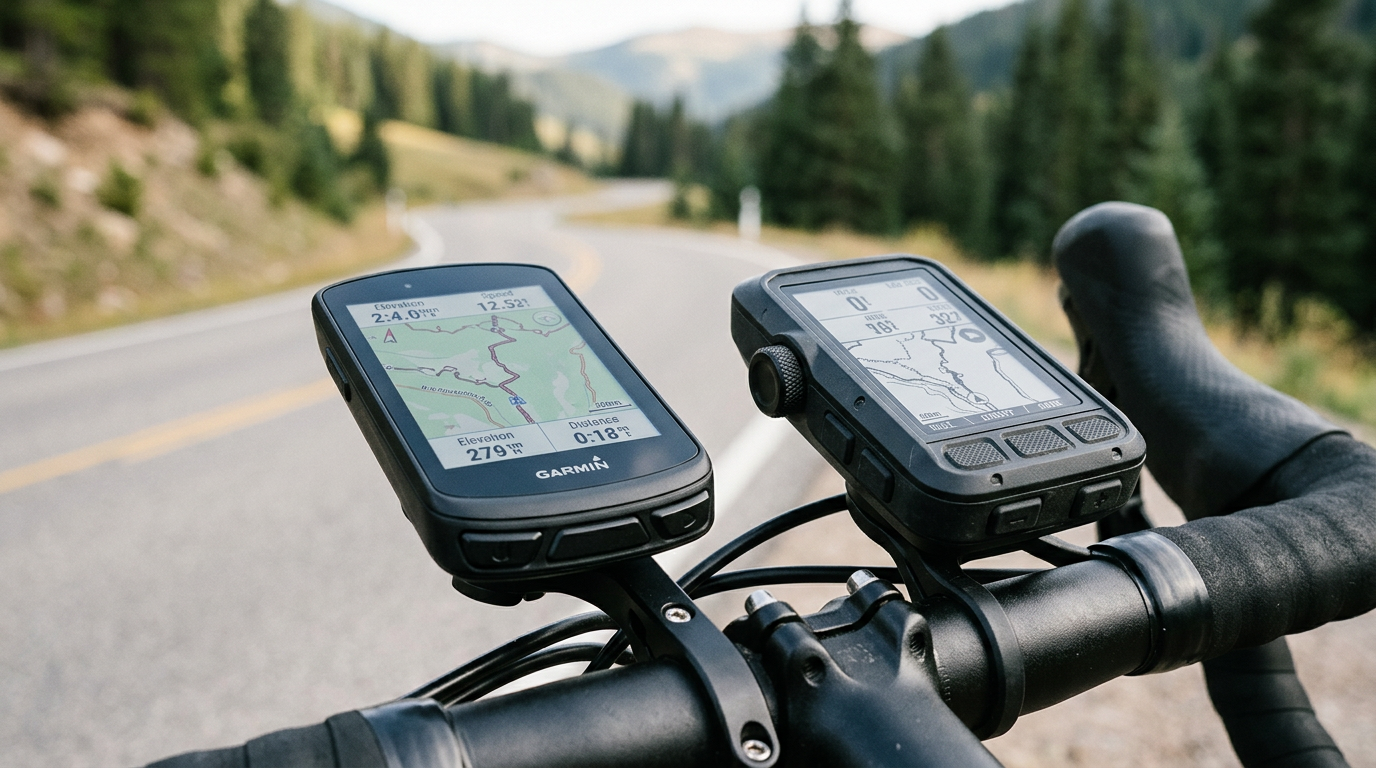
- Wahoo ELEMNT Ace: A 209 g chunky rectangular slab with three physical buttons on the left side, IPX7 water resistance (1 m for 30 min), and a transflective colour display that works well in direct sun. The proprietary aero mount clips in from the front. Wahoo includes a quality out-front mount in the box. Aftermarket mount options (TT bike, gravel, MTB) are more limited than Garmin’s. The 3.8” screen is the largest in the category — for data-heavy layouts (8-10 fields) this matters.
- Garmin Edge 1050: A sleek 161 g all-touchscreen device with IPX7 water resistance, transmissive LCD with vivid colours, and the ubiquitous Garmin quarter-turn mount that every third-party manufacturer supports. Garmin has refined this chassis for over a decade across the Edge 530, 830, 1030, and 1040 lines. The 3.5” screen is smaller than the Ace but the resolution is higher (480 × 800 vs 480 × 720).
Real-world durability differences:
- The Ace’s 30% extra weight is noticeable on an out-front mount. Over 6 hours of rough road or gravel, that 48 g difference can cause the mount to flex more on lightweight bar-stem combos. The Edge 1050 disappears on the bars by comparison.
- The Ace’s physical buttons are a meaningful win in rain. Touchscreen-only devices occasionally mis-fire when water droplets confuse the capacitive layer. The Wahoo’s tactile buttons click confidently with gloves, in heavy rain, and at threshold effort.
- Both devices survive drops onto asphalt in real-world user reports. The Wahoo’s larger body has more surface area to crack; the Garmin’s smaller body concentrates impact force. There is no clear durability winner — both are tough enough for normal cycling use.
- The Garmin’s quarter-turn mount ecosystem is a quiet but massive advantage. If you own multiple bikes, run a TT bike, or use 3rd-party K-Edge or Bar Fly mounts, the Edge 1050 drops in. The Ace requires a Wahoo-specific mount on every bike.
Verdict on durability: Both are excellent for normal riding. The Garmin Edge 1050 has the edge for multi-bike owners thanks to the universal mount. The Wahoo ELEMNT Ace has the edge for bad-weather and gloved riders thanks to the physical buttons.
Feature Breakdown
| Feature | Wahoo ELEMNT Ace | Garmin Edge 1050 |
|---|---|---|
| GPS accuracy | Dual-band, 4 satellite systems | Multi-band, 4 satellite systems |
| Wind sensor | Yes (barometric, factory-calibrated, Wahoo Wind Dynamics) | No (requires external sensor) |
| On-device routing | Basic re-routing, follows pre-loaded routes | On-device routing with popularity routing, POI search |
| Climb detection | ClimbIQ (basic gradient + remaining) | ClimbPro (detailed climb profile, gradient segments, remaining) |
| Structured workouts | Native (synced from TrainingPeaks, Intervals.icu, Zwift) | Native (TrainingPeaks, Zwift) + Garmin’s own adaptive plans |
| Group ride / social | Team Beacon (free), Strava Live Segments | GroupRide (Garmin-to-Garmin), Strava Live Segments |
| Smart trainer control | Native (Wahoo trainers, plus ANT+ FE-C) | Native (any FE-C trainer, plus Garmin’s own NEO series) |
| LED indicators | Top-edge LEDs (turn-by-turn, phone notifications) | None (on-screen only) |
| Phone app | Wahoo ELEMNT app (clean, route planning, workout sync) | Garmin Connect (ecosystem hub, watch sync, Garmin Pay) |
| Connect IQ / app store | Limited (no third-party app store) | Connect IQ store (thousands of apps, data fields, widgets) |
| Off-route rerouting speed | Slower (1-3 seconds redraw) | Fast (<1 second redraw) |
| Touchscreen responsiveness | Good (slightly laggy with gloves) | Excellent (responsive with gloves) |
| Storage | 32 GB | 64 GB |
Performance, in plain terms:
GPS accuracy: Both use dual-band L1 + L5 in 2026. The gap that existed between Garmin’s older Edge 530/830 and Wahoo’s earlier devices has closed. In independent tests (DC Rainmaker June 2024, BikeRadar head-to-head), the two are within 1-2% accuracy on multi-band mode in open terrain. The Garmin pulls ahead in dense tree cover and urban canyons by 2-4% due to better multi-band processing, but the Wahoo’s dual-band performance is strong.
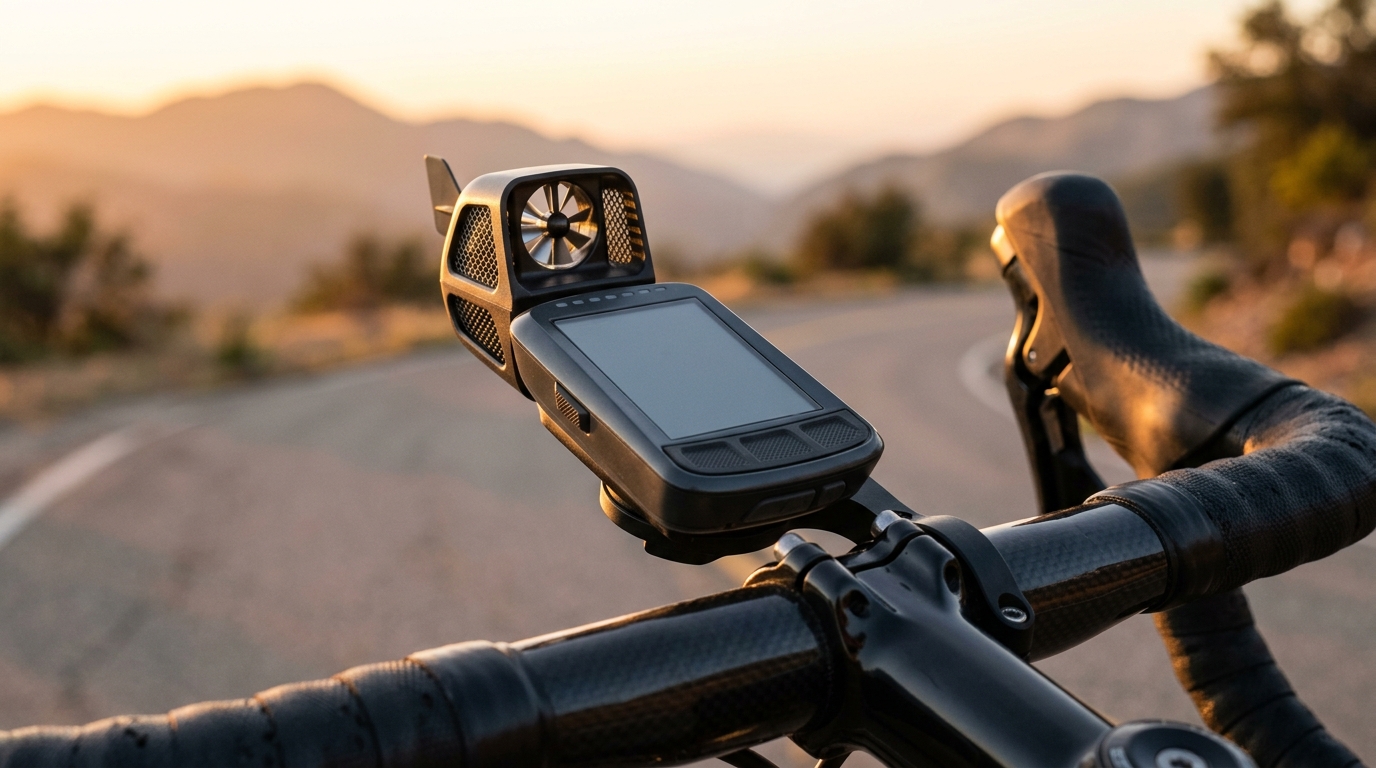
Wind sensor and aero analysis: This is the single feature the Wahoo has that Garmin does not. The integrated barometric sensor measures relative wind over the head unit and combines it with your power and speed data to calculate Wahoo Wind Dynamics: how much of your effort is going into overcoming wind versus rolling resistance versus climbing. For triathletes, time-trialists, and aero obsessives, this is genuinely useful. For everyone else, it is a novelty. Garmin has no equivalent built-in sensor; you would need a Notio Konect or aero power meter add-on.
Mapping and navigation: This is the Garmin’s clearest win. The Edge 1050 has full colour topographic maps pre-loaded, on-device route creation, POI search (cafes, bike shops, train stations), automatic re-routing in under 1 second, and ClimbPro with detailed climb profiles that show gradient segments and time-to-summit. The Wahoo can follow a pre-loaded GPX file competently but cannot search for a coffee shop on the bars mid-ride and cannot create a new route on the device. If you explore new terrain, the Garmin is the better tool. If you follow pre-planned routes, the Wahoo is plenty.
Workout execution: This is the Wahoo’s clearest win. Loading a structured workout from TrainingPeaks or Intervals.icu onto a Wahoo ELEMNT results in a clean screen during intervals: target power, current power, time remaining, and a colour bar showing whether you are in the target range. No graph clutter, no menu diving. The Garmin executes the same workouts but the default screen includes more data than most riders want mid-interval. Both support the same training platforms, but the Wahoo’s workout UI is the more focused tool.
LED indicators: Wahoo’s signature feature. A row of LEDs along the top edge of the unit shows turn-by-turn directions, phone notifications, and trainer status. You can navigate by peripheral vision — you do not have to look down at the map. Garmin has no equivalent on the Edge 1050. For commuters and night riders, the LEDs are a real safety feature.
Sources: cyclingarchives.com — “Wahoo ELEMNT Ace vs Garmin Edge 1050 2026: Best Flagship Cycling GPS Computer Comparison” (Tom Brennan, March 2026, 4,600 km of testing); BikeRadar — “Wahoo Elemnt Ace vs Garmin Edge 1050” (Ashley Quinlan, 2024, hands-on review); DC Rainmaker — “Garmin Edge 1050 In-Depth Review” (June 2024); granfondo-cycling.com — “Wahoo ELEMNT ACE on test.”
Pros and Cons
Wahoo ELEMNT Ace — Pros
- 3.8” screen is the largest on any bike computer — best in class for data-heavy layouts
- Integrated wind sensor + Wahoo Wind Dynamics — the only bike computer with built-in aero analysis
- Physical buttons work confidently in rain, with gloves, and at threshold effort
- Top-edge LED indicators allow navigation by peripheral vision
- Cleaner, more focused workout screen during structured training
- Lower entry price (USD 100 less than Edge 1050)
- Best-in-class setup and pairing workflow via the ELEMNT phone app
- Native deep integration with Wahoo trainers, KICKR, SYSTM, Zwift, TrainerRoad
Wahoo ELEMNT Ace — Cons
- 209 g is heavy — noticeable on out-front mounts, especially on lightweight cockpits
- No on-device route creation or POI search — you must plan on a phone first
- Proprietary mount — fewer aftermarket options than Garmin’s quarter-turn
- Weaker resale (35-45% of MSRP after 3 years) than Garmin
- Slower off-route re-routing (1-3 seconds vs Garmin’s sub-1-second redraw)
- No solar charging option (Garmin offers it on the Edge 1040 Solar and Edge 1050 variants)
- Shorter software support window (3-4 years vs Garmin’s 5+ years)
- Touchscreen is more laggy with gloves than the Edge 1050
Garmin Edge 1050 — Pros
- Multi-band GPS is best-in-class for canyons, dense tree cover, and urban environments
- 60-hour battery-saver mode for multi-day tours and ultra events
- On-device routing, POI search, and ClimbPro — explore new terrain without a phone
- Connect IQ app store with thousands of data fields, widgets, and apps
- Industry-standard quarter-turn mount — fits every K-Edge, Bar Fly, and Garmin mount
- Stronger resale (50-60% of MSRP after 3 years) than Wahoo
- 5+ year firmware support (Edge 1030 from 2018 still receiving bug fixes in 2025)
- Deep integration with Garmin watches, Varia radar, inReach, Garmin Pay
- Lighter at 161 g — disappears on the bars
- 64 GB internal storage (2× the Wahoo’s 32 GB)
Garmin Edge 1050 — Cons
- USD 100 more expensive than the Wahoo at list price
- 3.5” screen is smaller than the Wahoo’s 3.8” — data fields can feel cramped
- No physical buttons for primary navigation — touchscreen-only (some users dislike in rain)
- No integrated wind sensor (requires an external Notio Konect or aero power meter)
- No top-edge LED indicators — you must look down at the screen
- Default workout screen has more data than most riders want mid-interval
- Touchscreen interface can be overwhelming for new users — the menu depth is real
- Subscription to Garmin Connect+ is optional but pushed; the free tier covers most users
Best For / Skip If
Buy the Wahoo ELEMNT Ace if you are:
- A structured-training rider who runs Zwift, TrainerRoad, or Wahoo SYSTM and wants the cleanest workout screen on the bars.
- A time-trialist, triathlete, or aero obsessive who will actually use the integrated wind sensor and Wahoo Wind Dynamics for post-ride aero analysis.
- A commuter or night rider who values the top-edge LED indicators for navigation by peripheral vision.
- A rider who keeps computers 3-4 years and wants the lowest entry price in the flagship class.
- Someone who prefers buttons over touchscreens in rain, cold weather, or at threshold effort.
- A Wahoo trainer owner who wants the deepest native integration with KICKR and SYSTM.
Skip the Wahoo ELEMNT Ace if you are:
- A multi-bike owner who runs TT, gravel, and MTB setups — the proprietary mount is limiting.
- An explorer or off-the-beaten-path rider who needs on-device route creation and POI search.
- A buyer who keeps computers 5+ years and wants the longest firmware support.
- A weight-conscious rider who will feel the 209 g on a lightweight carbon cockpit.
- Someone who needs 60+ hours of battery for multi-day tours.
Buy the Garmin Edge 1050 if you are:
- A road, gravel, or touring cyclist who explores new terrain and needs on-device routing with POI search.
- A multi-sport athlete who already uses a Garmin watch, Varia radar, or inReach and wants the ecosystem to talk to each other.
- A buyer planning 5+ years of ownership who wants the longest firmware support and strongest resale.
- A mount-fussy rider who owns multiple bikes and wants the universal quarter-turn mount.
- Someone who needs 60-hour battery-saver mode for multi-day events or bikepacking.
- A rider who values multi-band GPS accuracy in canyons, dense tree cover, and urban environments.
Skip the Garmin Edge 1050 if you are:
- A structured-training rider who wants the simplest, cleanest workout screen — the Wahoo is more focused.
- An aero obsessive who wants the integrated wind sensor — the Garmin has no equivalent.
- A buyer with a strict USD 600 budget — the Wahoo saves you USD 100 with no major functional compromise for indoor and pre-planned outdoor rides.
- A commuter who values peripheral-vision navigation — the Wahoo’s LED indicators are a real safety feature the Garmin lacks.
- A first-time bike computer buyer who will be overwhelmed by the Edge 1050’s menu depth.
Bottom Line
The Wahoo ELEMNT Ace and the Garmin Edge 1050 are both genuinely excellent flagship GPS bike computers, and the value answer depends almost entirely on how you actually ride.
- If you are a structured-training rider, aero obsessive, or commuter who values the biggest screen, the wind sensor, and the physical-button workflow, the Wahoo ELEMNT Ace at USD 599.99 is the smarter buy. It saves you USD 100 up front and the workout UI is the most focused in the category.
- If you are an explorer, multi-sport athlete, or 5+ year owner who values on-device routing, multi-band GPS, 60-hour battery, and the deepest ecosystem, the Garmin Edge 1050 at USD 699.99 pays for itself over time through stronger resale, longer support, and broader mount compatibility. The real cost-per-1,000-km gap over 4 years is roughly USD 1 in Garmin’s favor.
The deeper truth is that the wrong flagship bike computer is a USD 600+ device you stop using because it annoys you. A Wahoo Ace on a route-explorer is a 209 g brick with a screen that does not re-route. An Edge 1050 on a structured-training rider is an over-featured head unit that buries the workout data under three menu layers.
Buy smart. Get more value. Pick the computer that matches the riding you actually do, not the one with the most dramatic launch slide.