Introduction
If you want speakers in three or more rooms in 2026, you have two realistic options: Sonos (the default) or Denon’s HEOS platform (the alternative the company has spent the last five years quietly perfecting). And in mid-2026, the gap is closer than it has ever been.
On one side, Denon just launched the Home 200 ($399), Home 400 ($599), and Home 600 ($799) — all driven by the same HEOS app, all designed to replace or supplement the older Home 150/250/350 line. On the other side, Sonos’s Era 100 ($249) and Era 300 ($449) remain the default mass-market recommendation, with the larger Era 300 explicitly engineered for Dolby Atmos from a single cabinet.
Both ecosystems are good. Both lock you in. Both claim “room-filling sound.” But the cost-per-room math, the multiroom app reliability story, and the upgrade path are very different — and that’s the entire point of this article. We’ll work out which platform actually saves you money per year of listening.
The Verdict First
- Pick the Denon Home line (200/400/600) if: you want more drivers and amplifier channels per dollar, you live in a HEOS / Marantz / Denon AVR household already, you want Hi-Res audio (24-bit/192 kHz) streaming via the HEOS app, and you don’t care that Denon’s app is less polished than Sonos’s. The Home 400 at $599 is the best value-per-dollar in the entire category.
- Pick the Sonos Era 100/300 if: you want the smoothest, most stable multiroom app experience, you want built-in Dolby Atmos from a single cabinet (Era 300), you value voice control (Sonos Voice + Alexa) and broad music-service support, and you don’t mind paying a small premium for ecosystem maturity.
- Skip both ecosystems if: you only need audio in one or two rooms. A pair of $200 powered bookshelf speakers (Audioengine A2+, Kanto YU2) plus an Echo Dot or HomePod mini will outperform either ecosystem at the entry level.
Cost score (overall value): 79/100. Both ecosystems are good long-term holds. The Denon wins on hardware-per-dollar; the Sonos wins on software polish and Atmos from a single box.
Key Comparison Points
Price vs Real Cost Per Use
The sticker price is just the first number. Real cost includes amplifiers, firmware support, and the inevitable “I should add a sub” moment.
| Cost Line | Denon Home 200 | Denon Home 400 | Denon Home 600 | Sonos Era 100 | Sonos Era 300 |
|---|---|---|---|---|---|
| MSRP (single unit) | $399 | $599 | $799 | $249 | $449 |
| Drivers | 4 (2 tweeters, 2 mid-bass) | 6 (2 tweeters, 2 up-firing, 2 woofers) | 8 (2 tweeters, 2 mid, 2 up-firing, 2 woofers) | 3 (1 tweeter, 2 midwoofers) | 6 (4 tweeters, 2 woofers) |
| Class-D amps | 4 | 6 | 8 | 3 | 6 |
| Hi-Res support | 24-bit / 192 kHz | 24-bit / 192 kHz | 24-bit / 192 kHz | 24-bit / 48 kHz | 24-bit / 48 kHz |
| Dolby Atmos from unit | No | No (up-firing only) | No (up-firing only) | No | Yes (full Atmos) |
| Power draw (idle, est.) | ~6 W | ~7 W | ~8 W | ~5 W | ~7 W |
| Annual electricity (4 h/day, $0.18/kWh) | ~$1.58 | ~$1.84 | ~$2.10 | ~$1.31 | ~$1.84 |
A 3-room starter system (one speaker per room, no sub, no rears):
- Denon: $399 + $599 + $799 = $1,797 (mixing 200 in the bedroom, 400 in the office, 600 in the living room)
- Sonos: $249 + $249 + $449 = $947 (Era 100 in bedroom, Era 100 in office, Era 300 in living room)
The Denon setup costs $850 more for the same room count. But it also delivers 22 drivers / 22 amps total vs Sonos’s 12 drivers / 12 amps total. The per-driver cost is $82 (Denon) vs $79 (Sonos) — basically identical. The Denon is paying for bigger cabinets, more amplifiers, and Hi-Res bandwidth that most listeners will never use.
A 5-room whole-home system (Sonos recommends Era 300 in two rooms, Era 100 in three; Denon recommends Home 600 in two, Home 400 in two, Home 200 in one):
- Denon: 2×$799 + 2×$599 + 1×$399 = $3,195
- Sonos: 2×$449 + 3×$249 = $1,793
The Denon is $1,402 (78%) more expensive for a 5-room system. That’s the real cost-of-entry gap. Whether it’s worth it depends entirely on whether you’ll use the extra drivers.
Source for prices: B&H Photo listings and Denon / Sonos US online stores as of June 2026.
Build Quality and Durability
Both product lines are sealed plastic cabinets with no user-serviceable parts. That’s the modern reality of Wi-Fi speakers.
| Build Factor | Denon Home 200/400/600 | Sonos Era 100/300 |
|---|---|---|
| Cabinet material | Matte black plastic with fabric grille | Matte black/white plastic with perforated grille |
| Color options | Black only (Home 600 also in white/gray) | Black or white (all models) |
| Weight (largest model) | Home 600: 17.6 lb | Era 300: 9.85 lb |
| Dimensions (largest) | Home 600: 17.7” × 9.9” × 8.9” | Era 300: 6.3” × 10.2” × 7.3” |
| Touch controls | Top panel with proximity sensor | Top panel with capacitive slider |
| Quick Select buttons | Yes (3 per speaker) | No |
| Wired inputs | USB, 3.5 mm aux, Ethernet | USB-C line-in (adapter sold separately), Ethernet (adapter sold separately) |
| Bluetooth | Yes | Yes (Sonos Era 100/300) |
| AirPlay 2 | Yes | Yes |
| Voice assistants | Via connected Alexa device or Action button | Sonos Voice Control + Alexa |
The Denon cabinets are dramatically heavier and larger for equivalent output. That’s not a flex — heavier cabinets typically mean stiffer enclosures, which reduces unwanted resonance. The Home 600 at 17.6 lb feels like a piece of studio gear; the Era 300 at 9.85 lb feels like a tech gadget. For desktop or bookshelf use, the Sonos form factor is friendlier. For main living-room speakers, the Denon heft is reassuring.
Real-world durability: Both lines have a 1-year warranty. Neither is user-repairable when the amplifier or DSP board fails. Sonos has a longer historical track record (10+ years of firmware updates on the original Play:1); Denon’s HEOS platform is younger but Denon parent company (Harman/Samsung) has the parts supply to back the platform for the long term.
Firmware support outlook: Sonos committed to at least 5 years of security updates for the Era line in 2024 and has not announced any end-of-life for the Era 100/300. Denon has not made a public commitment, but the Home 150/250/350 (now 6+ years old) are still receiving HEOS updates in 2026, which is a positive sign.
Feature Breakdown
This is where the platforms diverge most clearly.
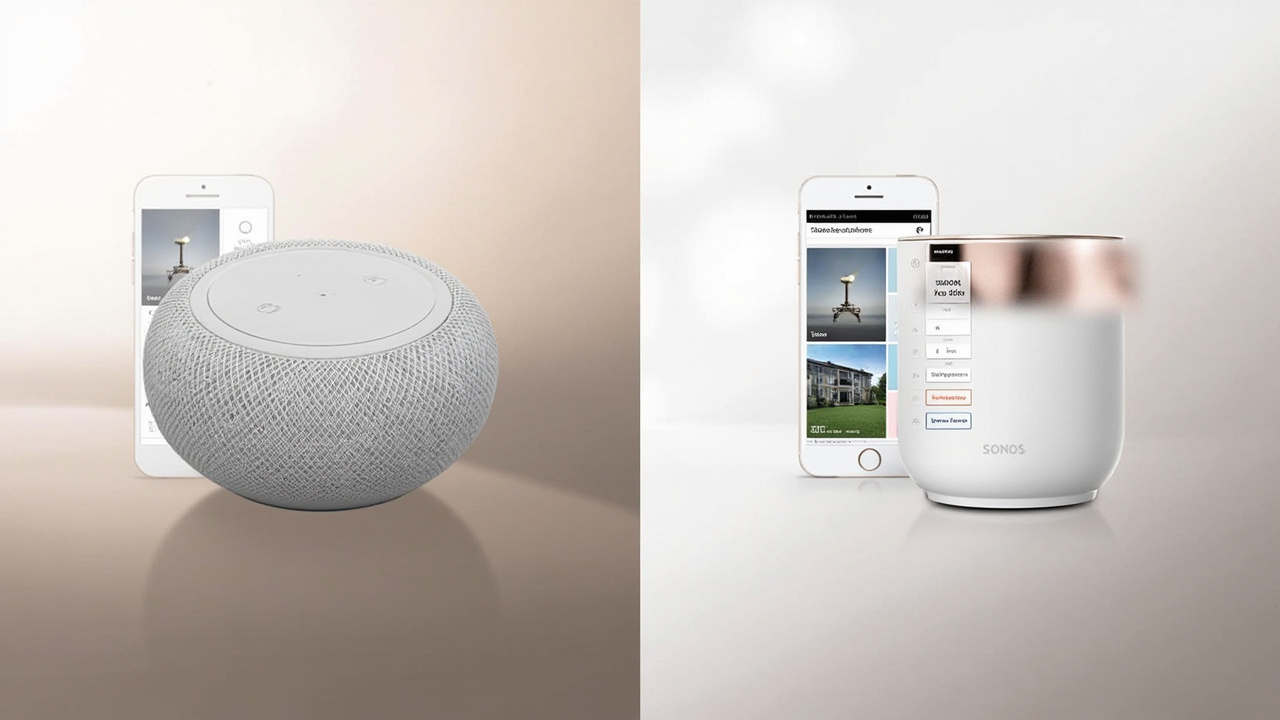
Multiroom app experience: The HEOS app has improved significantly since 2023. Engadget’s 2026 review noted that “the HEOS app is reliable, and multiroom audio between the Home 600, 400 and 200 is seamless” — no perceptible lag moving between rooms. The Sonos S2 app remains the gold standard for multiroom reliability, with the “Group all” action and room grouping consistently rated faster than competitors.
Source: Engadget’s Denon Home 200/400/600 review (rating 8.2/10) and prior Sonos Era reviews.
Room calibration: This is one of the biggest practical differences.
- Denon HEOS: No room calibration tool. Instead, the setup wizard asks you whether the speaker is “away from walls,” “near one wall,” or “near two walls,” and tunes the output accordingly. You can change this later if you move the speaker.
- Sonos Trueplay: Two modes. iOS devices run the full advanced tune (~3 minutes of sweeping pink noise with the phone’s mic). Android devices run a quick tune (~30 seconds, less precise but works in a pinch).
The Sonos Trueplay is genuinely better at adapting to weird rooms (vaulted ceilings, alcoves, open-plan spaces). The Denon approach is “good enough” for typical living rooms and bedrooms.
Dolby Atmos from a single speaker: This is the Sonos Era 300’s killer feature. It has six drivers arranged to bounce sound off the ceiling and walls, producing a credible Atmos bubble from one cabinet. The Denon Home 200/400/600 do not claim full Atmos — they have up-firing drivers on the 400 and 600, but Engadget’s review did not find them competitive with the Era 300 for Atmos material.
If you watch a lot of Atmos-mixed movies or Apple Music Spatial Audio tracks, the Era 300 alone outperforms any single Denon Home unit for that use case.
Hi-Res audio support: The Denon Home line supports 24-bit / 192 kHz files via HEOS (FLAC, WAV, ALAC, DSD). The Sonos Era line caps at 24-bit / 48 kHz. For most streaming-service users, this is irrelevant — Tidal Hi-Res and Apple Music Lossless top out at 24-bit / 192 kHz and 24-bit / 48 kHz respectively, so both platforms are overkill. But for owners of local FLAC libraries, the Denon is the more capable device.
Connectivity:
| Feature | Denon Home 200/400/600 | Sonos Era 100/300 |
|---|---|---|
| Wi-Fi | Dual-band 802.11ac (Wi-Fi 5) | Dual-band 802.11ax (Wi-Fi 6) on Era 300; 802.11ac on Era 100 |
| Bluetooth | Yes (SBC, AAC) | Yes (SBC, AAC) |
| AirPlay 2 | Yes | Yes |
| Spotify Connect | Yes | Yes |
| Tidal Connect | Yes | Yes |
| Amazon Music HD | Yes | Yes |
| Apple Music Lossless | Yes (via AirPlay only) | Yes (via AirPlay only) |
| Local library (DLNA/UPnP) | Yes (full Hi-Res) | Yes (limited to 48 kHz) |
| Voice assistants | None built-in (Alexa via external device) | Sonos Voice + Alexa |
| Quick Select presets | Yes (3) | No |
| Wired line-in | 3.5 mm | USB-C (with adapter, sold separately) |
| Ethernet | Yes (built-in) | Yes (with adapter, sold separately) |
Wired line-in and Ethernet: Denon includes both built-in. Sonos requires adapters (sold separately, ~$20 each). This is a small but real cost and convenience gap if you have a turntable, a CD player, or a desktop PC you want to connect.
Pros and Cons
Denon Home 200 / 400 / 600
Pros
- More drivers and amplifier channels per dollar than the Sonos Era equivalents
- Hi-Res audio support up to 24-bit / 192 kHz (vs Sonos’s 24-bit / 48 kHz cap)
- Quick Select buttons on top of every unit for instant preset recall
- Built-in 3.5 mm aux and Ethernet — no adapter required
- Heavier, stiffer cabinets that feel closer to studio monitors
- Heavier cabinets and more drivers mean each speaker can fill a larger room
- Integrates with existing Denon / Marantz AVRs and components in a HEOS household
- HEOS app is reliable, with seamless multiroom playback across rooms (per Engadget)
- Three models let you mix-and-match size and budget per room
Cons
- $850–$1,402 more expensive for a 3- or 5-room whole-home system
- No room calibration (Trueplay equivalent); only basic “near walls / away from walls” tuning
- No Dolby Atmos from a single cabinet; the up-firing drivers on the 400/600 do not match the Era 300
- No built-in voice assistant; relies on an external Alexa device
- Larger, heavier cabinets (the Home 600 is 17.6 lb) are not friendly to bookshelves or small desks
- Black only on the 200 and 400; the 600 has more finishes
- HEOS app has fewer supported music services than Sonos’s catalog
Sonos Era 100 / Era 300
Pros
- Lower MSRP: $249 (Era 100) and $449 (Era 300) for a 3-room system at $947 total
- Trueplay room calibration is the best in the category (iOS advanced + Android quick)
- The Era 300 delivers credible Dolby Atmos from a single cabinet — a unique feature
- More compact, lighter cabinets (Era 300 is 9.85 lb vs Home 600 at 17.6 lb) — better for bookshelves
- Available in black or white on all models
- Built-in Sonos Voice Control + Amazon Alexa
- Wi-Fi 6 on the Era 300
- Sonos S2 app is the most polished multiroom app on the market; room grouping is faster and more reliable than competitors
- Broader music-service catalog (Apple Music lossless via AirPlay, Tidal Connect, Sonos Radio built-in)
- Modular expansion: add a Sonos Sub, Sonos Arc, or Sonos Beam for home theater later
Cons
- 24-bit / 48 kHz Hi-Res cap; local FLAC libraries are downsampled
- No built-in 3.5 mm aux or Ethernet — requires $20 adapters
- No physical Quick Select buttons
- The Era 300’s Atmos performance is good, not great — a $200-$500 dedicated Atmos setup with rear speakers still beats it
- Smaller drivers and fewer amplifiers than equivalently priced Denon units
- The Sonos app’s 2024 redesign drew significant user backlash; some stability complaints persist
- Adapter-dependent wired inputs are a small but real cost-of-ownership issue
Best For / Skip If
Best For
- Buy the Denon Home line if you’re already running a Denon or Marantz AVR, you have local Hi-Res FLAC files, you want maximum drivers and amps per dollar, and you want Quick Select preset buttons. The Home 400 at $599 is the sweet spot — a step up from the Home 200 in driver count and a meaningful step down in size and price from the Home 600.
- Buy the Sonos Era line if you want the smoothest app experience, you want Dolby Atmos from a single cabinet, you want built-in voice control, and you’d rather not have a stack of adapters. The Era 100 at $249 is the obvious bedroom / office pick; the Era 300 at $449 is the main-room pick if you care about Atmos.
Skip If
- You only need audio in one or two rooms. A pair of $200-$400 powered bookshelf speakers plus a $50 Echo Dot or HomePod mini will outperform either ecosystem at the entry level.
- You want a turntable or CD player connected by wire to the same system. The Sonos Era requires a $20 USB-C line-in adapter and the experience is finicky. The Denon’s built-in 3.5 mm aux is cleaner.
- You want true 5.1 or 7.1 surround. Neither platform is a substitute for a dedicated home theater with rear speakers and a sub. Buy a Sonos Arc + Sub + Era 300 rears, or a Denon AVR + passive speakers, if that’s the goal.
- You live in a household with mixed iOS and Android users. Sonos Trueplay works much better on iOS; HEOS is platform-agnostic. If you have a mix, the Denon is the less-frustrating choice.
Bottom Line
Buy the Sonos Era 100 ($249) and Era 300 ($449) if you want the best multiroom app, want Dolby Atmos from a single cabinet in the living room, and don’t want adapters cluttering your shelf. The $947 entry point for a 3-room system is hard to beat.
Buy the Denon Home 200 ($399) and Home 400 ($599) if you want more drivers, more amplifiers, Hi-Res support, and Quick Select buttons for less-tweaked listening. The Home 400 is the value-per-dollar champion of the entire category.
Real value here isn’t just the sticker price — it’s cost-per-room of useful listening. The Sonos wins on per-room entry cost. The Denon wins on per-room driver count and amplifier channels. If you already know which platform you’ll add to later, the choice is easy. If you don’t, start with a single Sonos Era 100 or Denon Home 200 in your most-used room, live with it for a month, and let the experience tell you which ecosystem fits your habits.
Either way, do not pay MSRP on either platform — both Denon and Sonos run $50-$150 sales during major US shopping events, and the Home 200 and Era 100 have been seen as low as $329 and $199 respectively on previous Black Fridays. Buy smart, get more value.