Introduction
The single-cabinet Dolby Atmos soundbar category has a real problem: most reviews treat it as either a Sonos love letter or a Bose nostalgia trip. If you’re spending close to a thousand dollars, you want numbers, not tribalism.
Two bars dominate the >$800 segment in 2026: the Sonos Arc Ultra at $999 and the Bose Smart Ultra Soundbar at $899. Both ship as standalone units with no sub required, both promise a credible Atmos bubble, and both lock you into a proprietary app ecosystem. The price gap is $100 — about the cost of a decent HDMI cable.
The interesting question isn’t which one “wins.” It’s which one delivers better cost-per-use over a realistic 5–7 year ownership window, given the way you actually watch TV. That’s what this comparison is for.
The Verdict First
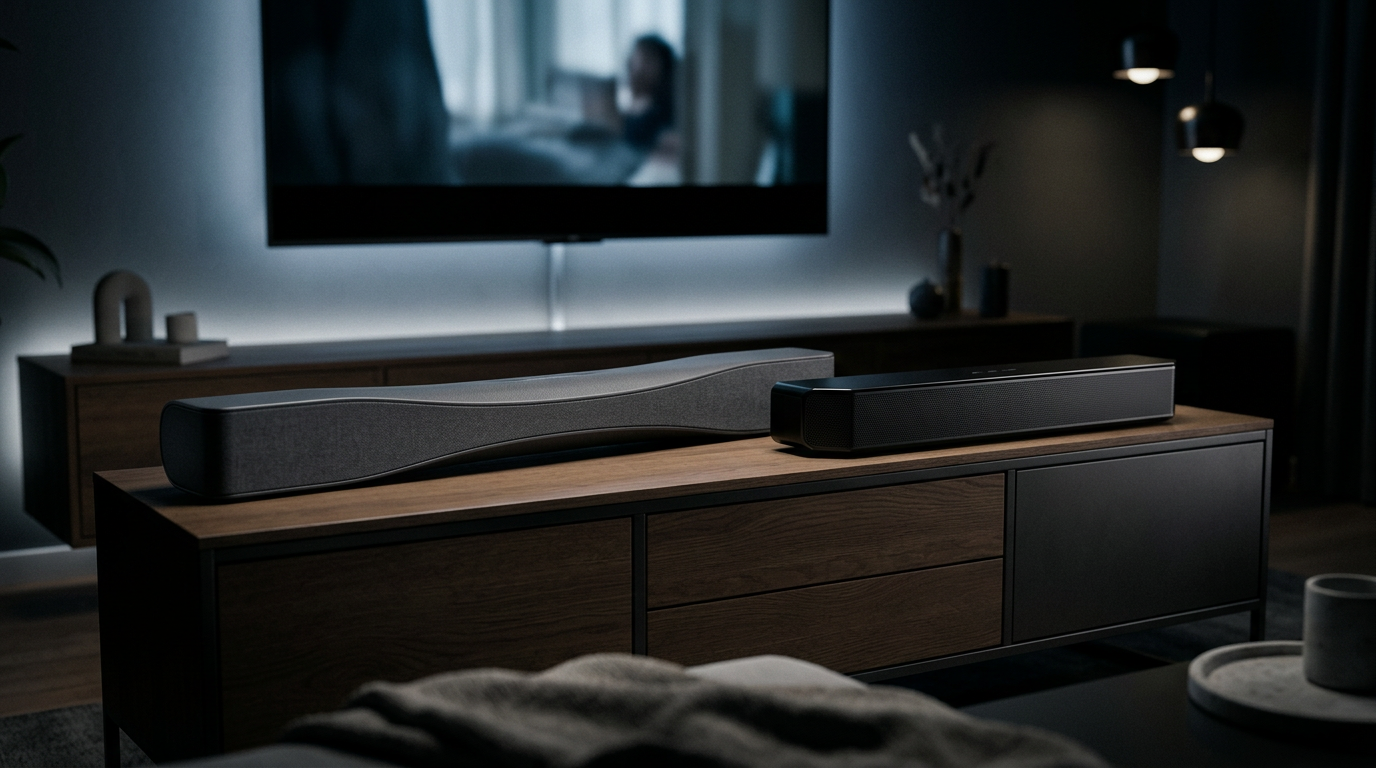
- Choose the Sonos Arc Ultra ($999) if you watch a lot of Atmos-mixed movies or games, care about bass without buying a sub, or already own other Sonos speakers. The 9.1.4 channel layout and Sound Motion woofer produce a measurably wider, deeper soundstage in side-by-side testing (Source: HomeToolHQ 2026 review, BassHeadSpeakers comparison).
- Choose the Bose Smart Ultra Soundbar ($899) if you primarily watch streaming TV, value a more compact cabinet, want louder maximum volume with less concern about audiophile imaging, or already own Bose headphones (SimpleSync is genuinely convenient).
- Skip both if you actually want true surround sound — a $500 Samsung HW-Q600C with rear speakers will beat a single-cabinet $999 bar for true surround, every time.

Key Comparison Points
Price vs Real Cost Per Use
Both bars sit in the premium tier, but the cost-per-hour math is more interesting than the sticker price.
| Cost Factor | Sonos Arc Ultra | Bose Smart Ultra |
|---|---|---|
| Sticker Price (MSRP) | $999 (Sonos US shop) | $899 (Bose US shop, per HometoolHQ 2026) |
| Power Draw (rated max) | 110 W RMS | 120 W RMS |
| Power Use (typical TV viewing) | ~10–15 W idle/active | ~10–18 W active |
| Annual Electricity (~4 hrs/day) | ~$5.50 (15 W × 4 h × 365 × $0.18/kWh) | ~$6.60 (18 W × 4 h × 365 × $0.18/kWh) |
| Likely Lifespan (firmware support) | 7+ years (Sonos has supported original Arc since 2020) | 5+ years (Bose firmware updates have slowed since 2024) |
| Cost per Year (5-yr amortized) | $200 + $5.50 = $205.50 | $180 + $6.60 = $186.60 |
| Cost per Year (7-yr amortized) | $143 + $5.50 = $148.50 | $129 + $6.60 = $135.60 |
At 4 hours of daily TV watching, the Bose saves you roughly $19 in the first year and $90 over seven years strictly on amortization — but that gap shrinks if Sonos’s longer firmware support actually keeps the bar relevant longer. The bigger cost-per-use lever is whether you’ll need to buy a $799 Sonos Sub 4 or $499 Bose Bass Module 700 to feel satisfied.
The HometoolHQ review explicitly notes that the Arc Ultra’s Sound Motion woofer reaches “usable output down to the mid-30 Hz range before distortion started to kick in, which is objectively extraordinary for a sealed soundbar cabinet.” That closes the gap on a subwoofer purchase for many buyers, which is a real $500+ savings if you would have otherwise caved.

Build Quality and Durability
| Build Factor | Sonos Arc Ultra | Bose Smart Ultra |
|---|---|---|
| Cabinet Width | 1,178 mm (46.4 in) | 1,045 mm (41.1 in) |
| Cabinet Height | 75 mm (2.95 in) | 58 mm (2.28 in) |
| Cabinet Depth | 110.6 mm | 107 mm |
| Weight | 5.9 kg (13 lb) | 5.8 kg (12.8 lb) |
| Finish | Matte plastic, Black or White | Matte plastic, Black only |
| Driver Count | 15 (7 tweeters, 6 midwoofers, 2 Sound Motion woofers) | 9 (6 transducers, 2 upward-firing dipole speakers) |
| Channel Layout | 9.1.4 (manufacturer-rated) | 5.1.2 |
| Power Output (RMS) | 110 W | 120 W |
| Warranty | 1 year (extendable with Sonos Care) | 1 year |
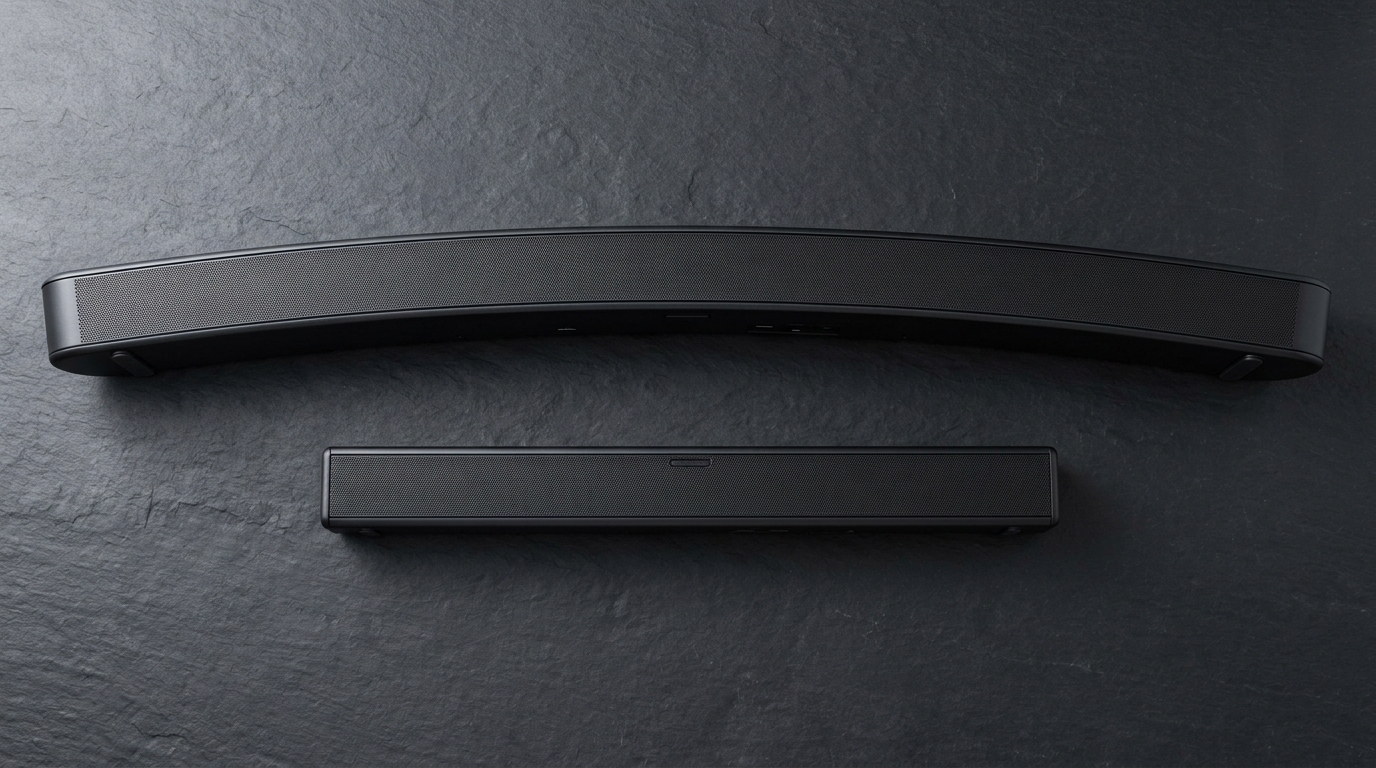
The Bose is meaningfully shorter (2.95” vs 2.28” cabinet height), which matters if your TV sits on a low stand and the bottom of the screen would otherwise be blocked. The Sonos is 13 cm wider, which can be a problem on smaller media consoles under 50-inch TVs.
Both are sealed plastic cabinets with no user-serviceable parts. Neither is repairable when the amplifier or DSP board fails — at this price point, you’re expected to replace, not repair. The Sonos ecosystem has a slight edge because the company still maintains a parts-and-trade-up program for older units, while Bose’s trade-in path is less consistent.
Feature Breakdown
This is where the gap widens.
Channel layout and Atmos immersion: Sonos markets 9.1.4 (15 drivers); Bose markets 5.1.2 (9 drivers). Marketing numbers are not directly comparable — Bose’s PhaseGuide technology and upward-firing dipole speakers are well-regarded — but in head-to-head listening reported by HometoolHQ, the Arc Ultra “creates a bubble, the Arc creates a wall” on Atmos demo material. RTINGS concludes: “The Sonos Arc Ultra is a better all-in-one soundbar than the Bose Smart Ultra Soundbar… better bass extension and an improved center performance, which helps localize dialogue.”
Dialogue clarity: Both have dedicated dialogue processing — Sonos offers three speech enhancement levels (Low/Medium/High), Bose offers an A.I. Dialogue Mode. In the HometoolHQ test on Tenet and Peaky Blinders, the Arc Ultra with speech enhancement at Medium “became fully intelligible without explosions turning into pops.” Bose’s A.I. Dialogue Mode is generally well-reviewed but less granular.
Room calibration: Sonos uses Trueplay (iOS advanced + Android quick-tune). Bose uses ADAPTiQ (headset-based, included in the box). The HometoolHQ reviewer noted the iOS Trueplay tune was “audibly smoother on the lower mids” but the Android quick-tune got 80% of the way there. ADAPTiQ is platform-agnostic but requires the headset and a quiet 5-minute setup.
Connectivity:
| Connectivity | Sonos Arc Ultra | Bose Smart Ultra |
|---|---|---|
| HDMI | 1× HDMI eARC (24-bit/192 kHz lossless) | 1× HDMI eARC + 1× Optical |
| Bluetooth | 5.3 (LE Audio supported) | 5.0 |
| Wi-Fi | Wi-Fi 6 | Wi-Fi 5 |
| AirPlay | AirPlay 2 | AirPlay 2 |
| Voice Assistants | Amazon Alexa, Sonos Voice | Amazon Alexa, Google Assistant |
| Streaming Services | 100+ via Sonos app | Bose Music app (smaller catalog) |
Bose’s inclusion of an optical input is a small but real plus for older TVs that predate eARC. Sonos’s Bluetooth 5.3 + LE Audio is a meaningful upgrade for anyone streaming directly from a phone without going through the app. Sonos’s app catalog (Apple Music lossless, Tidal Connect, Sonos Radio) is broader than Bose’s.
Multi-room / ecosystem lock-in: Both systems lock you in. If you already own Sonos One, Era 100, or Era 300 speakers, the Arc Ultra slots in seamlessly as the home theater brain. If you already own Bose QC Ultra headphones, the Smart Ultra’s SimpleSync pairs them automatically — useful for late-night listening without waking the household.
Pros and Cons
Sonos Arc Ultra ($999)
Pros
- 9.1.4 channel layout with 15 drivers; measurably wider Atmos bubble than the Bose in head-to-head tests
- Sound Motion woofer reaches mid-30 Hz without an external sub — saves a $500+ subwoofer purchase for many buyers
- Bluetooth 5.3 + Wi-Fi 6 + HDMI eARC with 24-bit/192 kHz pass-through
- Trueplay now works on Android (quick-tune), closing a long-standing platform gap
- Broader streaming service catalog via the Sonos app
- Stronger firmware support history; original 2020 Arc still receives updates in 2026
- Modular expansion path: add Sub 4, Era 300 rears later if you want a full 9.1.4 system
Cons
- $100 more expensive at MSRP
- Wider cabinet (1,178 mm) may not fit smaller TV stands
- Only one HDMI port; no optical fallback for older TVs
- Sonos app has a history of stability complaints (2024 app redesign drew significant user backlash)
- Larger physical footprint blocks the bottom of TVs with low stands
Bose Smart Ultra Soundbar ($899)
Pros
- $100 cheaper at MSRP
- More compact cabinet (1,045 mm × 58 mm height) — fits smaller TV stands and doesn’t block screens
- Includes both HDMI eARC and optical input
- Slightly louder max volume with less obvious compression at peak
- Built-in Google Assistant in addition to Alexa (Sonos dropped Google Assistant in 2023)
- ADAPTiQ calibration is platform-agnostic and works in any room
- SimpleSync auto-pairs with Bose QC Ultra / QC45 headphones for private listening
- Lower-stakes software: Bose Music app is simpler and less feature-bloated than the Sonos app
Cons
- 5.1.2 channel layout with 9 drivers — narrower Atmos bubble than the Sonos
- Bluetooth 5.0 (no LE Audio)
- No Wi-Fi 6
- A.I. Dialogue Mode is less granular than Sonos’s three-level speech enhancement
- Bose’s firmware update cadence has slowed in 2025–2026 vs Sonos’s
- Harder to expand into a true surround system; Bose Bass Module 700 is $499 and Surround Speakers 700 are $399/pair
- Only available in black (Sonos offers black and white)
Best For / Skip If
Best For
- Buy the Sonos Arc Ultra if you watch ≥5 hours of Atmos-mixed movies/TV per week, you own a TV 65 inches or larger, you don’t want a separate sub, and you may want to add Era 300 rears later. Budget-conscious buyers who already feel the pull of the Sonos ecosystem should grab it during holiday sales (it has dropped to $799 on Black Friday historically).
- Buy the Bose Smart Ultra if you mostly watch streaming TV and news, you have a 50–55 inch TV on a small stand, you want to use Google Assistant natively, and you already own Bose headphones.
Skip If
- You actually want true surround sound. A $500 Samsung HW-Q600C with wireless rear speakers beats either of these single-cabinet bars for genuine surround, no question.
- You watch almost no TV (under 2 hours/day). The cost-per-use math doesn’t justify $899+ — a $300 Vizio V-Series 5.1 will serve you better.
- Your living room has a vaulted ceiling or open floor plan on three sides. Single-cabinet Atmos relies on ceiling reflections; if the ceiling is missing, the Atmos effect collapses. The Sonos handles this slightly better thanks to its stronger side-firing drivers, but neither is great.
- You have a recent TV with poor eARC support. Double-check your TV’s HDMI port labeling before buying either.
Bottom Line
If you want the most Atmos immersion per dollar and might expand into a full Sonos home theater later, the Sonos Arc Ultra ($999) is the right spend — the Sound Motion woofer genuinely replaces a sub for most listeners, and the 9.1.4 layout produces a bubble, not a wall.
If you want a more compact, less Sonos-app-dependent bar that still delivers competent Atmos for everyday streaming TV, the Bose Smart Ultra ($899) saves you $100 upfront and gives you a more stable, simpler software experience. The trade-off is a narrower soundstage and weaker future expansion path.
Real value here isn’t the lower sticker price — it’s whether you’d otherwise spend another $500+ on a sub. If the answer is no, the Sonos wins on total cost of ownership. If the answer is yes, the Bose wins on upfront cost. Either way, do not pay MSRP: both bars see $100–$200 discounts during major US sale events. Buy smart, get more value.