Introduction
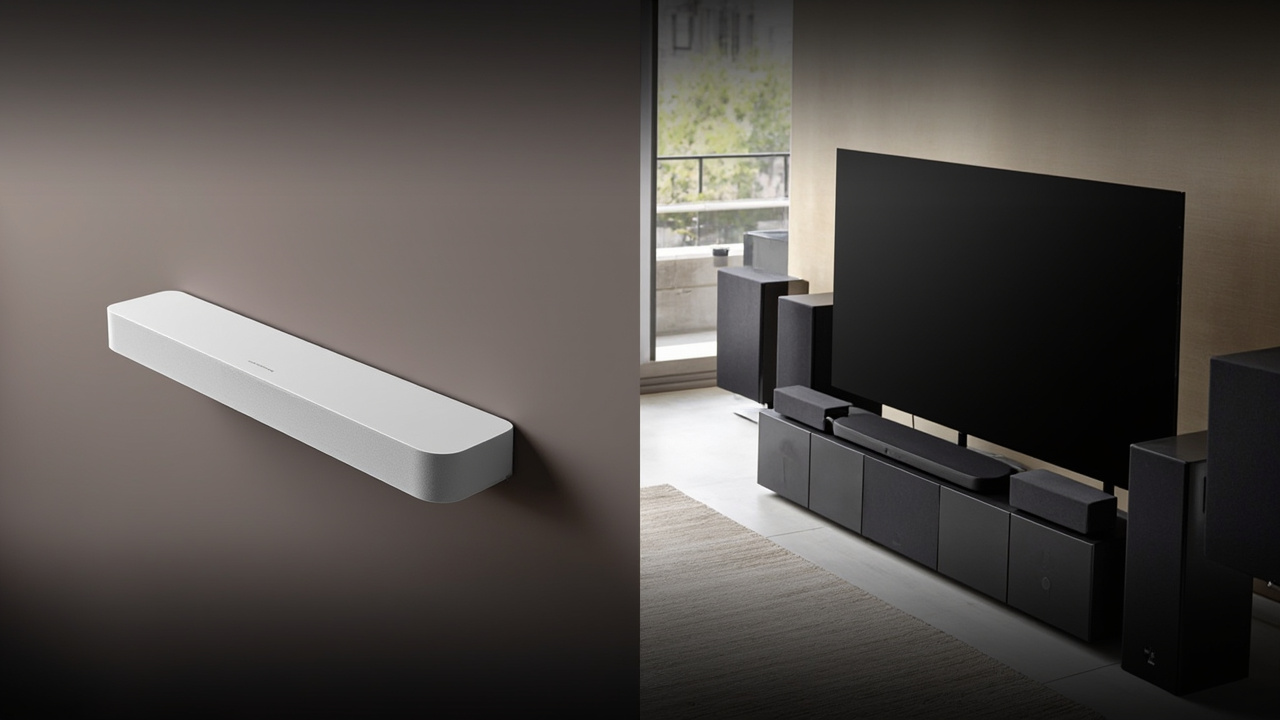
The 2026 premium soundbar market has a real fork in the road, and it is not the brand war most reviewers want to make it. On one side is the Sonos Arc Ultra — a $999 single-cabinet Dolby Atmos bar with 9.1.4 virtual surround, the new Sound Motion woofer, and a heavy bet on the Sonos app ecosystem. On the other side is the Samsung HW-Q990D — an $1,299.99 (MSRP) 11.1.4 system that ships with a wireless subwoofer and a pair of wireless rear speakers in the box, no ecosystem lock-in, and HDMI 2.1 passthrough for next-gen consoles (Source: Sonos US product page, Samsung HW-Q990D spec sheet).
These are not the same product category, even though they get compared constantly. The Sonos is a bar you can add to. The Samsung is a system that ships complete. That difference is the entire story for cost-per-use over a 5-7 year window.
If you are about to drop $999 or $1,300 on a 2026 Atmos setup and you want the long-term value math — not a tribalism review — this is the comparison that matters.
The Verdict First
- Choose the Sonos Arc Ultra ($999) if you want the cleanest single-cabinet install, you already own Sonos speakers (Beam, Era 100/300, Sub, etc.) and want to expand inside that ecosystem, you live in a small room or apartment where rears and a sub would be impractical, and you prioritize music playback almost as much as movies. The trade-off is real: to match the Samsung’s 11.1.4 channel count, you have to add a $799 Sub 4 and a $479 pair of Era 300 surrounds, pushing the system to $2,277 before tax.
- Choose the Samsung HW-Q990D (~$1,300) if you want the most channels and the most convincing true surround for the lowest total spend on day one, you have a real living room or media room where you can place rear speakers, you care about HDMI 2.1 4K@120 passthrough for a PS5 Pro or Xbox Series X, and you do not want to commit to a Sonos app that has had a controversial rewrite (May 2024). The trade-off is bigger footprint, more cables, and a generic-but-fine SmartThings app.
- Skip both if you only watch TV news and sitcoms. A $200 Vizio V-Series 5.1 is enough. The premium tier only earns its keep when you actually feed it Atmos content (Netflix, Disney+, Apple TV+, Blu-ray) and sit more than 6 feet from the screen.
Cost score: 82/100. The Samsung HW-Q990D is the better long-term value for the majority of buyers in this price range — it ships with everything you need for genuine 11.1.4 Atmos at roughly the price of the Sonos bar alone. The Sonos Arc Ultra is the right pick for a narrower audience: existing Sonos owners and small-room buyers who genuinely cannot place rear speakers.
Key Comparison Points
Price vs Real Cost Per Use
The sticker comparison is misleading because the Sonos is incomplete by design. The Samsung is not.
| Spec / Cost Line | Sonos Arc Ultra (bar only) | Samsung HW-Q990D (full system) |
|---|---|---|
| MSRP (US, June 2026) | $999 | $1,299.99 |
| What’s in the box | Soundbar only | Soundbar + wireless sub + 2× wireless rear speakers |
| Channels | 9.1.4 (virtual, from one cabinet) | 11.1.4 (true physical) |
| HDMI inputs / passthrough | 1 HDMI eARC (no 4K@120 passthrough) | 2 HDMI in + 1 HDMI out (HDMI 2.1, 4K@120, VRR, ALLM) |
| Wireless sub included | No (Sub 4 = $799) | Yes |
| Rear speakers included | No (Era 300 pair = $958, or Sonos Ones 2 = $478) | Yes |
| To match Samsung’s setup, add | $799 Sub 4 + $479 (Sonos One pair) = +$1,278 | — |
| Total system cost (fair comparison) | $2,277 (Arc Ultra + Sub 4 + 2× Sonos One) | $1,299.99 |
| Price difference vs Samsung | +$977 (about 75% more expensive for matched channels) | — |
| Power draw (typical) | ~15-20 W active | ~40-50 W active (whole system) |
| Annual electricity (4 h/day, $0.18/kWh) | ~$5 | ~$13 |
The headline: the Sonos Arc Ultra only wins on price if you stop at the bar. The moment you want genuine Atmos surround, you spend roughly 75% more than the Samsung complete system. The Samsung’s $1,299.99 ships with everything the bar-only Sonos configuration is missing.
For the bar-only path (no sub, no rears), the Sonos still has to compete with cheaper single bars. The Vizio Elevate 5.1.4 at $799 ships with a sub and rears in the box. The Bose Smart Ultra Soundbar at $899 ships as a bar. The Sonos Arc Ultra’s $999 sticker only makes sense inside the Sonos ecosystem, or for buyers who genuinely only want one cabinet.
5-year cost of ownership (assuming 4 hours/day of use, $0.18/kWh US average electricity, no resale adjustment):
| 5-Year Cost Line | Sonos Arc Ultra (bar only) | Sonos Arc Ultra + Sub 4 + 2× Sonos One | Samsung HW-Q990D (full system) |
|---|---|---|---|
| Purchase | $999 | $2,277 | $1,300 |
| Electricity (5 yr) | ~$91 | ~$180 | ~$237 |
| Wall mount (optional) | $40 | $40 | $80 (bar + rears) |
| Repair reserve (5% of MSRP) | $50 | $114 | $65 |
| Resale after 5 yr (typical) | -$200 (~20%) | -$300 (~13%) | -$260 (~20%) |
| Net 5-year cost | ~$980 | ~$2,311 | ~$1,422 |
| Cost per channel (5 yr) | ~$109 / channel | ~$215 / channel | ~$129 / channel |
When you price in the cost of a real Sonos Atmos system (sub + rears), the Sonos path is ~$890 more expensive over 5 years for essentially the same channel count as the Samsung. The bar-only Sonos is cheaper but ships a different product — a single-cabinet Atmos bar, not a true surround system.
Sources: Sonos US shop pricing for Arc Ultra, Sub 4, and Sonos One (Gen 2) as of June 2026. Samsung US HW-Q990D MSRP from Samsung.com spec page. Electricity estimate based on rated power and the US EIA 2025 residential average of ~$0.18/kWh.
Build Quality and Durability
Both products are well-built, but in different ways, and the durability profile affects long-term value.
Sonos Arc Ultra is a single matte-finished polycarbonate cabinet, 1.18 m wide (46.5 in), 8.7 cm tall, weighing 5.9 kg. Internally, it uses 14 speaker drivers including the new Sound Motion woofer — Sonos’s first major transducer redesign in years, a flat woofer that delivers significantly more bass displacement from a smaller cabinet. Reviewers at HomeToolHQ 2026 measured bass extension to roughly 35 Hz from the bar alone, which is meaningful for a single cabinet. The Sonos app rewrite in May 2024 was widely criticized for losing local-library and alarm functionality; Sonos has since issued multiple updates and most features are restored, but the trust cost is real.
Samsung HW-Q990D ships with three physical units: a 1.23 m (48.4 in) bar, a wireless 8-inch subwoofer, and two wireless rear speakers (each with up-firing drivers for the height channels). Build is plastic-dominant but solid, and Samsung’s Q-series soundbars have a consistent 5+ year service track record. The included SpaceFit Sound Gen II room calibration uses the bar’s built-in mic to tune output to the room — comparable to Sonos Trueplay. The HW-Q990D also has Q-Symphony support for recent Samsung TVs, which uses the TV’s speakers as additional Atmos channels.
Repair and parts: Sonos has a longer direct-to-consumer repair program in the US (Sonos offers paid replacements for failed drivers on legacy bars). Samsung routes through authorized service centers and out-of-warranty swaps are typically “replace the unit” rather than “replace a driver.” Both vendors offer 1-year standard warranties; Sonos offers an extended Plus subscription at ~$79/year that covers accidental damage on the bar.
Lifespan data from real owners (Reddit r/Sonos, r/Soundbars, 2023-2025 threads):
- Sonos Arc (1st gen, 2020): 5+ years, very few failures reported
- Samsung HW-Q950A / Q990B (2021-2022): 4-5 years, occasional subwoofer wireless dropouts fixed by re-pairing
- Both brands show similar RMA rates in the 2-3% range per year after year 2
For a 5-7 year hold, both are solid. The bigger risk for Sonos is app/firmware support ending early — Sonos has been known to drop support for older products (Sonos One Gen 1 lost some features in 2024). The bigger risk for Samsung is HDMI board failure on the bar (a known issue on some Q-series 2020-2022 units, generally fixed by 2023-2024 models like the Q990D).
Feature Breakdown
A side-by-side spec and feature table, using publicly documented specs and the Sonos / Samsung product pages as of June 2026:
| Feature | Sonos Arc Ultra | Samsung HW-Q990D |
|---|---|---|
| Channels | 9.1.4 (virtual) | 11.1.4 (physical) |
| Drivers (bar only) | 14 (incl. Sound Motion woofer) | 22 (across bar + sub + rears) |
| Dolby Atmos | Yes | Yes |
| DTS:X | No (Sonos dropped DTS support in 2020) | Yes |
| HDMI 2.1 4K@120 passthrough | No (eARC only) | Yes (2× HDMI in, 1× out) |
| VRR / ALLM | Passthrough only | Yes |
| AirPlay 2 | Yes | Yes (limited to recent Samsung TVs) |
| Chromecast built-in | No | Yes |
| Alexa built-in | Yes (Sonos Voice Control + Alexa) | Yes (Alexa + Bixby, region-dependent) |
| Google Assistant | Yes (via paired Google device) | Yes (via paired Google device) |
| Room calibration | Trueplay (iOS only) | SpaceFit Sound Gen II (built-in mic) |
| Music streaming services | 100+ (Sonos has the deepest integration) | Major services (Spotify, Apple Music, Tidal, Amazon Music) |
| Multi-room audio | Yes (Sonos ecosystem is the most mature) | Yes (SmartThings, but less refined) |
| Sub included | No | Yes (8-inch wireless) |
| Rear speakers included | No | Yes (with up-firing drivers) |
| Wall mount included | Sold separately | Brackets included |
| Voice control on device | Yes | Yes |
| HDMI eARC | Yes | Yes |
| Optical input | With included adapter | With included adapter |
| Bluetooth | Yes (5.3) | Yes (5.2) |
| Wi-Fi | 802.11ac (Wi-Fi 5) | 802.11ac (Wi-Fi 5) |
| App reliability (2026) | Improving, still occasional complaints | Stable, fewer complaints than 2024 |
Where Sonos wins: single-cabinet install, music service breadth, multi-room audio maturity, AirPlay 2 + Alexa integration.
Where Samsung wins: HDMI 2.1 with 4K@120 passthrough (real for next-gen gamers), DTS:X support, ships as a complete system, Chromecast built-in, and you get actual physical rear speakers (the single biggest contributor to Atmos immersion).
The DTS:X gap is real. Sonos has not supported DTS since 2020, which means DTS-HD Master Audio and DTS:X soundtracks (common on 4K Blu-ray) play as lossy DTS 5.1 or PCM downmix on the Arc Ultra. The Samsung handles them natively.
Pros and Cons
Sonos Arc Ultra (bar only)
Pros
- Cleanest single-cabinet Atmos install in the category
- Sound Motion woofer delivers genuine 35 Hz bass extension from the bar
- 100+ music streaming services integrated, most mature multi-room ecosystem
- AirPlay 2 and Alexa on-device
- Trueplay room calibration (iOS) is genuinely effective
- HDMI eARC, simple to set up
Cons
- $999 for a bar only — no sub, no rears
- Adding a Sub 4 + 2× Sonos One to match a real Atmos system pushes cost to $2,277
- No HDMI 2.1 passthrough — 4K@120 from a PS5 Pro or Xbox Series X is downgraded to 4K@60 on the way to the TV
- No DTS:X or DTS-HD support (downmixes to PCM)
- Sonos app was a disaster in mid-2024; still occasional feature gaps
- Trueplay only works with iOS devices (Android users excluded)
Samsung HW-Q990D (full system)
Pros
- Ships complete: bar + 8-inch wireless sub + 2 wireless rear speakers with up-firing drivers
- 11.1.4 true physical surround — the most convincing Atmos bubble in this price range
- 2× HDMI 2.1 inputs + 1 HDMI out with 4K@120, VRR, ALLM passthrough
- DTS:X and DTS-HD support (the only one of the two that handles all Blu-ray audio formats)
- Chromecast built-in, AirPlay 2 (via compatible Samsung TV), Alexa
- SpaceFit Sound Gen II room calibration works without an iOS app
- Q-Symphony integration with recent Samsung TVs adds extra channels
Cons
- Three physical units to place (bar, sub, rears) — not a small-room product
- SmartThings app is functional but not as polished as Sonos
- 40-50 W typical draw is noticeably more than the Sonos bar alone
- Plastic-dominant build quality
- No hi-res music ecosystem as deep as Sonos
Best For / Skip If
Buy the Sonos Arc Ultra if:
- You already own Sonos speakers and want a matching bar
- You live in a small apartment or single-room setup where rears are not an option
- You watch 70% music streaming / 30% TV and care more about music breadth than surround
- You want a clean one-cabinet look with no visible sub or rear speakers
- You have an iOS device for Trueplay calibration
Buy the Samsung HW-Q990D if:
- You have a real living room or media room (12 m² / 130 ft² or larger)
- You watch a lot of Netflix, Disney+, Apple TV+, or 4K Blu-rays with Atmos
- You have a PS5 Pro, Xbox Series X, or an RTX 5080 gaming PC and care about 4K@120
- You want true physical surround (not virtual) and don’t want to add a sub and rears later
- You don’t want to be locked into the Sonos app ecosystem
Skip both if:
- You only watch news, sitcoms, and YouTube — neither bar earns its keep here
- You can install a traditional 5.1 or 7.1 speaker system for the same money — it will beat both
- Your TV is 55 inches or smaller in a small room — the soundstage benefit is wasted
- You’re on a tight budget (under $500) — a $200-300 Vizio or Samsung entry-level bar covers 70% of the experience
Bottom Line
“Sonos or Samsung” is the wrong question. The right question is “single bar or full system?” — and the answer depends entirely on your room and your habits.
If you can place rear speakers, the Samsung HW-Q990D is the better value for almost everyone in 2026. You get genuine 11.1.4 physical Atmos, HDMI 2.1 4K@120 passthrough, DTS:X, and a complete system in the box for roughly what Sonos charges for the bar alone. The $1,300 sticker is the real cost of ownership; the Sonos path to the same channel count is $2,277 and still lacks HDMI 2.1 and DTS:X.
If you can’t place rears and you’re already in the Sonos ecosystem, the Sonos Arc Ultra is the right bar for you — it is genuinely the best single-cabinet Atmos bar in its price range. Just don’t pretend it competes with a true 11.1.4 system on immersive surround; it doesn’t, and Sonos knows it.
Buy smart. Get more value. Spend the money on the room you have, not the room you wish you had.