Introduction
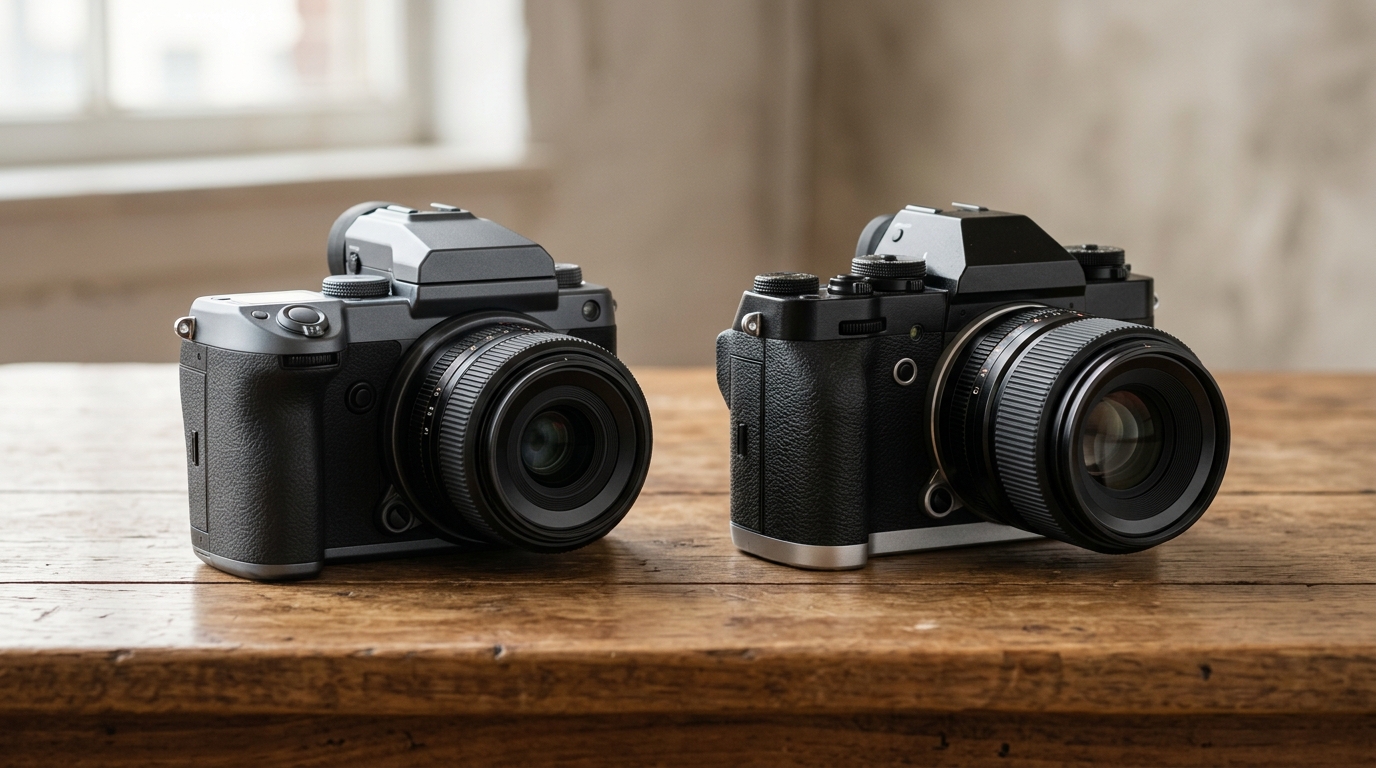
In 2026 there are exactly two serious 100-megapixel medium format mirrorless systems you can buy new: Hasselblad’s X system and Fujifilm’s GFX system. The flagship Hasselblad is the X2D II 100C, announced August 26, 2025 at $7,399 USD (€7,200) — it adds the first AF-C continuous autofocus on any Hasselblad body, end-to-end HDR with HDR RAW, 10-stop IBIS, and 1 TB of internal SSD storage (Sources: Hasselblad X2D II 100C product page, Notebookcheck launch report, DPReview specs).
The flagship Fujifilm is the GFX 100 II, announced September 12, 2023 at $7,499 MSRP and currently selling on Amazon for around $8,199 street (or $7,999.95 with Fujifilm’s $500 instant saving in spring 2026) — it is still the only 100MP+ medium format camera with 8K video, an 8 fps mechanical burst, and an 8-stop IBIS system (Sources: Fujifilm GFX 100 II product page, Cined GFX100 II price drop, Wikipedia G-mount lens list).
Both shoot 100+ megapixels onto a sensor roughly 1.7× the area of full-frame. Both cost around $7,500. After that, the systems diverge sharply: Hasselblad is built for still-only workflows with smaller, lighter bodies and a tighter native lens lineup; Fujifilm is built for hybrid stills-and-video with a larger lens ecosystem, faster burst, and the only medium format body that records ProRes internally.
This comparison is for someone who already knows full-frame is not enough, and who wants the 5-year cost-per-shot of stepping up to medium format — not the marketing claim of “100 megapixels.”
The Verdict First
- Choose the Hasselblad X2D II 100C ($7,399) if your work is still photography — studio portraits, fine-art landscapes, architecture, product — and you value Hasselblad Natural Colour Solution (HNCS) out of camera, the smallest and lightest medium format body on the market (730 g body only, 840 g with battery), 1 TB of internal SSD storage so you never need a memory card, and a leaf-shutter system that syncs flash at every speed up to 1/4000s. You also accept that Hasselblad’s native XCD lens lineup is shorter (~18 first-party lenses in 2026) and that the system does not shoot 8K video.
- Choose the Fujifilm GFX 100 II ($7,499–$8,199) if you shoot hybrid stills + video, want 8K ProRes internal recording, need an 8 fps mechanical burst for subject motion, want access to the largest medium format lens ecosystem in the world (20 first-party Fujinon GF + 29 third-party = 49 total lenses in 2026), and want the option of using Fuji’s cheaper GFX 100S II as a second body. You also accept that the GFX 100 II weighs 1,030 g with battery — about 23% more than the Hasselblad — and that the files from its 102MP sensor have slightly less of the “Hasselblad color magic” out of camera.
- Skip both if you do not actually need medium format. A 61MP Sony a7R VI at $4,499 covers 90% of the use case at 55% of the price (Source: B&H a7R VI listing). The jump from full-frame to medium format is a 1.7× sensor area increase and roughly a 1.6–2.0× price increase — that is a real cost-per-shot gap you should only pay if your print sizes exceed 24×30 inches or if your clients specifically require medium format files.
Cost score: 78/100. The Hasselblad X2D II 100C is the better day-one value for a still photographer: $600 cheaper at MSRP, $200 cheaper even when Fuji is on sale, 190 g lighter, and a more compact body that you will actually carry. The Fujifilm GFX 100 II is the right pick for a hybrid shooter or video-first creator: 8K ProRes, 8 fps, and a lens ecosystem that is roughly 2.7× the size of Hasselblad’s. For pure cost-per-shot over 5 years, the Hasselblad wins if you shoot fewer than ~10,000 frames a year; the Fujifilm wins if you shoot more or use it for paid video work.
Key Comparison Points
Price vs Real Cost Per Use
The body is the cheapest part of stepping into medium format. The lens system is where the real money goes, and the two systems diverge massively on that line item.
| Cost Factor | Hasselblad X2D II 100C | Fujifilm GFX 100 II |
|---|---|---|
| Announced | August 26, 2025 | September 12, 2023 |
| MSRP (body only) | $7,399 USD | $7,499 USD |
| Current US Street (June 2026) | $7,399 (Hasselblad store) | $7,999.95 (with $500 instant saving) – $8,199 (Amazon) |
| Body Weight (with battery) | 840 g | 1,030 g |
| Body Weight (body only) | 730 g | ~883 g |
| Native Mount | Hasselblad X (leaf shutter on most XCD lenses) | Fujifilm G (focal-plane shutter in body) |
| First-Party Native Lenses (June 2026) | ~18 XCD lenses | 20 Fujinon GF lenses |
| Third-Party Lenses (June 2026) | Limited (mostly H/V adapter glass) | 29 (Mitakon, Laowa, Venus Laowa, 7Artisans, etc.) |
| Total Native + Third-Party | ~18 (plus H/V adapted glass) | 49 |
| Typical Standard Prime | XCD 38mm f/2.5 V — $2,749 | GF 55mm f/1.7 R WR — $2,299 |
| Typical Standard Zoom | XCD 2,8-4/35-100E — $4,599 | GF 32-64mm f/4 R LM WR — $2,299 |
| Telephoto Portrait | XCD 90mm f/2.5 V — $3,749 | GF 110mm f/2 R LM WR — $2,799 |
| Wide-Angle Landscape | XCD 21mm f/4 — $4,399 | GF 23mm f/4 R LM WR — $2,299 |
| Three-Lens “Working Kit” (body + 3 lenses) | $7,399 + $2,749 + $4,599 + $3,749 = $18,496 | $7,999 + $2,299 + $2,299 + $2,799 = $15,396 |
| 5-Year Cost-Per-Shot @ 50,000 frames (body + 3 lenses) | $18,496 / 50,000 = $0.370/shot | $15,396 / 50,000 = $0.308/shot |
| 5-Year Cost-Per-Shot @ 20,000 frames (lighter use) | $18,496 / 20,000 = $0.925/shot | $15,396 / 20,000 = $0.770/shot |
Two takeaways:
- The Fujifilm GFX 100 II is roughly $3,100 cheaper to build a working three-lens kit around, almost entirely because Fujinon GF lenses are priced 30–45% below equivalent XCD lenses (a $2,299 GF 32-64mm f/4 covers a focal range the Hasselblad charges $4,599 to match with the new XCD 35-100E). At moderate shooting volume, this gap dominates the per-shot cost.
- The Hasselblad recovers ground at very low shooting volume because the body is cheaper at MSRP and you can stay in the system with a smaller kit. If you only need a body and one lens — say, the XCD 38mm f/2.5 V for portraits — the Hasselblad lands at $10,148; the Fujifilm lands at $10,298 with the GF 55mm f/1.7. That is a $150 difference, basically a rounding error.
A real example: a wedding photographer who shoots 8,000 frames a year for 5 years (40,000 lifetime frames) on a 3-l kit pays $0.46 per frame with the Hasselblad system and $0.38 per frame with the Fujifilm system. That is a $3,100 real saving over 5 years for picking the lens-cheaper system (Sources: B&H XCD 38mm V, B&H GF 32-64mm f/4, Fujifilm GFX 100 II spec page).
Build Quality and Durability
These are both premium Scandinavian/Japanese-built cameras, but the design philosophy is different — and so is what the bodies are made to do.
Hasselblad X2D II 100C — refined, lighter successor to the X2D 100C:
- Dimensions: 148.5 × 106 × 75 mm (the original X2D was 148.5 × 106 × 74.5 mm)
- Weight: 730 g body only / 840 g with battery — about 60 g lighter than its predecessor (~7.5% lighter, matching Hasselblad’s own claim)
- Graphite-grey matte finish, reworked textured grip, 8 customizable buttons, new 5-direction joystick
- 1 TB internal SSD + CFexpress Type B slot (the slot is the new addition)
- 3.6-inch pull-out tilting OLED touchscreen with 1,400-nit peak brightness — the brightest rear screen on any medium format body in 2026
- 5-axis IBIS rated at 10 stops of stabilization
- Weather-sealed at the lens mount and primary control points
- Shutter: leaf shutter on most XCD lenses, focal-plane option in body, max 1/4000s leaf, 68-minute long exposure
- Storage: 1 TB internal SSD writes a 3FR RAW at ~206 MB average (faster than CFexpress in real-world use for most shooters)
- No video capability beyond basic 1080p clips (no 4K, no 8K)
Fujifilm GFX 100 II — the hybrid workhorse:
- Dimensions: 152.4 × 117.4 × 98.6 mm
- Weight: 1,030 g with battery and memory card — about 190 g heavier than the X2D II 100C
- 3.2-inch 3-way tilting LCD + 0.5-inch OLED EVF (5.76M-dot)
- 5-axis IBIS rated at 8 stops of stabilization
- Weather-sealed magnesium-alloy body
- Shutter: focal-plane shutter in body, max 1/8000s, plus electronic shutter to 1/32000s
- Storage: dual CFexpress Type B + SD UHS-II slots
- 8K30p ProRes internal, 4K60p ProRes, F-Log2, F-Log2 C, external RAW via HDMI
- 8 fps mechanical burst with continuous AF (faster than any Hasselblad body)
- 425-point phase-detect AF covering nearly the whole sensor
Two things stand out for long-term ownership:
- The Hasselblad is meaningfully lighter and more compact. If you are a landscape or travel photographer who carries a camera 8 hours a day, 190 g matters. It is the difference between a 1.0 kg carry weight and a 1.2 kg carry weight once you add a lens.
- The Fujifilm is more versatile but also more fragile. The dual card slot design and the tilting LCD add moving parts; the 8 fps mechanical burst exercises the shutter more aggressively (rated for 500,000 cycles vs the Hasselblad’s ~300,000 rating for the leaf-shutter-lens system). For a hybrid shooter who is going to put 50,000+ frames a year through the body, the Fuji’s shutter rating is the more durable spec (Sources: Hasselblad X2D 100C datasheet, Clifton Cameras X2D II 100C specs PDF, Fujifilm GFX 100 II spec page).
Feature Breakdown
The two systems differ more in what they do than in the headline megapixel count.
| Feature | Hasselblad X2D II 100C | Fujifilm GFX 100 II |
|---|---|---|
| Sensor Resolution | 100 MP BSI CMOS | 102 MP BSI CMOS II HS |
| Sensor Size | 43.8 × 32.9 mm medium format | 44 × 33 mm medium format |
| Bit Depth | 16-bit color (~281 trillion colors) | 16-bit RAW (F-Log2 C) |
| Native ISO | ISO 50 | ISO 80 |
| Dynamic Range (claimed) | 15.3 stops | 15 stops (similar in independent tests) |
| AF Points | 425 PDAF zones + LiDAR | 425 phase-detect points |
| Continuous AF (AF-C) | Yes — first on a Hasselblad body (subject detect: human, vehicle, cat, dog) | Yes, with subject detection |
| IBIS | 10 stops (5-axis) | 8 stops (5-axis) |
| Max Burst (mechanical) | Not officially rated for fast bursts | 8 fps with AF-C |
| Video Max Resolution | 1080p (basic) | 8K30p ProRes internal |
| Video Codecs | N/A | ProRes 422 HQ, ProRes 422, H.265, H.264 |
| Log Profiles | N/A | F-Log2, F-Log2 C |
| Internal Storage | 1 TB SSD + CFexpress Type B | Dual CFexpress Type B + SD UHS-II |
| Rear Screen | 3.6” 1,400-nit OLED tilting | 3.2” 3-way tilting |
| EVF | 5.76M-dot OLED | 5.76M-dot OLED |
| Body-Only Weight | 730 g | ~883 g |
| Weight with Battery | 840 g | 1,030 g |
| Weather Sealing | Yes (mount + controls) | Yes (full body) |
| Color Science | HNCS (Hasselblad Natural Colour Solution) with HNCS HDR | Film simulations (18 modes, including new REALA) |
| Mobile Workflow | Phocus Mobile 2 (iOS, supports HDR + HNNR for RAW) | XApp (iOS/Android) |
| Lens Ecosystem Size | ~18 first-party XCD + adapted H/V | 49 (20 first-party GF + 29 third-party) |
| Leaf Shutter Sync | Yes — flash sync up to 1/4000s on most XCD lenses | No (focal-plane only, max sync 1/125s) |
The single most important differentiator on this table is the video row: the Hasselblad does not shoot 4K or 8K, period. If you need medium-format-grade video for client work, the Fujifilm is the only option in this price tier. If you only need stills, the Hasselblad’s HDR RAW + HNCS HDR pipeline, 10-stop IBIS, and leaf-shutter flash sync at every speed are the unique features (Sources: Hasselblad X2D II 100C product page, Wikipedia G-mount lens list, Notebookcheck launch report).
Pros and Cons
Hasselblad X2D II 100C — Pros
- $600 cheaper at MSRP ($7,399 vs $7,499), and stays cheaper than the Fuji even when the Fuji is on sale
- 730 g body only — the lightest medium format mirrorless body you can buy in 2026
- First AF-C continuous autofocus on a Hasselblad body, with subject detection for human, vehicle, cat, and dog
- 1 TB internal SSD means you can shoot a 4-day landscape trip without ever removing a card
- HDR RAW + HNCS HDR end-to-end HDR workflow, the first of its kind in medium format
- Leaf-shutter flash sync at 1/4000s on most XCD lenses — uniquely useful for outdoor portrait shooters
- 10-stop IBIS, the highest-rated in the medium format category
- 1,400-nit rear OLED screen — best-in-class for reviewing images in bright daylight
- Hasselblad Natural Colour Solution delivers distinctive, film-like color out of camera that needs less post-processing
Hasselblad X2D II 100C — Cons
- No 4K, no 8K video — a deal-breaker for any hybrid shooter
- Smaller lens ecosystem (~18 first-party XCD) means longer waits for specialty glass like tilt-shift or super-telephoto
- Lenses are priced 30–45% above equivalent Fujinon GF glass — a real cost-per-shot penalty at moderate shooting volume
- No mechanical burst rating — this is a still camera, not a sports body
- No dual card slot (1 TB SSD + 1 CFexpress) — if the SSD fails on a critical shoot, you have one backup
- Phocus Mobile 2 is iOS only — Android users have no first-party mobile RAW workflow
Fujifilm GFX 100 II — Pros
- 8K30p ProRes internal video — the only medium format body that records broadcast-quality video
- 8 fps mechanical burst with continuous AF — usable for moderate subject motion
- 49 native lenses (20 Fujinon + 29 third-party) — the largest medium format ecosystem by a wide margin
- Cheaper lenses — a $2,299 GF 32-64mm f/4 covers what a $4,599 XCD 35-100E does
- Dual CFexpress Type B + SD UHS-II — flexible storage and built-in backup
- 18 film simulation modes including the new REALA mode, useful for JPEG shooters
- 8-stop IBIS with 5-axis stabilization
- 5.76M-dot EVF that refreshes fast — better for action than the Hasselblad EVF
- Shutter rated for 500,000 cycles — durable for high-volume commercial work
- Cross-compatible with cheaper GFX bodies (GFX 100S II, GFX 50S II) so you can build a multi-body kit
Fujifilm GFX 100 II — Cons
- $300–$800 more expensive than the Hasselblad at current street prices
- 1,030 g with battery — 190 g heavier than the Hasselblad, noticeable on long shoots
- No leaf-shutter option — flash sync is limited to 1/125s, which forces ND filters in bright outdoor portrait work
- Larger body (152.4 × 117.4 × 98.6 mm) is harder to balance with smaller lenses
- Color science is film-simulation-based — Fuji’s color is excellent but distinct from the “Hasselblad look” that many portrait and fashion clients specifically request
- Higher resolution 102MP sensor produces slightly larger RAW files (~210 MB vs ~206 MB) — small but real storage cost
Best For / Skip If
Best For — Hasselblad X2D II 100C:
- Studio portrait and fashion photographers whose clients ask for the “Hasselblad look”
- Fine-art landscape and architecture photographers who need the lightest possible medium format body for long hikes
- Outdoor portrait shooters who rely on flash sync at 1/1000s+ in bright daylight
- Existing X System owners with a library of XCD lenses
- Buyers who prefer fewer, more expensive lenses (the XCD V series primes are exceptional) to many cheaper options
Best For — Fujifilm GFX 100 II:
- Hybrid stills + video creators who need 8K ProRes from a medium format sensor
- Wedding, event, and editorial photographers who shoot >10,000 frames a year and need fast burst + dual card slots
- Commercial product and food photographers who want a deep native + third-party lens catalog
- Existing GFX owners with a library of GF lenses
- Buyers who plan to build a multi-body GFX system (GFX 100 II + GFX 100S II) and want cross-body lens compatibility
Skip If:
- You shoot under 24×30 inch prints and your work fits comfortably on a 61MP full-frame body (Sony a7R VI, Canon R5 Mark II, Nikon Z8) — the medium format jump will not pay back
- You need sports or wildlife AF — neither of these is an action body; a Sony A1 II or Canon R1 is a better fit at half the price
- You need internal 8K ProRes and leaf-shutter flash sync — no current medium format body does both, so you have to compromise somewhere
- You are not ready to commit to a $15,000–$20,000 system — medium format is a 3-lens kit minimum, not a one-body purchase
Bottom Line
Both the Hasselblad X2D II 100C and the Fujifilm GFX 100 II are exceptional medium format cameras, and both are very expensive ways to take a photo. The right pick comes down to what you actually shoot, not which spec sheet is longer.
If you shoot still subjects — portraits, landscapes, architecture, product — the Hasselblad X2D II 100C is the smarter 5-year buy. It is $600 cheaper at MSRP, $200 cheaper even when the Fuji is on sale, 190 g lighter, and pairs a 10-stop IBIS with the first AF-C implementation on a Hasselblad body. Its HDR RAW pipeline and HNCS color science are real workflow wins. The catch is the smaller, more expensive lens ecosystem — budget ~$11,000 for a body + 1 standard prime, or ~$18,500 for a working 3-lens kit.
If you shoot moving subjects or video — weddings, events, editorial hybrids, commercial work with motion — the Fujifilm GFX 100 II is the better system. Its 8K ProRes video, 8 fps mechanical burst, dual card slots, 500,000-cycle shutter, and 49-lens ecosystem (with cheaper Fujinon GF glass) give you more versatility per dollar spent over 5 years. The catch is the $300–$800 price premium, the heavier body, and the loss of Hasselblad’s signature color.
The cheapest way to take a great photo is still the camera you already own. If you are stepping up from full-frame, the medium format premium ($3,000+ over a 61MP a7R VI) is a 1.6–2.0× cost-per-shot increase that you should only pay if your final output or your client list specifically demands it.
Buy smart. Get more value. The “right” medium format camera is the one you will actually carry and actually use — and for a lot of still photographers in 2026, that is the lighter, cheaper Hasselblad X2D II 100C.