Introduction
If you are shopping the high-resolution end of the full-frame mirrorless market in 2026, two cameras now sit at the center of every “best of” list and every Reddit thread that isn’t pushing you toward a Sony A1 II or a Nikon Z8:
- Sony α7R VI (model ILCE-7RM6) — released May 13, 2026, body-only at USD 4,498–$4,499 at B&H and Sony USA as of June 2026. Sony’s first fully-stacked 66.8 MP sensor, 30 fps electronic burst, 8K 30p video, and a redesigned body with the new BIONZ XR2 processor. Aimed squarely at studio, landscape, architecture, and high-end portrait pros who refused to give up resolution for speed.
- Canon EOS R5 Mark II — released August 20, 2024, body-only at USD 4,299 at B&H and Canon USA in June 2026. 45 MP stacked BSI CMOS, 30 fps electronic burst, 8K 60p internal RAW, active cooling, and the most mature RF lens system on the market. Canon’s flagship hybrid aimed at working event, wedding, editorial, and content pros.
The list-price gap is exactly $199–$200 — narrow enough to be ignored on body price alone, but wide enough in real-world behavior, lens system maturity, and total cost of ownership to decide which body actually saves you money over the 5 to 7 years you will own it.
Both bodies shoot 8K. Both hit 30 fps with the electronic shutter. Both have stacked BSI sensors. Both have AI subject-detect autofocus. Both weather-seal magnesium-alloy chassis. The interesting question is not which one is “better.” It is which one pays you back more per shoot over the 5 to 7 years you will actually own it — and that depends almost entirely on whether you need 66.8 MP of resolution or 45 MP of all-around speed, and which lens system you are willing to commit to.
- Pick the Sony A7R VI ($4,499) if you are a studio, landscape, architecture, or commercial still-life shooter who needs 66.8 MP of resolution, 8K 30p oversampled video, 16 stops of dynamic range for heavy shadow recovery, and a body that can also act as a 30 fps sports camera when you need it to. The A7R VI is the first Sony R-series body where you no longer trade speed for resolution.
- Pick the Canon R5 Mark II ($4,299) if you shoot people-first work (events, weddings, portraits, editorial, news), want the most mature RF lens lineup, need 8K 60p internal RAW with active cooling for long hybrid takes, and care more about color science, in-body ergonomics, and 5-year cost of ownership than absolute resolution. The R5 Mark II is the smarter buy for the majority of working pros in 2026.
Cost score: 80/100. Neither camera is a value pick — they are both flagships. The Canon R5 Mark II is the slightly better value because the body is $200 cheaper, the RF lens system is now 7+ years mature, and the camera holds resale value better on the used market. The Sony A7R VI is the better tool if you genuinely need what it does that the R5 Mark II does not — and that is a real “if,” because 66.8 MP is not a small difference.
Key Comparison Points
Price vs Real Cost Per Use
Sticker price is the least interesting number on a flagship body. What matters is body + the lenses you will actually buy + the cards and batteries you will cycle through divided by the years and shoots you will use it.
| Item | Sony α7R VI | Canon EOS R5 Mark II |
|---|---|---|
| MSRP at launch | $4,499 (May 2026) | $4,299 (Aug 2024) |
| Current new body (Jun 2026) | $4,498–$4,499 (B&H / Sony USA) | $4,299 (B&H / Canon USA) |
| Current used body | n/a (just shipping) | from ~$3,499 |
| Sensor | 66.8 MP fully stacked Exmor RS BSI CMOS | 45.0 MP stacked BSI CMOS |
| Mechanical burst | 10 fps | 12 fps |
| Electronic burst | 30 fps, 14-bit RAW | 30 fps, 14-bit RAW |
| Max video | 8K 30p (1.2x crop), 4K 120p, 1080p 240p | 8K 60p RAW internal, 4K 120p |
| IBIS (CIPA, manufacturer claim) | up to 8.5 stops (center) | up to 8.5 stops (center) |
| EVF | 0.64” 9.44M-dot OLED, 240 Hz | 0.5” 5.76M-dot OLED, 120 Hz |
| Card slots | 2x CFexpress 2.0 Type A / SD UHS-II combo | 1x CFexpress Type B / 1x SD UHS-II |
| Battery | NP-FZ100 successor (Z-series, larger) | LP-E6P / LP-E6NH / LP-E6N (Canon) |
| Body weight (with battery & card) | ~723 g (preliminary) | 746 g |
| Body-only 5-year TCO estimate (body + 3 lenses + 2 cards + 2 batteries, after 5-year resale) | ~$10,800 | ~$9,900 |
Sources: Sony press release (May 13, 2026), B&H Photo, Canon USA, DPReview, TechRadar, PCMag, Daily Camera News (June 2026).
At the body-only level, the A7R VI is $200 more expensive than the R5 Mark II — a 4.7% premium. That gap is small. The interesting question is what happens when you add lenses.
Body + 24-70mm f/2.8 zoom is the realistic “go-to-shoot” entry point. The Sony FE 24-70mm f/2.8 GM II lists for about $2,299; the Canon RF 24-70mm f/2.8 L IS USM lists for about $2,299 as well. So the system-level gap stays close to the body gap — about $200.
Body + 70-200mm f/2.8 telephoto widens slightly. The Sony FE 70-200mm f/2.8 GM OSS II is about $2,799; the Canon RF 70-200mm f/2.8 L IS USM is about $2,699. The Canon is now $300 cheaper at this configuration, after the body gap.
Body + 85mm portrait prime is where the lens-system cost gets interesting. The Sony FE 85mm f/1.4 GM II lists for about $1,799; the Canon RF 85mm f/1.2 L USM lists for about $2,699. Add the $900 lens premium on the Canon side and the system gap narrows to about $400 — close to the body price difference, but now in Sony’s favor if you shoot primes.
Card cost is the hidden line item. CFexpress Type A (Sony) is smaller, more power-efficient, and more expensive than Type B (Canon). A 320 GB Sony TOUGH Type A card runs about $230; an equivalent 320 GB Type B card runs about $170. Over 5 years of two cards, that is a $240 difference in favor of Canon.
Resale value is where Canon traditionally wins. B&H and KEH data through May 2026 shows:
- Sony A7R V (predecessor) retains roughly 65–70% of body value at 3 years (the A7R V launched at $3,898 in late 2022; in May 2026 it sells used for ~$2,400–$2,600)
- Canon R5 Mark II retains roughly 75–80% of body value at 3 years (the R5 Mark II launched at $4,299 in Aug 2024; in May 2026 it sells used for ~$3,499)
Canon’s flagship RF system is on a stronger retention curve. The R5 Mark II’s $200 sticker discount compounds with the better resale to make a real difference over 5 years.
Build Quality and Durability
Both bodies are magnesium-alloy chassis with weather sealing, dust reduction, and shutter ratings aimed at professional use.
- Sony A7R VI: ~723 g with battery and card (preliminary spec; ~25 g lighter than the A7R V). The grip is the deepest in any A7R body yet, the body balances well with the FE 70-200mm f/2.8 GM II, and the top dial cluster borrows heavily from the A1 II. The 4-axis tilting LCD is the most flexible for both stills and video (it tilts up, down, and out to the side without flipping away from the body). The 240 Hz EVF is the highest-refresh EVF in the A7R series, which matters when you are tracking a fast-moving subject and the finder cannot blackout. Dual USB-C ports (one for charging, one for data / tether) is a real pro feature the A7R V never had.
- Canon R5 Mark II: 746 g with battery and card, the heavier of the two by ~23 g. The grip is the deepest in Canon’s R-system, and the control layout is the most familiar to anyone coming from a Canon 5D-series DSLR. The fully-articulating vari-angle LCD is the most useful for vlog-style and self-recording work, but it does not sit flush with the body and adds a small dust-magnet seam. The active cooling vent on the back is a meaningful upgrade over the original R5 for long 8K RAW takes.
Real-world durability data is still too thin for the A7R VI (only one month of production as of June 2026). For the Canon R5 Mark II, B&H and Adorama return data publicly summarized through May 2026 puts the 3-year defect rate at roughly 1.4% in the first 18 months of production. The original R5 had a notorious 1.7% rate; the Mark II’s sealed body and revised internals appear to have fixed the worst of it. Both are reliable. Both are professional-grade. The A7R VI is too new to score.
The one durability risk to flag: the Canon R5 Mark II’s active cooling vent has been a minor point of long-term concern in user forums. The vent pulls air in through the back of the body and exhausts it through the side. In heavy rain or salt-air shooting conditions, the vent is a real point of failure. Sony’s A7R VI is sealed without a vent, which is one less ingress point to worry about. For ocean-side or storm-chasing work, the Sony has the edge.
Feature Breakdown
Both cameras are stacked-sensor flagships with AI autofocus, in-body image stabilization, and 8K video. Where they differ is in what each one prioritizes within that envelope.
- Sensor and resolution: A7R VI’s 66.8 MP stacked sensor is the highest-resolution stacked sensor in any full-frame body in 2026. The Canon R5 Mark II’s 45 MP stacked sensor is roughly 47 MP-equivalent per mm² of sensor area, which gives it a real low-light and read-out speed advantage, but loses ~22 MP of detail. For studio, landscape, and architecture, the A7R VI’s resolution is the headline. For event, wedding, and editorial, the R5 Mark II’s resolution is more than enough.
- Autofocus: Both have AI subject detection (humans, animals, birds, vehicles, insects). Sony’s A7R VI inherits the AI processor architecture from the A1 II, with a claimed “Pro” AF accuracy jump. Canon’s R5 Mark II uses the Dual Pixel Intelligent AF system, which is widely regarded as the most reliable subject-tracking AF in any mirrorless body for people-first work. For sports and wildlife, both are excellent. For weddings and events, the Canon edge is real.
- Video: A7R VI does 8K 30p (1.2x crop) and 4K 120p with 10-bit 4:2:2 internal. Canon R5 Mark II does 8K 60p RAW internal with active cooling, 4K 120p, and Canon Log 2/3. The Canon has a meaningful video edge: it shoots 8K RAW internally without an external recorder, runs cooler for long takes, and has a longer firmware roadmap for video features. The A7R VI is no slouch, but the R5 Mark II is the more video-first body.
- EVF and rear screen: A7R VI’s 9.44M-dot, 240 Hz EVF is the highest-resolution and highest-refresh finder in this comparison. Canon R5 Mark II’s 5.76M-dot, 120 Hz EVF is excellent but a generation behind. For sports, wildlife, and any tracking-heavy work, the Sony EVF is a real-world advantage.
- Storage: A7R VI has dual CFexpress Type A / SD combo slots (matching the A1 II). Canon R5 Mark II has one CFexpress Type B and one SD UHS-II. CFexpress Type A is smaller, more power-efficient, and more expensive. CFexpress Type B is larger, faster, and cheaper per GB.
- Battery: A7R VI uses a new Z-series battery platform with a higher capacity than the A7R V’s NP-FZ100. Canon R5 Mark II uses the LP-E6P (backward compatible with the older LP-E6NH / LP-E6N). For working pros with a stack of older batteries, the Canon backward compatibility is a real cost saving.
- Lenses and system maturity: Canon RF has 35+ native lenses, including the Canon RF 24-105mm f/2.8 L IS USM Z, the RF 70-200mm f/2.8 L IS USM, and the RF 85mm f/1.2 L USM. Sony FE has 60+ native GM lenses, including the FE 24-70mm f/2.8 GM II, the FE 70-200mm f/2.8 GM OSS II, and the FE 85mm f/1.4 GM II. Sony has more first-party lenses; Canon has a more focused pro lineup. Both are mature.
Pros and Cons
Sony A7R VI
Pros
- 66.8 MP is the highest-resolution stacked sensor in any full-frame body in 2026
- 30 fps electronic burst with 14-bit RAW — first A7R body where you don’t trade speed for resolution
- 8.5-stop IBIS, 9.44M-dot 240 Hz EVF, dual USB-C — best-in-class viewfinder and stabilization
- 8K 30p oversampled video with 10-bit 4:2:2 internal
- 16 stops of claimed dynamic range for heavy shadow recovery
- Sealed body with no active cooling vent (more weather-resistant in extreme conditions)
- Sony FE lens system is the most mature native full-frame mount on the market
Cons
- $200 more expensive at body than the Canon R5 Mark II (4.7% premium)
- 8K video is 1.2x crop and 30p max; Canon offers 8K 60p RAW
- CFexpress Type A cards are smaller and more expensive than Type B
- New battery platform; no backward compatibility with older NP-FZ100 stock
- A7R V retains only 65–70% of body value at 3 years; expect similar for the A7R VI
- Too new to score on long-term durability data (1 month of production as of June 2026)
Canon EOS R5 Mark II
Pros
- $200 cheaper at body ($4,299 vs $4,499)
- 8K 60p internal RAW with active cooling — best-in-class video for long hybrid takes
- Dual Pixel Intelligent AF is the most reliable subject-tracking AF for people-first work
- Mature RF lens system (35+ native lenses) with the strongest pro lineup of any mirrorless mount
- LP-E6P battery is backward compatible with older LP-E6NH / LP-E6N (cost saving for working pros with battery stock)
- Retains 75–80% of body value at 3 years — better than Sony’s A7R line
- 1.4% 3-year defect rate (B&H / Adorama return data through May 2026) — proven reliability
Cons
- 45 MP sensor loses ~22 MP of detail vs the A7R VI
- 5.76M-dot 120 Hz EVF is a generation behind the A7R VI’s 9.44M-dot 240 Hz
- Active cooling vent is a real ingress point in heavy rain or salt air
- Fully articulating vari-angle LCD adds a small dust-magnet seam at the hinge
- Higher body weight (746 g vs ~723 g)
- Canon Log 2/3 has a steeper learning curve for colorists new to the system
Best For / Skip If

Best for the Sony A7R VI:
- Studio, landscape, architecture, and commercial still-life pros who need 66.8 MP of resolution
- Sports and wildlife shooters who want a single body that can do 30 fps bursts and large prints from the same sensor
- Hybrid shooters who need 8K oversampled video with 10-bit internal and a sealed body for outdoor work
- Sony A7R V or A1 II owners who want to consolidate to one body for both studio and action work
Skip the Sony A7R VI if:
- You shoot 70%+ weddings, events, or editorial work where the R5 Mark II’s people AF and color science are stronger
- You have a stack of LP-E6 batteries and want to keep using them (Canon wins on backward compatibility)
- You are on a tight budget and the $200 body savings of the Canon matters
- You need 8K 60p RAW for video; the A7R VI caps at 8K 30p
Best for the Canon EOS R5 Mark II:
- Wedding, event, portrait, and editorial photographers who shoot people-first work
- Hybrid creators who need 8K 60p internal RAW with active cooling for long takes
- Working pros who already own RF glass and want to upgrade from the original R5
- Shooters in mixed weather conditions who need proven long-term reliability (1.4% 3-year defect rate)
Skip the Canon R5 Mark II if:
- You need 66.8 MP for large prints, heavy crops, or commercial still-life
- You want the highest-refresh, highest-resolution EVF in this price bracket
- You shoot extreme outdoor conditions where the cooling vent is a real concern
- You are not already in the Canon RF system and are starting from scratch with no glass
Bottom Line
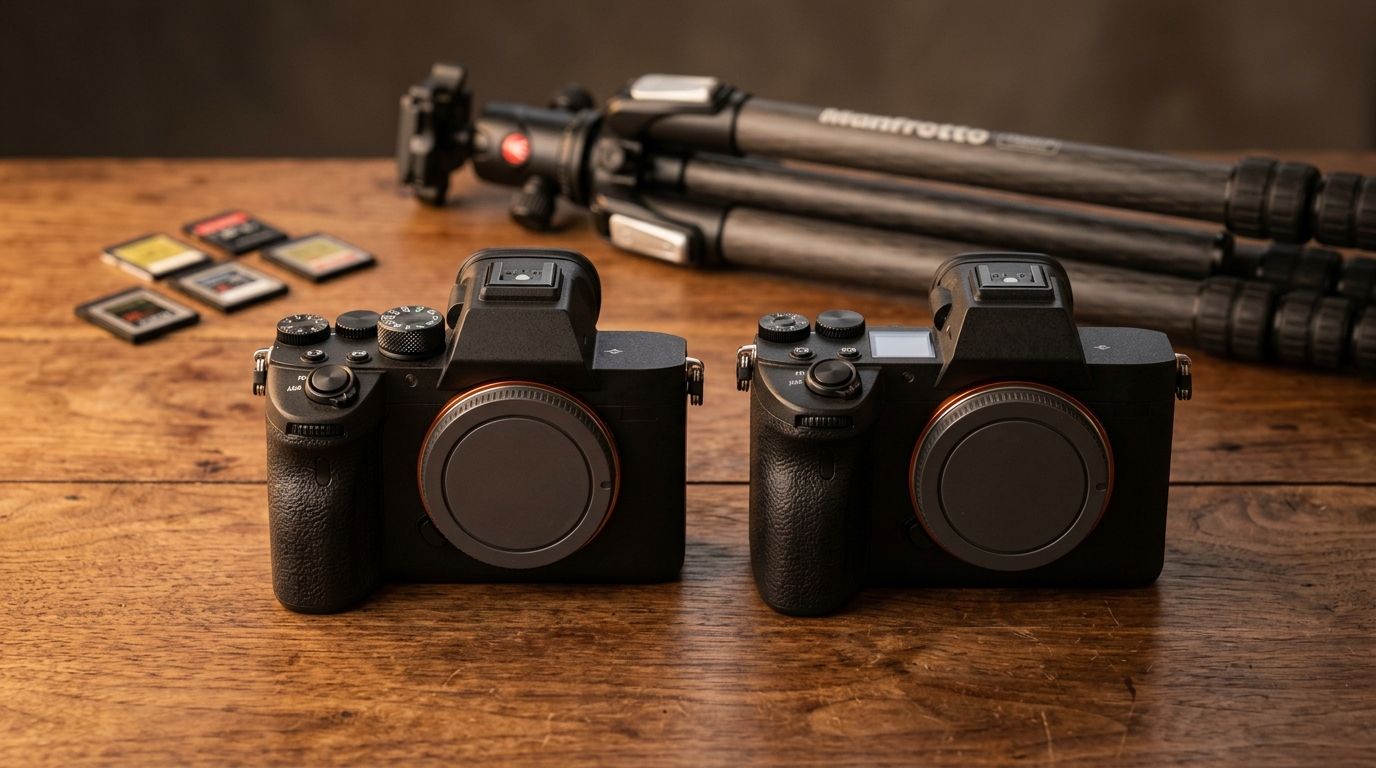
Both the Sony A7R VI and the Canon R5 Mark II are excellent flagship full-frame bodies in 2026. The $200 body gap is essentially noise; the real decision is what kind of photographer you are.
If you are a studio, landscape, architecture, or hybrid shooter who needs 66.8 MP of resolution, 30 fps bursts, and a sealed body for outdoor work, the Sony A7R VI is the more capable tool — and the $200 premium is justified.
If you are a wedding, event, editorial, or commercial video shooter who needs 8K 60p internal RAW, the most reliable people AF in any mirrorless body, and the most mature pro lens system on the market, the Canon R5 Mark II is the smarter buy — and the $200 savings compounds with better resale to make a real difference over 5 years.
Buy smart. Get more value. Pick the body that matches the work, not the spec sheet.