Introduction
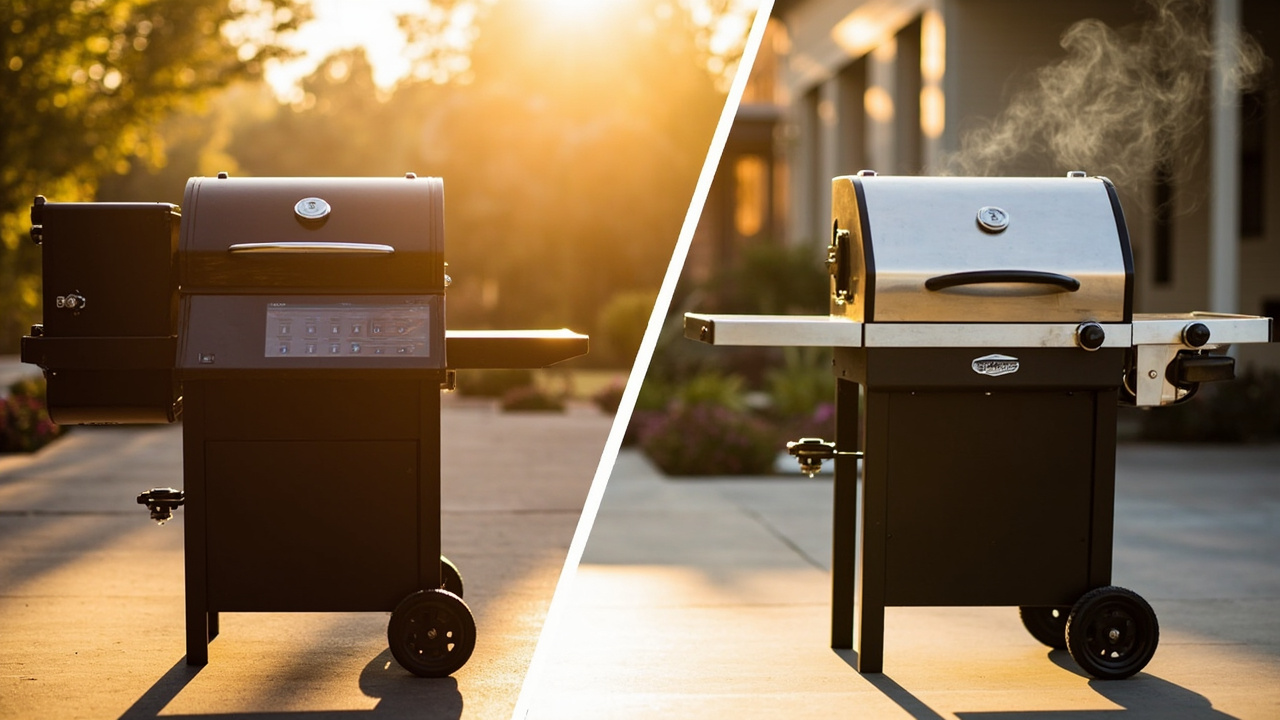
If you’ve shopped for a premium pellet grill in 2026, you’ve probably ended up staring at the same two names: Traeger and Weber. They are the two oldest, best-known players in the category, and their flagship pellet grills are also the two most-debated machines on Reddit and BBQ forums this year.
The question gets sharper when you put the two specific flagships side by side:
- Traeger Timberline XL — $3,999.99 MSRP, the largest residential Traeger ever built, 1,320 sq in of cooking space, induction cooktop, full-color touchscreen, 10-year limited warranty. Catering-level capacity with software-driven temperature control (Sources: Traeger Timberline XL product page, Pellet Grill Life review).
- Weber SmokeFire EX6 (2nd Gen) — $1,579.15 current street price at major retailers, 1,008 sq in of dual-level cooking, 600°F searing (a genuine first for pellet grills), Weber Connect WiFi, 3-year warranty. Half the price of the Traeger and the only pellet grill on the market that can actually sear a steakhouse crust (Sources: Best Wood Fired Grills review, Weber SmokeFire EX6 Walmart listing).
The sticker-price gap is $2,420.84. That’s the difference between a used Honda Civic and a used Toyota Corolla. The cost-per-cook story is even more interesting — and that’s what this comparison is about.
The Verdict First
- Choose the Traeger Timberline XL ($3,999.99) if you regularly cook for 8+ people, run full-pack catering-style cooks (multiple briskets, full holiday spreads), or want the induction cooktop + Smart Combustion + 10-year warranty combo. The XL is overkill for most buyers, but for households that genuinely use the capacity, no other residential pellet grill comes close (Source: Pellet Grill Life, Traeger Timberline XL review).
- Choose the Weber SmokeFire EX6 ($1,579) if you want one grill that smokes AND sears, you cook for 2–6 people most weekends, you don’t need a built-in induction burner, and you’d rather spend the $2,420 difference on actual food, wood pellets, or a side of ribs. The 600°F capability and porcelain-enameled construction make it the better value pick for the median American backyard cook (Source: Best Wood Fired Grills, Weber SmokeFire EX6 review).
- Skip both if you rarely cook outdoors, live in a place with strict no-smoke ordinances, or primarily need weeknight-fast searing — a $500–$700 gas grill will serve you better.
- Skip the Timberline XL specifically if you’re paying for capacity you won’t use. Reddit’s r/Traeger has long threads about XL owners who cooked big 3–4 times a year and wish they’d bought the standard Timberline or a Weber. The XL is a tool, not a trophy — but only if you actually use the tool.
Key Comparison Points
Price vs Real Cost Per Use
The MSRP gap is $2,420. The cost-per-cook story gets more interesting when you factor in pellets, electricity, warranty length, and replacement cost over 10 years.
| Cost Factor | Traeger Timberline XL | Weber SmokeFire EX6 (2nd Gen) |
|---|---|---|
| MSRP (USD) | $3,999.99 | $1,599.00 (MSRP) / ~$1,579 street |
| Cooking Area | 1,320 sq in (XL class) | 1,008 sq in (dual-level) |
| Cost per Sq Inch | ~$3.03 | ~$1.59 |
| Hopper Capacity | 22 lbs with pellet sensor | 22 lbs |
| Temperature Range | 165°F – 500°F | 200°F – 600°F |
| Warranty | 10 years limited | 3 years |
| Power Spec | WiFi + Smart Combustion PID | Weber Connect PID, DC-powered auger |
| Pellet Use @ 225°F (low/slow) | ~1.5 lbs/hr (XL chamber, more fuel) | ~1.0–1.2 lbs/hr |
| Pellet Use @ 600°F (searing) | N/A — max 500°F | ~3–4 lbs/hr (heavy sear sessions) |
Cost per cook estimate, assuming 30 cooks/year over 10 years:
- Timberline XL: $3,999.99 ÷ 300 cooks = $13.33 per cook (excluding pellets and electricity).
- SmokeFire EX6: $1,579.15 ÷ 300 cooks = $5.26 per cook (excluding pellets and electricity).
Add pellet + electricity (~$0.30/lb pellets, ~$0.18/kWh, average 8-hour cook):
- Timberline XL at 1.5 lbs/hr × 8 hrs × $0.30 = $3.60/cook pellets + ~$0.50 electricity = ~$17.43 per cook.
- SmokeFire EX6 at 1.0 lbs/hr × 8 hrs × $0.30 = $2.40/cook pellets + ~$0.40 electricity = ~$8.06 per cook.
10-year total cost of ownership (300 cooks, pellets + electricity):
- Timberline XL: $3,999.99 + (300 × $4.10) = $5,229.99 ($13.33 + $4.10 amortization per cook).
- SmokeFire EX6: $1,579.15 + (300 × $2.80) = $2,419.15 ($5.26 + $2.80 amortization per cook).
Net difference: $2,810.84 over 10 years, or about $281/year. The Traeger costs ~$2 more per cook across its lifetime, even after you account for the longer 10-year warranty (Sources: pellet consumption from Pellet Grill Life and Best Wood Fired Grills).
Build Quality and Durability
Traeger Timberline XL ships with a 10-year limited warranty — the longest in the residential pellet grill category. The premium double-wall steel insulation is a meaningful upgrade: in sub-freezing weather, the XL shows pellet consumption increases of less than 10%, compared to 30–40% on comparable-size grills (Source: Pellet Grill Life, Timberline XL review). The build is solid, the foldable shelves and P.A.L. accessory rail feel purpose-built, and the full-color touchscreen is genuinely responsive.
The trade-off: the XL weighs more than the Weber and uses more pellets per cook because the larger chamber has more thermal mass to maintain. Long-term reliability is still being measured for the current XL generation (launched 2024), but the standard Timberline (which shares the same internals except for size) has generally positive 2–3 year owner reports.
Weber SmokeFire EX6 (2nd Gen) has a 3-year warranty — standard for the price band, though RecTeq and Pit Boss both offer longer (5–6 years) coverage. The porcelain-enameled steel finish is the standout. After 8 months of outdoor testing, owners report zero rust and zero paint issues (Source: Best Wood Fired Grills, Weber SmokeFire EX6 review). Heavy-duty locking wheels, solid hopper lid hinges, and stable foldable side tables all reinforce the “Weber lasts 10+ years” reputation the brand has built since 1952.
The trade-off: Gen 1 (2020–2021) was a disaster — flare-ups, grease fires, and class-action-adjacent complaints. Gen 2 redesigned the fire pot and grease management, and after 8 months of high-fat cooks (pork belly, bacon-wrapped everything) the reviewer at Best Wood Fired Grills reported zero flare-ups. Weber’s massive service network is also a real plus: replacement parts are easy to source years later, which is not always true for Traeger.
Feature Breakdown
| Feature | Traeger Timberline XL | Weber SmokeFire EX6 (2nd Gen) |
|---|---|---|
| Controller | Full-color touchscreen | Weber Connect (PID) |
| Smart Combustion / Auto-Feed | Yes (Smart Combustion, ±3°F) | Yes (Weber Connect PID) |
| Super Smoke / Smoke Boost | Yes (Super Smoke Mode) | No dedicated boost (use smoke tube) |
| Max Temperature | 500°F | 600°F (real, measured 580–610°F) |
| Searing Capability | Limited (500°F is not steakhouse sear) | Yes — direct flame system |
| Induction Cooktop | Yes — built-in | No |
| Meat Probes | Dual ports included | 1 included (Weber Connect) |
| Hopper Cleanout | Yes (pellet swap door) | No (must scoop out by hand) |
| App Control | Traeger App (WiFi) | Weber Connect (WiFi + Bluetooth) |
| Accessory System | ModiFIRE + P.A.L. Pop-And-Lock | Weber CRAFTED frames + standard grates |
| Assembly Time | ~2 hours, 2-person job | ~2 hours, 2-person job (178 lbs) |
| Cover Included | Sold separately | Sold separately |
Standout differences worth calling out:
- The Traeger induction cooktop is the headline feature. It’s the only pellet grill in this tier with a built-in induction burner, which means you can sear a reverse-seared steak on cast iron right at the grill station while the smoke rolls. This is genuinely useful for catering cooks.
- The Weber’s 600°F max is the headline feature on the other side. Real searing is the single biggest gap between pellet grills and gas, and the SmokeFire EX6 closes it. Owners report 90-second-per-side ribeye sears that match a $2,000 gas grill (Source: Best Wood Fired Grills).
- Hopper cleanout is a real annoyance on the Weber. If you want to switch from hickory to mesquite mid-week, you’re scooping pellets out by hand. The Traeger’s pellet-swap door solves this in 30 seconds.
Pros and Cons
Traeger Timberline XL — Pros
- 1,320 sq in of cooking space — fits 3 full packer briskets or 30+ burgers at once (Source: Pellet Grill Life)
- Built-in induction cooktop — the only pellet grill with this feature in 2026
- 10-year limited warranty — longest in the category
- Smart Combustion holds ±3°F precision even at full chamber load (40 lbs of meat tested)
- Super Smoke Mode + downdraft exhaust for clean, intense smoke flavor
- Full-color touchscreen with WiFi and a pellet sensor
Traeger Timberline XL — Cons
- $3,999.99 MSRP — the most expensive residential Traeger; entry barrier is real
- 500°F max is not steakhouse sear territory — still need a cast-iron reverse sear or separate gas grill for crust
- Larger chamber burns more pellets per cook — ~30% higher pellet use vs Weber
- One-star review cluster on Traeger.com (overall 3.8 average) — long-term electronic reliability still being measured (Source: r/Traeger discussion)
- Heavier and bulkier than the Weber — needs deck or patio with structural support
Weber SmokeFire EX6 (2nd Gen) — Pros
- 600°F real max temperature — closes the searing gap with gas grills (Source: Best Wood Fired Grills)
- $1,579.15 street price — under half the Traeger XL
- Porcelain-enameled steel finish — resists rust, looks new after 8+ months outdoors
- Weber Connect app with guided recipes — best-in-class app for beginners
- 1,008 sq in dual-level cooking — fits 2 full briskets with room for sides
- Massive Weber service network — replacement parts are easy to source years later
Weber SmokeFire EX6 (2nd Gen) — Cons
- 3-year warranty vs Traeger’s 10 — meaningfully shorter
- Gen 1 reputation still lingers — even though Gen 2 is a different machine
- No hopper cleanout door — switching pellet flavors is a scoop-out job
- 5–8°F temperature swings on long low-and-slow cooks (vs Traeger’s ±3°F)
- No induction cooktop — needs a separate side burner for searing sides
- Heavier than expected at 178 lbs — two-person assembly required
Best For / Skip If
Buy the Traeger Timberline XL if you are:
- A household that entertains 10+ people regularly and runs catering-style cooks (full packer briskets, multi-protein holiday spreads)
- A pitmaster who wants the induction cooktop + Smart Combustion + 10-year warranty package
- Someone who lives in a cold-weather climate and needs the insulated double-wall chamber
- A buyer with the budget and a large deck, patio, or outdoor kitchen to host the 1,320 sq in of cooking surface
Skip the Traeger Timberline XL if you are:
- Cooking for 2–6 people most weekends — the standard Timberline ($2,499) is a smarter fit
- Looking for real steakhouse searing — the 500°F max won’t get you a hard Maillard crust without a separate cast-iron step
- Tight on outdoor space — the XL is genuinely large and needs a 6+ ft clearance zone
- Paying for capacity you won’t use (the most common regret in r/Traeger threads)
Buy the Weber SmokeFire EX6 if you are:
- The median American backyard cook — smokes a few times a month, sears on weekends, hosts 4–8 people
- A buyer who wants one grill that does both jobs at under $1,600
- Someone who values Weber’s brand reputation for build quality and parts availability
- A household that’s already invested in a gas grill and wants to add smoking capability without doubling the kitchen footprint
Skip the Weber SmokeFire EX6 if you are:
- A heavy low-and-slow smoker (40+ hours/week) who needs the tightest possible temperature control — RecTeq and Grilla Grills beat the SmokeFire on that metric
- Squeamish about the Gen 1 reputation, even though Gen 2 is genuinely a different machine
- Someone with a strict $1,000 budget — Pit Boss and Z Grills offer solid pellet grills for half the price
- Cooking for 10+ people every weekend — you’ll outgrow the 1,008 sq in
Bottom Line
The Weber SmokeFire EX6 (2nd Gen) at $1,579.15 is the smarter buy for 90% of readers. Half the price, real 600°F searing, porcelain-enameled build, and a brand with 70+ years of outdoor cooking credibility. For the median backyard cook — smoking a few times a month, searing on weekends, hosting 4–8 people — it delivers everything the Timberline XL does except the XL’s extra 312 sq in and the induction cooktop. And it does it for $2,420 less upfront and roughly $281 less per year over 10 years in pellets and electricity.
The Traeger Timberline XL at $3,999.99 is the right call only for a specific buyer: a household that regularly cooks for 10+ people, runs catering-style cooks, lives in a cold climate, and will genuinely use the induction cooktop and 1,320 sq in of cooking space. For everyone else, it’s a beautiful machine that pays for capacity they won’t fully use.
The BuyCospa rule applies: price is just the upfront number. Total cost is what matters over 10 years. By that measure, the SmokeFire EX6 is the better value, and the Timberline XL is the better tool — for the right buyer.
Buy smart. Get more value. That means matching the grill to the cook you actually do, not the cook you imagine doing.