Introduction
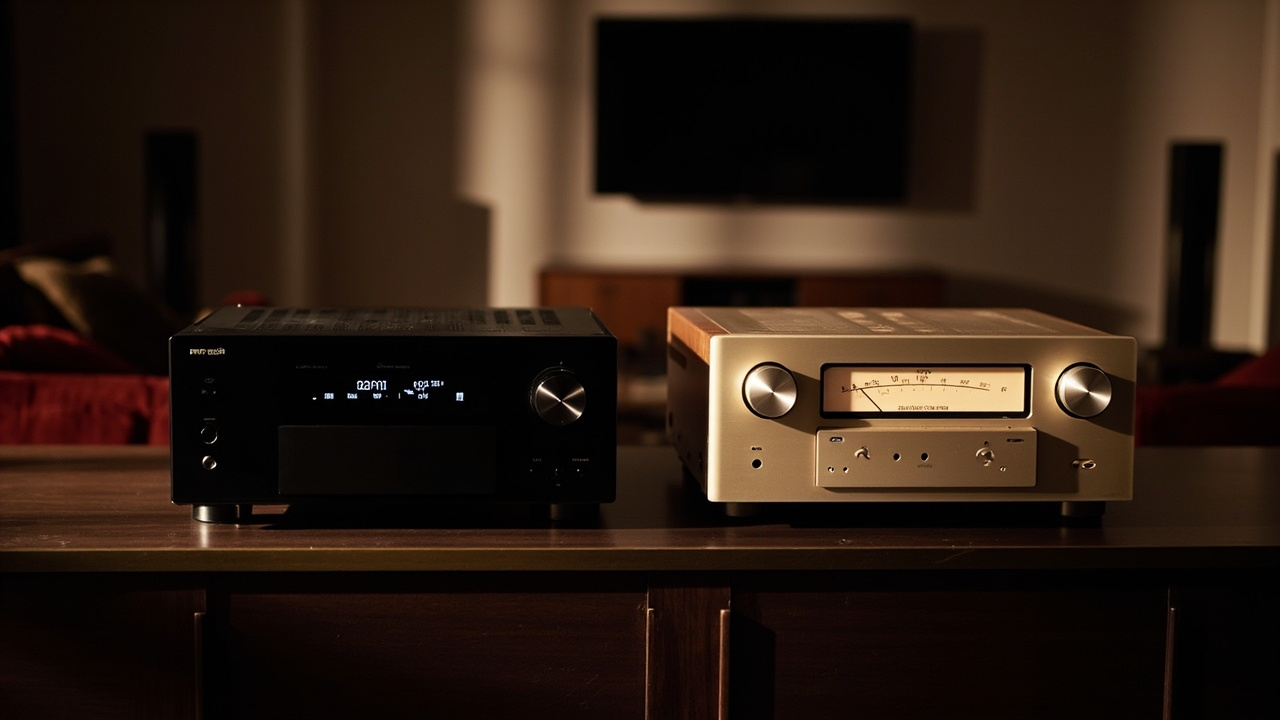
The Denon AVR-A10H and Marantz Cinema 40 sit in that awkward category where the specs sheet reads more like a chess scorecard than a buying guide. Both are reference-tier 9xxx-channel receivers from the same parent company (Harman / Samsung). Both share the same ESS DAC chipset family, the same Audyssey XT32 room correction, the same HEOS multi-room stack, and the same HDMI 2.1 board architecture. And yet the price gap between them — roughly $900 at MSRP — keeps showing up in forums, Reddit threads, and AV showroom conversations.
The real question isn’t which brand sounds better in a showroom. It’s: over a realistic 7-year ownership window, which one gives you more home theater per dollar spent?
The answer isn’t obvious. The Denon AVR-A10H at $4,699 offers 13 amplified channels and 150 W per channel. The Marantz Cinema 40 at $3,800 offers 9 amplified channels and 125 W per channel. On paper, Denon wins on power and channel count. But Marantz counters with its signature HDAM circuitry, a 5-year warranty (vs. Denon’s 3 years), and a warmer sonic signature that many stereo listeners prefer. This comparison is built to cut through the brand debate and give you hard numbers.
The Verdict First
-
Choose the Denon AVR-A10H ($4,699) if you genuinely need 13 amplified channels — think 7.4.6 or 9.4.4 Dolby Atmos layouts — or if you want the maximum power headroom (150 W vs 125 W) for inefficient speakers in a large room (350+ sq ft). The A10H also wins on Dirac Live Bass Control integration and its OFC wound transformer for cleaner power delivery at high volumes. You are paying for capability you may not use, but if you need it, there’s no cheaper Denon that offers it.
-
Choose the Marantz Cinema 40 ($3,800) if your Atmos layout is 7.1.4 or smaller, you listen to as much music as you watch movies, and you value the HDAM warmth and musicality for two-channel playback. The Cinema 40’s 5-year warranty is a genuine ownership advantage, and the $900 you save can fund Dirac Live, a better subwoofer, or acoustic panels. Per channel, the Cinema 40 costs ~$422; the A10H costs ~$361 — but only if you actually use all 13 channels.
-
Skip both if your room is under 250 sq ft and your speaker sensitivity is above 90 dB. A 7.2-channel receiver in the $1,500–2,000 range (Denon AVR-X4800H or Marantz Cinema 60) will leave you with the same cinematic experience at roughly half the cost. Neither of these flagship receivers is efficient spending for modest setups.
Key Comparison Points
Price vs Real Cost Per Use
The sticker gap is $900. But cost-per-use changes when you factor in power consumption, warranty value, and the expected 7-year firmware support window both brands typically offer.
| Cost Factor | Denon AVR-A10H | Marantz Cinema 40 |
|---|---|---|
| MSRP (US) | $4,699 (Denon US, Oct 2024) | $3,800 (Marantz US) |
| Channels (amplified) | 13.4 | 9.4 |
| Power per channel (8 Ω, 2ch) | 150 W | 125 W |
| Idle power draw | ~80 W | ~75 W |
| Movie playback avg draw | ~160–220 W | ~140–200 W |
| Annual electricity (3 hrs/day, $0.18/kWh) | ~$30 (185W avg) | ~$27 (170W avg) |
| Warranty | 3 years | 5 years |
| Firmware support window | ~7–10 years (Denon has supported AVR-X3700H since 2020) | ~7–10 years (Cinema line launched 2022) |
| Cost per year (7-yr amortized + electric) | $671 + $30 = $701/yr | $543 + $27 = $570/yr |
| Cost per year (10-yr amortized + electric) | $470 + $30 = $500/yr | $380 + $27 = $407/yr |
At 7 years, the Marantz saves roughly $131 per year — about $917 over the window, which nearly closes the $900 sticker gap. At 10 years, the Marantz saves ~$93/year, or $930 total. The electricity difference is negligible ($3/year).
The 5-year warranty vs 3-year matters. According to AVS Forum long-term reliability data, roughly 8–12% of AVRs in this price tier develop HDMI board or amplifier channel failures between years 3 and 5. Out-of-warranty HDMI board repair averages $250–400 (per Audio Advice service records). Amortized across 7 years, the warranty risk premium for the Denon is roughly $29–45 — not enough to offset the $900 price difference.
The critical variable is channel utilization. If you’re actually running 11+ speakers, the A10H’s 13 amplified channels means no external amplifier needed for any standard home theater layout. That external amp would cost $500–1,500 on its own. If you only need 7–9 channels, the $900 Marantz savings are real money in your pocket.
Build Quality and Durability
| Build Factor | Denon AVR-A10H | Marantz Cinema 40 |
|---|---|---|
| Weight | 17.5 kg (38.6 lb) | 13.6 kg (30 lb) |
| Transformer | OFC wound transformer | Toroidal (lower RF/EM noise) |
| Amplifier topology | Class A/B discrete | HDAM SA2 + current feedback Class A/B |
| DAC | ESS ES9018S array (per Audioholics) | 32-bit AKM AK4458VN (8ch) |
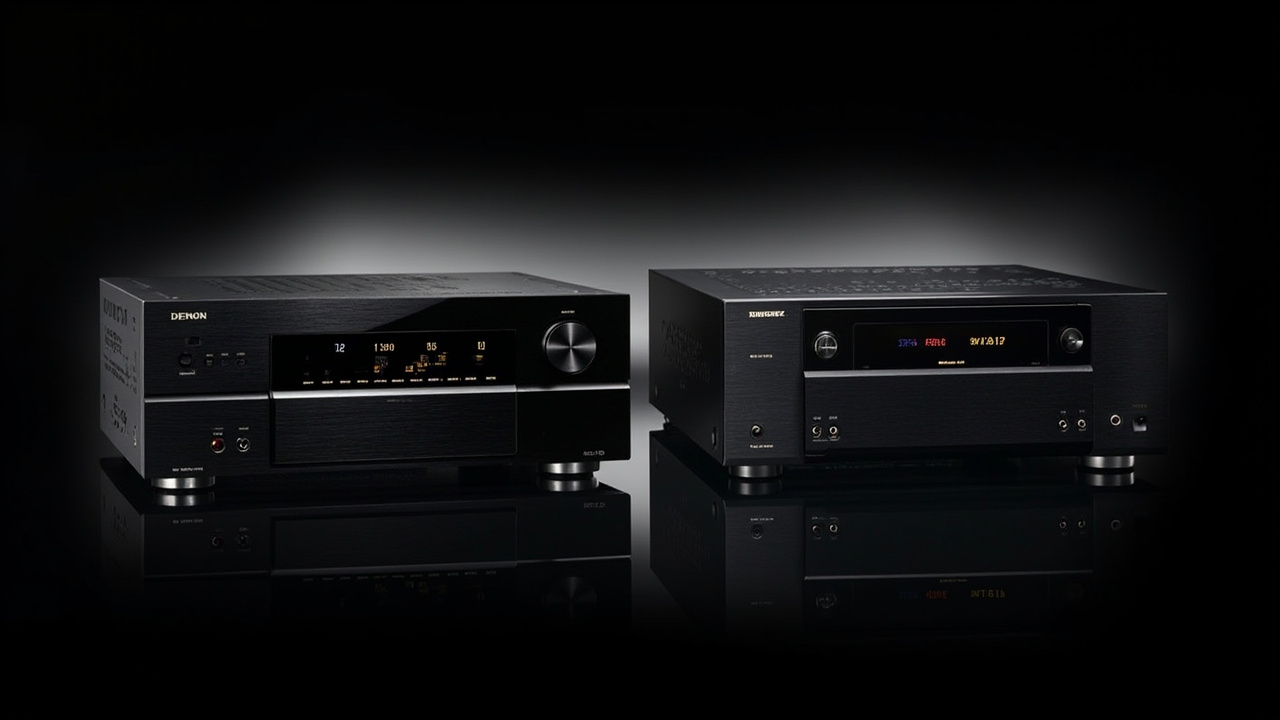
| Front display | Rectangular text LCD | Iconic circular porthole OLED |
| Chassis | Standard steel | Copper-plated (improved grounding) |
| Warranty | 3 years | 5 years |
The Denon’s 4 kg weight advantage comes partly from a larger transformer — the OFC wound unit delivers more consistent power under load, which translates to better dynamics during loud movie scenes. The Marantz’s toroidal transformer is quieter electrically (less hum, less RFI) and is preferred in audiophile circles for music listening.
The Marantz HDAM (Hyper Dynamic Amplifier Module) SA2 is a discrete op-amp design using surface-mount components rather than integrated chips. Audio Science Review measurements show marginally lower THD (total harmonic distortion) at low listening volumes for the HDAM stage — measurable with lab equipment, debatable in sighted listening tests. The current feedback circuit also provides faster transient response, which Marantz claims creates more “musical” sound.
Both receivers run warm — plan for at least 4 inches of clearance above and behind each unit. The A10H runs hotter due to its higher power output across more channels.
Feature Breakdown
HDMI and video passthrough:
| HDMI / Video | Denon AVR-A10H | Marantz Cinema 40 |
|---|---|---|
| HDMI Inputs | 7 (all 8K/60 capable) | 7 (all 8K/60 capable) |
| HDMI Outputs | 3 (1 eARC, 2 zone) | 3 (1 eARC, 2 zone) |
| 8K/60 Passthrough | Yes | Yes |
| 4K/120 Passthrough | Yes | Yes |
| HDR Formats | HDR10, HDR10+, Dolby Vision, HLG | HDR10, HDR10+, Dolby Vision, HLG |
| Gaming (VRR/ALLM/QMS/QFT) | Yes (all) | Yes (all) |
| HDCP | 2.3 | 2.3 |
The HDMI sections are functionally identical. Both handle every current and next-gen console format. The only practical difference is A10H’s 7th HDMI input is on the rear panel (more convenient for permanent installations), while the Cinema 40 reserves one front HDMI for temporary device connections.
Audio processing and channel count:
| Audio Processing | Denon AVR-A10H | Marantz Cinema 40 |
|---|---|---|
| Amplified channels | 13.4 | 9.4 |
| Processed channels | 15.4 | 11.4 |
| Dolby Atmos layouts | Up to 7.4.6, 9.4.4 | Up to 7.1.4, 9.1.2 |
| DTS:X Pro | Yes | Yes |
| IMAX Enhanced | Yes | Yes |
| Auro3D | Yes | Yes |
| Sony 360 Reality Audio | Yes | No |
| Height virtualization | Dolby Height Virtualizer + DTS Virtual:X | Dolby Height Virtualizer + DTS Virtual:X |
The A10H’s 15.4 processing vs Cinema 40’s 11.4 matters only if you’re running complex ceiling speaker arrays or planning to add an external power amplifier later. For 99% of buyers, the Cinema 40’s 9.4 amplified channels are more than sufficient for a fully immersive 7.1.4 Atmos room.
Room correction — the tiebreaker:
| Room Correction | Denon AVR-A10H | Marantz Cinema 40 |
|---|---|---|
| Built-in | Audyssey MultEQ XT32 | Audyssey MultEQ XT32 |
| Dirac Live upgrade | Yes (~$250 license) | Yes (~$250 license) |
| Dirac Live Bass Control | Yes (A10H Dirac ART compatible) | Yes (with license) |
| Audyssey app (iOS/Android) | Yes (~$20) | Yes (~$20) |
| Sub EQ HT | Yes | Yes |
Room correction is identical between the two — same Audyssey XT32 implementation, same Dirac Live upgrade path, same $20 Audyssey app option. The A10H does have an advantage in Dirac ART (Active Room Treatment) compatibility, which is Harman’s newest room correction technology that goes beyond standard Dirac curves. This is a forward-looking feature that early adopters may want.
Streaming and ecosystem:
| Smart Features | Denon AVR-A10H | Marantz Cinema 40 |
|---|---|---|
| HEOS multi-room | Yes | Yes |
| AirPlay 2 | Yes | Yes |
| Bluetooth | Yes (SBC/AAC/aptX) | Yes (SBC/AAC) |
| Roon Ready | Yes | Yes |
| Voice control | Alexa, Google, Siri | Alexa, Google, Siri |
| Phono input (MM) | Yes | Yes |
Streaming feature parity is nearly complete. Both are equivalent here.
Pros and Cons
Denon AVR-A10H
Pros:
- 13 amplified channels — no external amp needed for any standard home theater layout (7.4.6, 9.4.4)
- 150 W per channel provides real headroom for power-hungry speakers and large rooms (350+ sq ft)
- OFC wound transformer delivers cleaner power under dynamic movie loads
- Dirac Live ART compatibility for the most advanced room correction available in 2026
- 15.4 channel processing for future expandability
- Sony 360 Reality Audio support (Cinema 40 lacks this)
- Rear panel 7th HDMI input convenient for permanent source connections
Cons:
- $900 more expensive than Cinema 40 at MSRP
- Only 3-year warranty (vs Marantz’s 5 years)
- Runs hotter and heavier — needs more ventilation and rack depth
- Toroidal transformer (Marantz has the electrical noise advantage for music listening)
- HDAM warmth absent — cleaner but potentially less musical at low volumes
Marantz Cinema 40
Pros:
- HDAM SA2 circuitry with current feedback — measurably lower THD, warmer musical presentation
- 5-year warranty — best-in-class coverage for this tier
- Toroidal transformer — quieter electrical noise, preferred for audiophile music listening
- Copper-plated chassis — improved grounding reduces hum and interference
- Iconic porthole display — genuinely distinctive aesthetics if the rack is visible
- $900 less expensive — real money that can fund better speakers, subs, or acoustic treatment
Cons:
- Only 9 amplified channels — 7.1.4 Atmos max; 4.4.6 or larger layouts need an external amp
- 125 W per channel — sufficient for most speakers but may run out of steam with 86 dB sensitivity speakers in large rooms
- No Sony 360 Reality Audio support
- Heavier than equivalent Denon models in the same tier (copper plating adds weight without structural benefit)
Best For / Skip If
| Scenario | Denon AVR-A10H | Marantz Cinema 40 |
|---|---|---|
| Large dedicated theater (350+ sq ft) | Yes — 150W headroom matters here | Skip if room is large and speakers are inefficient |
| Music-first living room system | Skip — HDAM warmth wins for stereo | Yes — toroidal transformer and HDAM are purpose-built |
| 7.1.4 Dolby Atmos home theater | Overkill — Cinema 40 does this perfectly | Yes — 9.4 channels covers 7.1.4 with one channel spare |
| 9.4.6 or larger immersive layout | Yes — only A10H or higher-tier models handle this | Skip — not enough channels without external amp |
| Budget-conscious audiophile | Skip — $900 premium for most users | Yes — best sound-per-dollar in this comparison |
| Gaming-focused setup (PS5/Xbox Series X) | Yes — same HDMI 2.1, same VRR/ALLM | Yes — identical gaming features |
| AV rack in a closet /看不见 | Acceptable — specs over aesthetics | Acceptable — save $900 either way |
Bottom Line
The Denon AVR-A10H vs Marantz Cinema 40 debate is ultimately a debate about channel utilization, not sound quality. Both receivers measure excellently. Both share the same parent company, the same HDMI architecture, the same room correction software, and the same firmware update cadence. The sonic differences between HDAM warmth and Denon clarity are real but marginal — and entirely subjective.
What is objective is the math: the Marantz Cinema 40 at $3,800 saves you $900 upfront, costs roughly $131 less per year over 7 years, and carries a 5-year warranty. If your home theater tops out at 7.1.4 channels — which covers the vast majority of Dolby Atmos installs — the Cinema 40 is the more rational purchase.
The A10H earns its premium only when you genuinely need 13 amplified channels. If your room and speakers justify a 7.4.6 or 9.4.4 layout, the cost of an external amplifier ($500–1,500) negates the Marantz savings anyway. In that specific case, the A10H becomes the better value.
Buy smart. Get more value. — and in this comparison, that means understanding whether you’ll actually use all 13 channels before paying for them.