Introduction
The single-cabinet Dolby Atmos soundbar market in 2026 has a real identity crisis. Two categories of buyer keep running into each other:
- The fashion-first listener who wants the Marshall Heston 120 — the rock-and-roll-amp-styled 5.1.2 bar with vegan leather trim and gold accents, priced at $1,299 at Marshall, with a claimed 130 W output and a bass reach that goes deeper than its 1100 mm cabinet has any right to.
- The mainstream value-seeker who lands on the Bose Smart Ultra Soundbar at $899 MSRP (often $699 on sale at major US retailers in 2026) — a more compact 1045 mm bar with Bose’s AI Dialogue Mode, ADAPTiQ room calibration, and the entire Bose Music app ecosystem.
Both bars share the same fundamental trade-off: they’re sealed single-cabinet designs that try to fake a surround bubble from one box. Neither one ships with rear speakers. Both promise a credible Dolby Atmos experience, both decode DTS:X (well — Bose does with caveats), and both lock you into a proprietary app for setup and EQ.
The question isn’t “which one wins on a spec sheet.” The question is which one delivers better cost-per-use over a realistic 5–7 year ownership window, given how you actually use your TV.
The Verdict First
- Choose the Marshall Heston 120 ($1,299) if you watch a lot of bass-heavy film and gaming content, want the deepest low-end reach of any single-cabinet bar in this price range, care about replaceable drivers and a longer serviceable lifespan (the fret, end caps, drivers, and circuit boards are user-replaceable per Marshall), and don’t mind paying $300+ more for a bar with RCA + HDMI-in + sub-out + AirPlay 2 + Google Cast + Spotify Connect + Tidal Connect + Auracast in a single box. Source: Trusted Reviews Heston 120 review.
- Choose the Bose Smart Ultra Soundbar ($899, often $699 on sale) if you mostly watch streaming TV and movies in mixed Atmos/non-Atmos content, want a 30 mm shorter cabinet (matters if your TV sits on a low stand), value the AI Dialogue Mode for talk-heavy content, and want the most mature cross-room multi-speaker ecosystem if you already own other Bose products. Source: What Hi-Fi? Bose Smart Ultra Soundbar review.
- Skip both if you actually want true surround — a $500 Samsung HW-Q600C with discrete rears will beat a single-cabinet $1,000+ bar for true surround, every time.
Key Comparison Points
Price vs Real Cost Per Use
Both bars sit in the premium tier, but the cost-per-hour math is more interesting than the sticker price.
| Cost Factor | Marshall Heston 120 | Bose Smart Ultra Soundbar |
|---|---|---|
| Sticker Price (MSRP) | $1,299 (Marshall US, B&H lists same) | $899 (Bose US, often $699 on sale in 2026) |
| Street Price (June 2026) | $999–$1,299 | $699–$899 |
| Power Output (RMS) | 130 W (11 channels of amplification) | 120 W |
| Power Draw (typical use) | ~12–20 W active | ~10–18 W active |
| Annual Electricity (~4 hrs/day) | ~$9.50 (20 W × 4 h × 365 × $0.13/kWh) | ~$8.50 (18 W × 4 h × 365 × $0.13/kWh) |
| Likely Lifespan (firmware + hardware) | 7+ years (replaceable drivers per Marshall) | 5+ years (Bose firmware cadence has slowed since 2024) |
| Cost per Year (5-yr amortized at MSRP) | $260 + $9.50 = $269.50 | $180 + $8.50 = $188.50 |
| Cost per Year (7-yr amortized at MSRP) | $186 + $9.50 = $195.50 | $129 + $8.50 = $137.50 |
At 4 hours of daily TV, the Bose saves you roughly $81 in year one and $406 over seven years strictly on amortization at MSRP. If you catch Bose on its recurring $699 sales, the gap widens to $130 in year one and $650 over seven years.
The bigger cost-per-use lever is whether you’ll need to add a separate sub. The Heston 120’s dual 2×5-inch subwoofers inside the cabinet reach a depth Trusted Reviews calls “weighty” and “impressive” — they’re genuinely usable for action films without buying the $349 Marshall Heston Sub. The Bose Smart Ultra relies more on the bass module 700 ($499) for real low-end slam. If you would have caved and bought a sub anyway, the Marshall effectively cancels $349 of that hidden cost.
Marshall’s stated sustainability story also has a cost angle: 74% of the plastic is recycled, the leather is vegan, and the drivers, fret, end caps, and circuit boards are user-replaceable (per Trusted Reviews). That matters for the 7+ year ownership horizon. Bose doesn’t publish a comparable parts program — once the amp or DSP fails, you replace the bar.
Build Quality and Durability
| Build Factor | Marshall Heston 120 | Bose Smart Ultra Soundbar |
|---|---|---|
| Cabinet Width | 1,100 mm (43.3 in) | 1,045 mm (41.1 in) |
| Cabinet Height | 76 mm (2.99 in) | 58 mm (2.28 in) |
| Cabinet Depth | 145 mm | 107 mm |
| Weight | 7.0 kg (15.4 lb) | 5.8 kg (12.8 lb) |
| Finish | Salt-and-pepper fret, gold accents, vegan PU leather end caps | Matte plastic, Black only |
| Driver Count | 11 (2× 5” subwoofers, 2× 3” mid-woofers, 2× 0.8” tweeters, 5× 2” full-range drivers) | 9 (1 soft dome tweeter, 6 transducers, 2 upfiring dipole speakers) |
| Channel Layout | 5.1.2 | 5.1.2 |
| Power Output (RMS) | 130 W | 120 W |
| Warranty | 2 years | 1 year |
| Recycled Content | 74% recycled plastic, PVC-free, vegan leather | Not disclosed publicly |
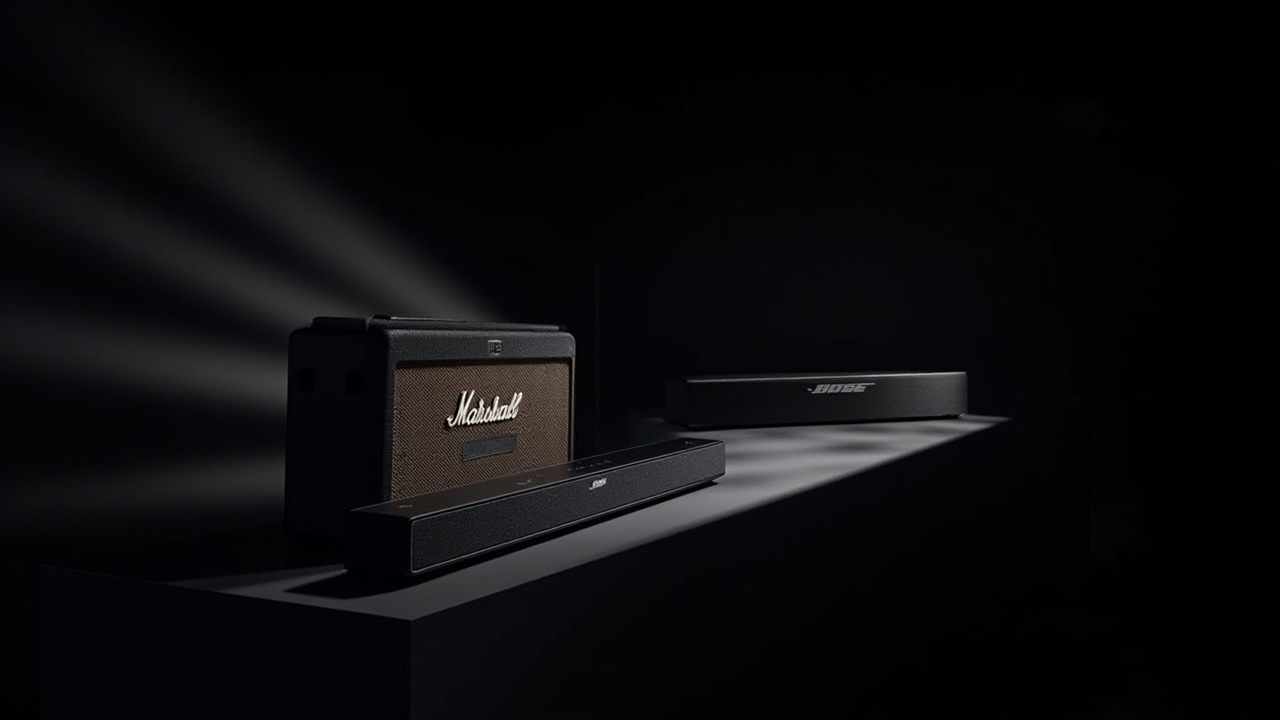
The Bose is meaningfully shorter (58 mm vs 76 mm) and shallower, which is genuinely useful if your TV sits on a low stand and the bottom of the screen would otherwise be blocked. The Marshall is 55 mm wider and a full 1.2 kg heavier — it’ll need a wider, sturdier piece of AV furniture.
The Marshall’s defining physical feature is tactile amp-style dials on top: three knurled knobs for source input, volume, treble, and bass, each with a red LED ring confirming position. That’s actually useful for guests who don’t want to fight an app — you can hand someone the bar and say “twist the right dial.” The Bose has no top-panel controls beyond a single mic-mute button; everything else lives in the Bose Music app.
Durability score: The Marshall wins on parts-replaceability (Marshall’s own claim, per Trusted Reviews). The Bose wins on being lighter, easier to wall-mount, and slightly more discreet. The Marshall’s vegan leather end caps and fret will show wear over years of finger oil and dust, especially if it’s wall-mounted near a kitchen — a real-world concern if you’re buying for a long horizon.
Feature Breakdown
This is where the gap widens.
Channel layout and Atmos immersion: Both are rated 5.1.2 on paper. But the underlying driver counts differ — Marshall uses 11 drivers across 11 amp channels; Bose uses 9 drivers in its 5.1.2 layout. In What Hi-Fi?’s Heston 120 review, the magazine concluded that the Atmos performance was “disappointing” relative to the Sonos Arc Ultra, but explicitly noted the bar’s strengths are in bass weight and musicality. For pure Atmos immersion (height effects, discrete overhead channels), Bose’s PhaseGuide dipole technology and dedicated upfiring drivers have a longer track record in reviews.
Dialogue clarity: The Bose has a notable edge here with its A.I. Dialogue Mode (per Bose Smart Ultra product page) that uses onboard DSP to lift voices relative to background effects. The Marshall’s “Voice” sound mode is a single EQ preset — functional but less granular. For talk-heavy content (news, sports, reality TV), Bose wins. For cinematic explosions and music, Marshall wins.
Room calibration: The Marshall uses Room Calibration via the new Marshall app — Trusted Reviews found it “worth running; if left uncalibrated, it can sound a little noisy.” The Bose uses ADAPTiQ with a headset-based setup that’s platform-agnostic (works on iOS, Android, no phone requirement). The Marshall’s app is reportedly less polished (a long-standing complaint about the Marshall Bluetooth app carried over, per Trusted Reviews), but the calibration itself delivers real results.
Connectivity — and this is where Marshall dominates:
| Connectivity | Marshall Heston 120 | Bose Smart Ultra Soundbar |
|---|---|---|
| HDMI eARC (out) | ✅ | ✅ |
| HDMI In (passthrough) | ✅ (4K/120Hz, Dolby Vision, ALLM, VRR) | ❌ |
| RCA analog input | ✅ (rare on a soundbar; turntable-friendly) | ❌ |
| Subwoofer Out | ✅ (Heston Sub $349) | ❌ (wireless Bass Module only) |
| Ethernet | ✅ | ✅ |
| USB-C | ✅ | ❌ |
| Bluetooth | 5.3 (SBC, LC3, AAC) | 5.0+ (SBC, AAC) |
| Wi-Fi | Wi-Fi 6 | Wi-Fi 5 |
| AirPlay 2 | ✅ | ✅ |
| Google Cast | ✅ | ✅ (via Google Assistant) |
| Spotify Connect | ✅ | ✅ (via Spotify in Bose app) |
| Tidal Connect | ✅ | ✅ |
| Qobuz Connect | ❌ | ❌ |
| Auracast (broadcast) | ✅ | ❌ |
The HDMI-in with 4K/120Hz passthrough + Dolby Vision + ALLM + VRR is the single biggest practical win for the Marshall. If you’re a gamer with a PS5 or Xbox Series X and a TV that supports HDMI 2.1 features, you can plug the console directly into the soundbar without losing VRR or 4K/120. The Bose has only HDMI eARC, meaning you route everything through the TV and accept whatever passthrough your TV supports — usually fine, but a real constraint for serious console gamers.
The RCA input on the Marshall is also legitimately unusual for a 2026 soundbar. If you own a turntable with a built-in phono preamp (or an external phono stage), the Marshall becomes a competent two-channel music system in a way the Bose cannot match.
Smart assistants and ecosystem:
- The Bose has built-in Alexa and Google Assistant (you pick one). The Marshall has neither — you control via the app, the included remote, or the on-bar dials.
- The Bose’s killer ecosystem feature is SimpleSync — pair the soundbar with any Bose QC Ultra Headphones, Bose QC Earbuds, or other Bose speakers for private listening or multi-room. If you already own Bose headphones, this is genuinely frictionless.
- The Marshall has Auracast, which lets the bar broadcast audio to any compatible Auracast speaker or hearing aid. That’s a future-leaning feature — Auracast adoption is still patchy in 2026 — but a real differentiator if you care about accessibility.
Pros and Cons
Marshall Heston 120 ($1,299)
Pros:
- Best-in-class bass for a single-cabinet bar — dual 5-inch subwoofers reach depth that genuinely competes with smaller discrete sub setups (Trusted Reviews: “strong, weighty bass”).
- 11 drivers, 11 amp channels — more headroom than Bose’s 9-driver layout.
- HDMI-in with 4K/120Hz + Dolby Vision + VRR passthrough — unique in this price tier; saves you an HDMI 2.1 port on your TV.
- RCA analog input — turntable-friendly, unusual on a 2026 soundbar.
- Subwoofer pre-out — can use a wired sub if you ever upgrade.
- Replaceable drivers, fret, end caps, circuit boards — real longevity story; 74% recycled plastic, PVC-free.
- Auracast support for future broadcast audio.
- 2-year warranty (vs Bose’s 1-year).
- Tactile amp-style dials — usable without an app.
Cons:
- $1,299 MSRP — $400+ more than the Bose at MSRP, $600+ more on sale.
- Atmos height effects are weaker than Sonos Arc Ultra or Bose Smart Ultra in head-to-head listening (per What Hi-Fi? Heston 120 review).
- Voice mode is a single EQ preset — Bose’s AI Dialogue Mode is more sophisticated.
- No built-in voice assistant — must use your phone or TV assistant.
- Marshall app is reportedly buggy (volume slider resetting to zero — per Trusted Reviews).
- No Qobuz Connect if you’re a Qobuz subscriber.
- Heavier (7 kg) and wider (1100 mm) — needs sturdy AV furniture.
- Vegan leather and fret show wear over years, especially wall-mounted near cooking areas.
Bose Smart Ultra Soundbar ($899, sale $699)
Pros:
- $200–$600 cheaper than the Marshall depending on sale timing (per Lifehacker 2026 deal report).
- More compact (1045 mm × 58 mm × 107 mm) — fits smaller media consoles and lower TV stands.
- AI Dialogue Mode — genuinely useful for talk-heavy content.
- ADAPTiQ headset-based calibration — platform-agnostic, no phone required.
- Built-in Alexa + Google Assistant (pick one).
- SimpleSync ecosystem — pairs seamlessly with Bose headphones and speakers.
- Bose TrueSpace upmixing — non-Atmos content gets a convincing 5.1.2 bubble.
- Bose Music app is mature and stable (Marshall’s app is still catching up).
- Proven long-term firmware support — Bose has updated original Soundbar 700 units for 5+ years.
Cons:
- 9 drivers vs Marshall’s 11 — measurably less headroom on loud passages.
- Bass is shallower than Marshall — most reviewers recommend pairing with the $499 Bass Module 700 for satisfying slam.
- No HDMI-in — everything routes through TV; loses 4K/120Hz passthrough flexibility for gamers.
- No analog inputs — no turntable-friendly connection.
- No subwoofer pre-out — wireless Bass Module only.
- No Auracast — no future broadcast audio support.
- No top-panel controls beyond mic mute — must use the app or the included remote.
- Black only — Marshall offers more visual character.
- 1-year warranty (vs Marshall’s 2 years).
- Firmware cadence has slowed since 2024 per multiple reviews.
Best For / Skip If
Buy the Marshall Heston 120 if:
- You watch action films, sci-fi, and play modern console games where bass impact and 4K/120Hz passthrough both matter.
- You own a turntable and want one box that handles both TV and vinyl.
- You’re thinking about a 7+ year ownership horizon and value that the drivers and circuit boards are user-replaceable.
- You want to ditch the app and use physical amp-style dials sometimes — guests and older relatives will appreciate this.
- You have wide, sturdy AV furniture and 1.2 m of clearance.
Buy the Bose Smart Ultra Soundbar if:
- You mostly watch streaming TV, news, sports, and dramas where dialogue clarity is more important than bass weight.
- You want built-in Alexa or Google Assistant without thinking about it.
- You already own Bose headphones or other Bose speakers — SimpleSync is genuinely good.
- You have a compact media console under a 50–65” TV and need a shorter cabinet.
- You want to spend $200–$600 less and catch one of the recurring $699 sales.
Skip both if:
- You have room for a 5.1 setup with discrete rears — a $500 Samsung HW-Q600C with bundled rears beats a single-cabinet $1,000+ bar for true surround, every time.
- You watch TV fewer than 2 hours a day on average — both bars are overkill for casual viewers; a $200 Sony HT-S2000 is fine.
- You actually need DTS:X passthrough reliably — the Bose does not support DTS natively (it downmixes to PCM if your TV can’t pass DTS through); the Marshall supports DTS:X via its HDMI passthrough.
- You want Dolby Atmos height effects to be the star of the show — the Sonos Arc Ultra ($999) is still the Atmos height champion in this price range, though it has its own compromises.
Bottom Line
Both bars are competent. Neither is “the best soundbar ever.” The real question is what kind of buyer you are.
The Marshall Heston 120 is for the reader who wants a single-box solution that does TV, gaming, music, and vinyl, with deeper bass than its cabinet suggests, and who’s willing to pay $1,299 for a more future-proof parts story and an HDMI input the Bose doesn’t have.
The Bose Smart Ultra Soundbar is for the reader who wants the simpler, more compact, cheaper path, with the most mature app and ecosystem in the category, and who’s happy with $699–$899 for the privilege.
Buy smart. Get more value. For most people reading this, that probably means the Bose at $699 on sale — you keep $300–$600 in your pocket, you get 90% of the audio experience for TV watching, and the simpler app is less likely to frustrate you in year three. If you specifically need the bass depth, the HDMI-in for a console, the RCA for a turntable, or the replaceable drivers for a 7+ year horizon, the Marshall earns its $1,299 — but only for those specific use cases.
For everyone else, the Bose is the smarter buy in 2026.
Sources cited in this article: Trusted Reviews Heston 120 review, What Hi-Fi? Heston 120 review, What Hi-Fi? Bose Smart Ultra Soundbar review, Bose Smart Ultra Soundbar specifications, Lifehacker Bose Smart Ultra sale report (June 2026), RTINGS Sonos Arc Ultra vs Marshall Heston 120 comparison.