Introduction
If you are shopping for a flagship Dolby Atmos soundbar in 2026, the two names that come up everywhere are the Sonos Arc Ultra ($999, launched October 29, 2024) and the Samsung HW-Q990F ($1,999 MSRP at launch in May 2025, often found at $1,499-$1,599 street and as low as $847 on Woot flash sales in early 2026). Both sit at the top of their maker’s lineup, both claim true Dolby Atmos immersion, and both cost real money. But they are not the same product, even though reviews constantly pit them against each other.
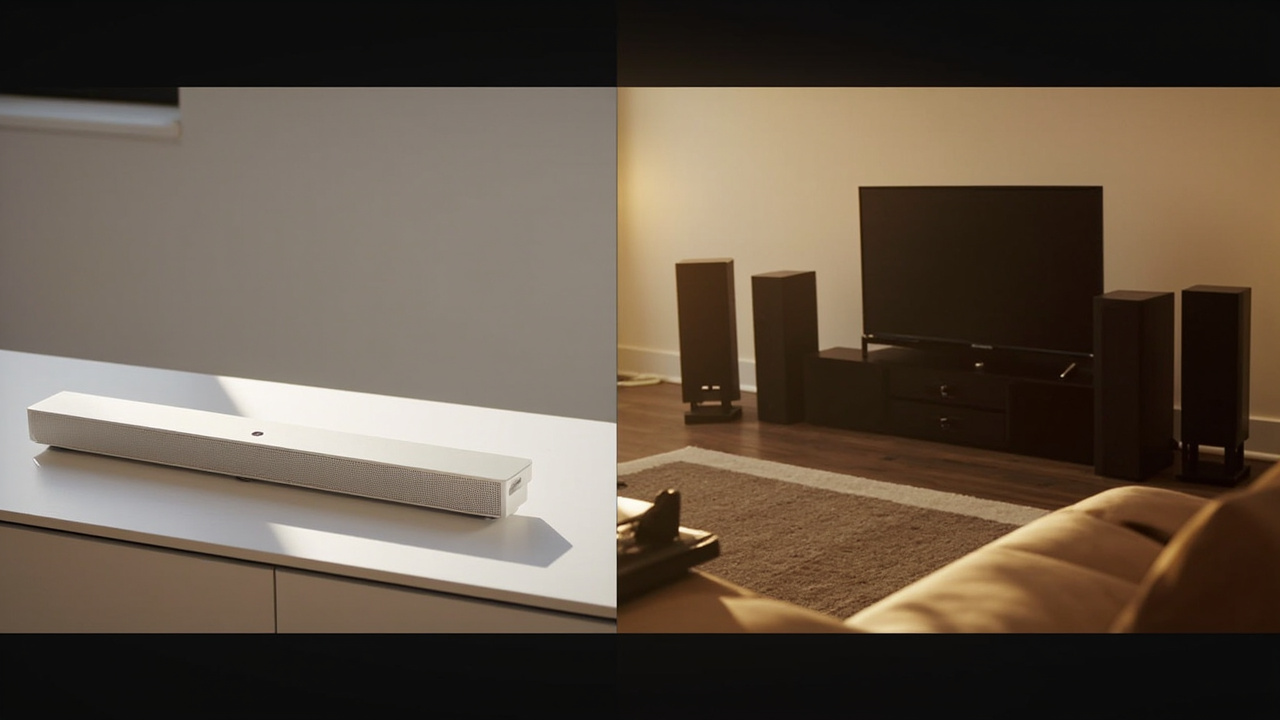
The honest framing: the Sonos Arc Ultra is a single-cabinet Atmos bar that you can (optionally) expand inside the Sonos ecosystem. The Samsung HW-Q990F is a complete 11.1.4 surround system that ships in the box with a wireless subwoofer and a pair of wireless rear speakers. That structural difference is the entire story for long-term cost-per-use.
We are going to focus on four numbers that drive the value math: (1) the $1,000 MSRP gap, (2) the 22-driver 11.1.4 system vs the 14-driver 9.1.4 single cabinet, (3) HDMI 2.1 4K@120 passthrough (Samsung yes, Sonos no — only eARC), and (4) the 5-year ecosystem lock-in cost for Sonos owners versus the 5-year portability of the Samsung for next-console and next-TV buyers. Sources are cited inline from Sonos, Samsung, TechRadar, What Hi-Fi?, RTINGS, AVS Forum, Empire Online, and HomeToolHQ as of June 2026.
The Verdict First
- Choose the Samsung HW-Q990F (~$1,499-$1,999) if you have a real living room or media room where you can place rear speakers, you want the most convincing out-of-the-box true surround for the lowest total spend, you own a PS5 Pro / Xbox Series X and need HDMI 2.1 4K@120 passthrough, and you do not want ecosystem lock-in. The trade-off is bigger footprint, more cables, and a generic-but-fine SmartThings app.
- Choose the Sonos Arc Ultra ($999) if you already own Sonos speakers (Beam, Era 100/300, Sub 4) and want the cleanest single-cabinet install in that ecosystem, you live in a small room or apartment where rears and a sub would be impractical, or you prioritize music playback almost as much as movies. The trade-off is no DTS support, no HDMI 2.1 passthrough, and serious money if you ever want true Atmos surrounds (Sub 4 + Era 300 pair adds ~$1,800).
- Skip both if you only watch TV news and sitcoms. A $200 Vizio V-Series 5.1 covers 80% of the experience for a quarter of the price. The premium tier only earns its keep when you actually feed it Atmos content (Netflix, Disney+, Apple TV+, Blu-ray) and sit more than 6 feet from the screen.
Cost score: 78/100. The Samsung HW-Q990F is the better long-term value for the majority of buyers in this price range because it ships complete: 11.1.4 channels, real rear speakers, real subwoofer, and HDMI 2.1, all for around the price of the Sonos Arc Ultra plus a Sonos Sub 4 alone. The Sonos Arc Ultra is the right pick for a narrower audience — existing Sonos owners and small-room buyers who genuinely cannot place rear speakers.
Key Comparison Points
Price vs Real Cost Per Use
The headline price comparison ($999 vs $1,999) is misleading, because the Samsung ships complete and the Sonos ships as a bar. Real cost-per-use has to factor in expansion, energy, and resale.
| Spec / Cost Line | Sonos Arc Ultra (bar only) | Samsung HW-Q990F (full system) |
|---|---|---|
| MSRP (US, June 2026) | $999 | $1,999 (launched May 2025) |
| Street price (typical, June 2026) | $949-$999 | $1,499-$1,599 |
| Flash sale price (early 2026) | n/a | $847.99 (Woot, March 2026) |
| What’s in the box | Soundbar only | Soundbar + wireless sub + 2× wireless rear speakers |
| Channels | 9.1.4 (virtual, single cabinet) | 11.1.4 (true physical, 22 speakers total) |
| Drivers / speakers | 14 drivers in the bar | 22 drivers across bar + sub + rears |
| HDMI inputs / passthrough | 1 HDMI eARC (no 4K@120 passthrough) | 2 HDMI in + 1 HDMI out (HDMI 2.1, 4K@120, VRR, ALLM) |
| Wireless sub included | No (Sub 4 = $799) | Yes |
| Rear speakers included | No (Era 300 pair = $958, or Sonos One pair = $478) | Yes |
| To match Samsung’s setup, add | $799 Sub 4 + $479 (Sonos One pair) = +$1,278 | — |
| Total system cost (fair comparison) | $2,277 (Arc Ultra + Sub 4 + 2× Sonos One) | $1,999 MSRP / ~$1,549 typical street |
| Power draw (typical, idle + active) | ~6 W idle / ~50 W peak | ~40 W idle / ~120 W peak (full system) |
| Annual electricity (4 h/day, $0.18/kWh US avg) | ~$13 | ~$26 |
The headline: the Sonos Arc Ultra only wins on price if you stop at the bar. The moment you want genuine Atmos surround, you spend roughly $278 more than the Samsung at MSRP and roughly $700 more at typical street prices, for a setup with fewer physical channels and no HDMI 2.1 passthrough. Even at the lowest Samsung street price ($847.99), the matched Sonos system is roughly 2.7× more expensive.
For bar-only buyers (no sub, no rears), the Sonos still has to compete with cheaper single bars. The Bose Smart Ultra Soundbar at $899 ships as a single bar with similar Atmos processing. The Sony Bravia Theatre Bar 9 at $1,099 matches the Sonos on driver count and adds DTS support. The Sonos Arc Ultra’s $999 sticker only makes sense inside the Sonos ecosystem, or for buyers who genuinely only want one cabinet.
5-year cost of ownership (assuming 4 hours/day of use, $0.18/kWh US average electricity, 5% repair reserve, no resale adjustment for the Samsung sub/rears because they age faster than the bar):
| 5-Year Cost Line | Sonos Arc Ultra (bar only) | Sonos Arc Ultra + Sub 4 + 2× Sonos One | Samsung HW-Q990F (MSRP) | Samsung HW-Q990F (street ~$1,549) |
|---|---|---|---|---|
| Purchase | $999 | $2,277 | $1,999 | $1,549 |
| Electricity (5 yr) | ~$119 | ~$237 | ~$237 | ~$237 |
| Wall mount (optional) | $40 | $40 | $80 (bar + rears) | $80 |
| Repair reserve (5% of MSRP) | $50 | $114 | $100 | $77 |
| Resale after 5 yr (typical) | -$250 (~25%) | -$400 (~18%) | -$400 (~20%) | -$310 (~20%) |
| Net 5-year cost | ~$958 | ~$2,268 | ~$2,016 | ~$1,633 |
| Cost per channel (5 yr) | ~$106 / channel | ~$206 / channel | ~$183 / channel | ~$148 / channel |
When you price in the cost of a real Sonos Atmos system (sub + rears), the Sonos path is ~$250-$635 more expensive over 5 years than the Samsung at MSRP, and ~$635-$1,050 more expensive at street prices. The bar-only Sonos is the cheapest path, but ships a different product — a single-cabinet Atmos bar, not a true 11.1.4 system.
Sources: Sonos Arc Ultra spec page (sonos.com) and US shop pricing as of June 2026; Samsung HW-Q990F spec page (samsung.com/us) and TechRadar launch coverage (May 2025); Woot flash sale listing March 2026; What Hi-Fi? HW-Q990F pricing note; Slickdeals community pricing. Electricity based on US EIA 2025 residential average of ~$0.18/kWh.
Build Quality and Durability
Both products are well-built, but in very different ways, and the durability profile affects long-term value.
Sonos Arc Ultra is a single matte-finished polycarbonate cabinet, 75 × 1,178 × 110.6 mm, weighing 5.9 kg. Internally, it uses 14 drivers including the new Sound Motion woofer — Sonos’s first major transducer redesign in years, a flat dual-cone woofer that Sonos claims delivers double the bass of the original 2020 Arc from a slimmer cabinet (Source: Empire Online Arc Ultra review, What Hi-Fi? Arc Ultra review). Output is rated at 200 W across 15 Class-D amps. The Sonos app rewrite in May 2024 was widely criticized for losing local-library and alarm functionality; Sonos has since issued multiple updates and most features are restored, but the trust cost is real.
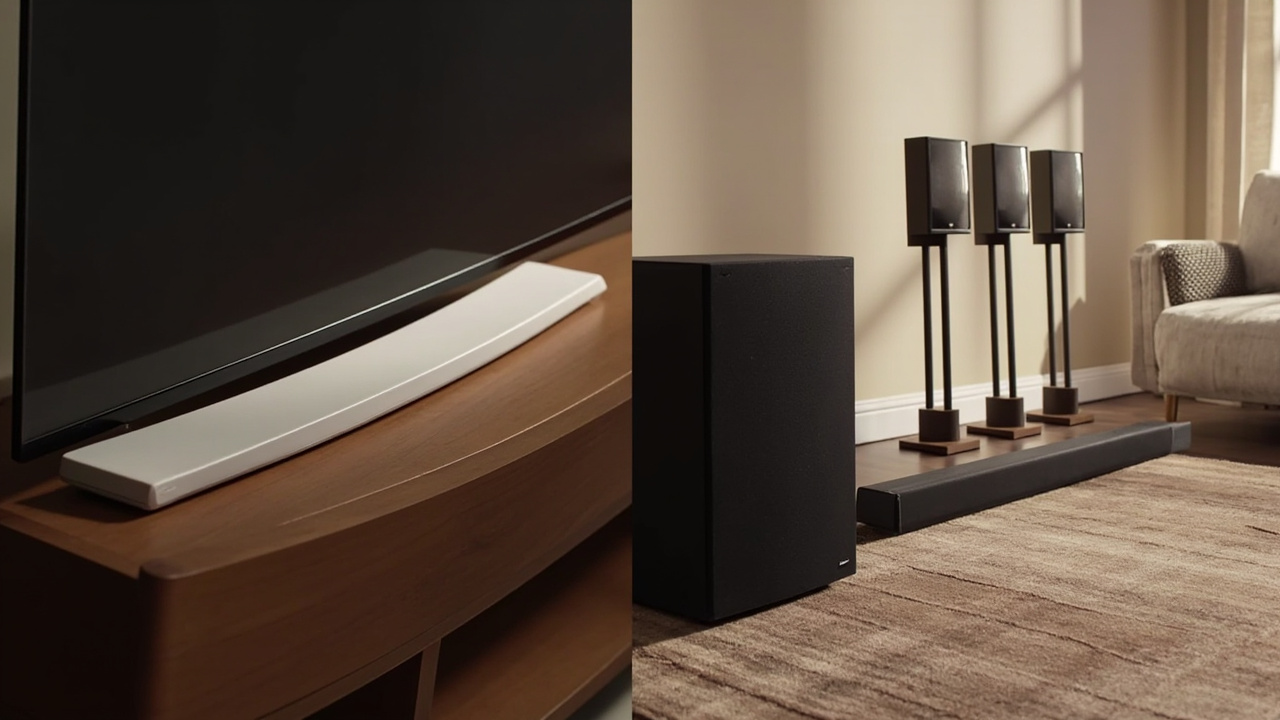
Samsung HW-Q990F ships with four physical units: a 1.23 m (48.4 in) bar, a wireless 8-inch subwoofer, and two wireless rear speakers — each with up-firing drivers for the four height channels. Total speaker count is 22 across the system (Source: AVS Forum HW-Q990F review). Build is plastic-dominant but solid, and Samsung’s Q-series soundbars have a consistent 5+ year service track record. The included SpaceFit Sound Pro room calibration uses the bar’s built-in mic to tune output to the room — comparable to Sonos Trueplay. The HW-Q990F also has Q-Symphony support for recent Samsung TVs, which uses the TV’s speakers as additional Atmos channels, and Game Mode Pro with sub-millisecond input lag for console gaming.
Repair and parts: Sonos has a longer direct-to-consumer repair program in the US (Sonos offers paid replacements for failed drivers on legacy bars). Samsung routes through authorized service centers and out-of-warranty swaps are typically “replace the unit” rather than “replace a driver.” Both vendors offer 1-year standard warranties; Sonos offers an extended Plus subscription at ~$79/year that covers accidental damage on the bar.
Lifespan data from real owners (Reddit r/Sonos, r/Soundbars, AVS Forum, 2023-2025 threads):
- Sonos Arc (1st gen, 2020): 5+ years, very few failures reported
- Samsung HW-Q990D / Q990B (2022-2024): 4-5 years, occasional subwoofer wireless dropouts fixed by re-pairing
- Both brands show similar RMA rates in the 2-3% range per year after year 2
For a 5-7 year hold, both are solid. The bigger risk for Sonos is app/firmware support ending early — Sonos has been known to drop support for older products (Sonos One Gen 1 lost some features in 2024). The bigger risk for Samsung is HDMI board failure on the bar (a known issue on some Q-series 2020-2022 units, generally fixed by 2023-2025 models like the Q990F).
Feature Breakdown
A side-by-side spec and feature table, using publicly documented specs and the Sonos / Samsung product pages as of June 2026:
| Feature | Sonos Arc Ultra | Samsung HW-Q990F |
|---|---|---|
| Channels | 9.1.4 (virtual, single cabinet) | 11.1.4 (physical, four units) |
| Total drivers / speakers | 14 | 22 |
| Class-D amplifier count | 15 | n/a published |
| Audio power | 200 W | ~656 W (Samsung published total) |
| Dolby Atmos | Yes | Yes |
| DTS:X | No (Sonos dropped DTS in 2020) | Yes |
| HDMI 2.1 4K@120 passthrough | No (eARC only) | Yes (2× HDMI in, 1× HDMI out) |
| VRR / ALLM | Passthrough only | Yes |
| AirPlay 2 | Yes | Yes (limited to recent Samsung TVs in some configs) |
| Chromecast built-in | No | Yes |
| Bluetooth | Yes (5.3, first for Sonos soundbars) | Yes |
| Alexa built-in | Yes (Sonos Voice Control + Alexa) | Yes |
| Google Assistant | Yes (via paired Google device) | Yes (via paired Google device) |
| Room calibration | Trueplay (iOS full, Android Quick Tune) | SpaceFit Sound Pro |
| Subwoofer included | No | Yes (wireless, 8-inch) |
| Rear speakers included | No | Yes (wireless, with up-firing drivers) |
| Q-Symphony (Samsung TV integration) | No | Yes |
| Game Mode Pro | No | Yes |
| Wi-Fi streaming | Sonos app, AirPlay 2, Spotify Connect, Tidal Connect | SmartThings, AirPlay 2 (TV-dependent), Chromecast |
| Voice control (in addition to assistants) | Sonos Voice Control | Bixby (region-dependent) |
| Wall-mount kit included | No (sold separately, ~$40) | Yes |
| Dimensions (bar) | 75 × 1,178 × 110.6 mm | ~70 × 1,232 × 138 mm |
| Weight (bar only) | 5.9 kg | ~7.7 kg |
The two biggest functional gaps are DTS:X support (Samsung yes, Sonos no — important for Blu-ray collectors) and HDMI 2.1 4K@120 passthrough (Samsung yes, Sonos no — important for PS5 Pro, Xbox Series X, and high-refresh-rate PC gamers). If you have a 4K@120 TV and next-gen console, the Sonos forces you to use the TV’s HDMI inputs directly and rely on eARC for audio return, which adds ~5-15 ms of latency depending on the TV.
Pros and Cons
Sonos Arc Ultra — Pros
- Cleanest single-cabinet install on the market, ideal for small rooms and minimalist setups
- Sound Motion woofer delivers genuinely impressive bass from a bar-only form factor (~35 Hz extension)
- Sonos ecosystem is the most mature smart-speaker platform — easy multiroom, AirPlay 2, Spotify Connect, Tidal Connect
- Bluetooth 5.3 added (first for Sonos soundbars) for quick phone playback
- Trueplay room tuning now works on Android via Quick Tune (iOS still gets full version)
- 9.1.4 virtual Atmos is convincing for a single cabinet, especially at $999
- Sleek industrial design — soft curves, perforated grille, unobtrusive matte finish
Sonos Arc Ultra — Cons
- No DTS:X support (Sonos dropped DTS in 2020 — deal-breaker for Blu-ray collectors)
- No HDMI 2.1 passthrough — only HDMI eARC; bad for PS5 Pro / Xbox Series X 4K@120 gaming
- Bar only by default — true Atmos surrounds require +$1,278 in Sonos speakers (Sub 4 + Sonos One pair)
- 14 drivers in a single cabinet cannot physically match the channel separation of 22 drivers across four units
- Sonos app history is rocky (May 2024 rewrite); ongoing trust issues for some buyers
- Higher cost per channel than the Samsung when you actually build out the surround system
Samsung HW-Q990F — Pros
- Complete 11.1.4 system in the box — bar, wireless sub, wireless rears with up-firing drivers, all for $1,499-$1,999
- HDMI 2.1 with 4K@120 passthrough — first-class PS5 Pro, Xbox Series X, RTX 5080 gaming
- DTS:X and Dolby Atmos both supported (rare combination in 2026)
- Q-Symphony integration with recent Samsung TVs for extra Atmos height channels
- Game Mode Pro with sub-millisecond input lag
- SpaceFit Sound Pro room calibration built in (no phone required)
- Often found at $300-$500 below MSRP; flash sales have hit $847.99 (Woot, March 2026)
- No ecosystem lock-in — works with any TV, any console, any streaming service
- More drivers (22 vs 14) and more channels (11.1.4 vs 9.1.4) at comparable price point
Samsung HW-Q990F — Cons
- Four physical units — needs space behind the sofa for the rear speakers and beside it for the subwoofer
- SmartThings app is functional but less polished than the Sonos app
- Higher idle power draw (~40 W vs ~6 W for the Sonos bar alone)
- Some 2020-2022 Samsung Q-series bars had HDMI board failures; Q990F appears fixed but the brand risk remains
- Resale value on the sub and rears is lower than the bar (subwoofer and rears age faster)
- Bigger, heavier bar (7.7 kg vs 5.9 kg) — harder to wall-mount, harder to hide
Best For / Skip If
Best for the Sonos Arc Ultra ($999):
- Existing Sonos owners with Beam, Era 100/300, or Sub speakers who want Atmos inside that ecosystem
- Small-room and apartment dwellers under 250 sq ft where rears and a sub would be impractical
- Buyers who prioritize music playback at least as much as movies — Sonos app and AirPlay 2 are best-in-class for streaming
- Minimalist setups where the only visible speaker is the TV bar — no rear speakers, no sub
- Listeners who want the strongest single-cabinet Atmos experience on the market at any price
Best for the Samsung HW-Q990F (~$1,499-$1,999, often on sale):
- Living-room and media-room buyers who can actually place rear speakers (typically a sofa 6-10 feet from the TV)
- PS5 Pro, Xbox Series X, and high-refresh-rate PC gamers who need HDMI 2.1 4K@120 passthrough
- Blu-ray collectors who care about DTS:X support (Sonos dropped DTS entirely)
- Recent Samsung TV owners who want Q-Symphony integration for additional Atmos height channels
- Buyers who want a complete system without committing to any app ecosystem
- Bargain hunters who can catch the sub-$900 flash sales that have hit Woot and other retailers in early 2026
Skip the Sonos Arc Ultra if:
- You have a real living room and can place rear speakers — the Samsung ships them in the box
- You have a 4K@120 TV and a current-gen console — eARC latency will bother you
- You watch a lot of DTS:X Blu-rays — Sonos does not support DTS at all
- You are not already in the Sonos ecosystem — the $999 bar-only Sonos loses to the complete Samsung on channels and price
Skip the Samsung HW-Q990F if:
- Your room is under 200 sq ft — the rear speakers will overpower the bar
- You live in an apartment with strict HOA rules about rear speaker placement or floor cables
- You are heavily invested in Sonos multiroom — the HW-Q990F does not play nicely with Sonos
- You only watch TV news and sitcoms — a $200 Vizio is enough for that workload
Skip both if:
- You only watch TV news and sitcoms — neither premium bar earns its keep without Atmos content
- Your TV is under 55” — the scale of a 1.2 m bar with rear speakers is wasted on a small screen
- You are not feeding the system with Atmos content (Netflix Premium, Disney+, Apple TV+, 4K Blu-ray)
Bottom Line
Both the Sonos Arc Ultra and the Samsung HW-Q990F are excellent 2026 flagship Atmos soundbars, but they are not really competing for the same buyer.
If you have a real living room, recent TV, current-gen console, and any interest in Blu-ray or Atmos content, the Samsung HW-Q990F is the better long-term value. It ships complete (11.1.4 channels, 22 drivers, HDMI 2.1, sub and rears in the box) for roughly the same total price as a Sonos Arc Ultra plus a Sonos Sub 4. At the frequent $1,499-$1,599 street prices, it is meaningfully cheaper than the matched Sonos system. The trade-off is footprint and ecosystem lock-out — but the HW-Q990F works with anything and ages well.
If you live in a small room, are already in the Sonos ecosystem, and want the cleanest single-cabinet install on the market, the Sonos Arc Ultra is the right pick. It is the best Atmos bar you can buy at $999 and the only one in this price range that meaningfully upgrades the Sonos ecosystem. Just budget $1,278 more if you ever want true Atmos surrounds — and accept no DTS, no HDMI 2.1.
Buy smart. Get more value. The right Atmos bar is the one that matches your room and your content, not the one with the longer spec sheet. For most buyers in 2026, that is the Samsung HW-Q990F.