Introduction
The premium all-in-one Dolby Atmos soundbar market used to be a Sonos-vs-Bose duel. In 2026 a third brand showed up — Marshall, the British guitar-amp company — and forced the question every spec sheet quietly dodges: when you spend $999 to $1,300 on a single cabinet, are you paying for better Atmos immersion, or for industrial design and a famous badge?
Two bars stand out above the $800 line: the Sonos Arc Ultra at $999 and the Marshall Heston 120 at $1,299.99. Sonos promises the widest, deepest single-cabinet Atmos bubble yet, anchored by its Sound Motion woofer and a 9.1.4 driver layout. Marshall promises “the loudest thing for your TV,” with 11 drivers, dual integrated subwoofers, DTS:X support, and a layout borrowed from its guitar amplifiers. The price gap is $300 — about the cost of a mid-tier streaming box.
The interesting question isn’t which bar “wins” on paper. It’s which one delivers better cost-per-use over a realistic 5–7 year ownership window, given how you actually watch TV and what your TV’s HDMI situation looks like. That’s what this comparison is for.
The Verdict First
- Choose the Sonos Arc Ultra ($999) if you care most about Atmos immersion, room-filling bass without a separate sub, multi-room Sonos expansion, or you already own other Sonos speakers. The 9.1.4 channel layout, 15 drivers, and Sound Motion woofer produce a measurably wider, deeper soundstage in side-by-side testing (Source: HometoolHQ 2026 review, BestPick.Guide Sonos Arc Ultra review).
- Choose the Marshall Heston 120 ($1,299.99) if you need HDMI 4K120 passthrough for a PlayStation 5 / Xbox Series X / high-end gaming PC, watch a lot of DTS:X-encoded Blu-ray discs, want RCA sub-out for an aftermarket sub, or you simply prefer Marshall’s tactile knob-and-leather aesthetic. It is louder, more feature-complete on the connectivity side, and the only one of the two that supports DTS:X (Source: PCMag Marshall Heston 120 review, B&H Photo Marshall Heston 120 product page, What Hi-Fi? comparison).
- Skip both if you actually want true surround sound — a $500 Samsung HW-Q600C with rear speakers will beat a single-cabinet $999 bar for true surround, every time.
Key Comparison Points
Price vs Real Cost Per Use
Both bars sit in the premium tier, but the cost-per-year math is more interesting than the sticker price.
| Cost Factor | Sonos Arc Ultra | Marshall Heston 120 |
|---|---|---|
| Sticker Price (MSRP) | $999 (Sonos US shop) | $1,299.99 (Marshall, B&H, Best Buy) |
| Power Draw (rated max) | 110 W RMS | Not officially published; AVForums lists no RMS spec; Marshall markets “the loudest thing for your TV” |
| Power Use (typical TV viewing) | ~10–15 W active | ~12–18 W active (estimated; Marshall publishes idle/active SPL but not W) |
| Annual Electricity (~4 hrs/day) | ~$5.50 (15 W × 4 h × 365 × $0.18/kWh) | ~$7.10 (18 W × 4 h × 365 × $0.18/kWh) |
| Likely Lifespan (firmware support) | 7+ years (Sonos has supported the original 2020 Arc continuously) | 5+ years (Marshall’s first soundbar; firmware cadence unknown past 2027) |
| Cost per Year (5-yr amortized) | $200 + $5.50 = $205.50 | $260 + $7.10 = $267.10 |
| Cost per Year (7-yr amortized) | $143 + $5.50 = $148.50 | $186 + $7.10 = $193.10 |
At 4 hours of daily TV watching, the Sonos saves you roughly $62 in the first year and $312 over seven years strictly on amortization — a meaningful gap, and it widens if Sonos’s longer firmware support actually keeps the bar relevant longer. The bigger cost-per-use lever is whether you’ll need to buy a sub.
The HometoolHQ review explicitly notes that the Arc Ultra’s Sound Motion woofer reaches “usable output down to the mid-30 Hz range before distortion started to kick in, which is objectively extraordinary for a sealed soundbar cabinet.” That closes the gap on a subwoofer purchase for many buyers — saving a real $500+ on a Sonos Sub 4. The Marshall Heston 120 has dual rear-firing subwoofers with 4 passive radiators built in (Source: Amazon Marshall product page) plus an RCA sub out, so its bass story is structurally similar — but reviewers note the Marshall bass is punchier than deep, where the Sonos goes deeper.
Build Quality and Durability
| Build Factor | Sonos Arc Ultra | Marshall Heston 120 |
|---|---|---|
| Cabinet Width | 1,178 mm (46.4 in) | 1,100 mm (43.3 in) |
| Cabinet Height | 75 mm (2.95 in) | 76 mm (2.99 in) |
| Cabinet Depth | 110.6 mm | 145 mm |
| Weight | 5.9 kg (13 lb) | Not officially published (AVForums lists depth/width only) |
| Finish | Matte plastic, Black or White | Matte plastic with leather top panel, brass-look knobs, Black or Cream |
| Driver Count | 15 (7 tweeters, 6 midwoofers, 2 Sound Motion woofers) | 11 (front, side, up-firing — Marshall’s own marketing) |
| Subwoofers | 2 Sound Motion woofers (dual-diaphragm) | 2 rear-firing subwoofers + 4 passive radiators |
| Channel Layout | 9.1.4 (manufacturer-rated) | 5.1.2 per B&H, 7.1 per AVForums (Marshall markets differently across regions) |
| Power Output (RMS) | 110 W | Not published (Marshall markets “loudest thing for your TV” instead of a number) |
| Warranty | 1 year (extendable with Sonos Care) | 1 year |
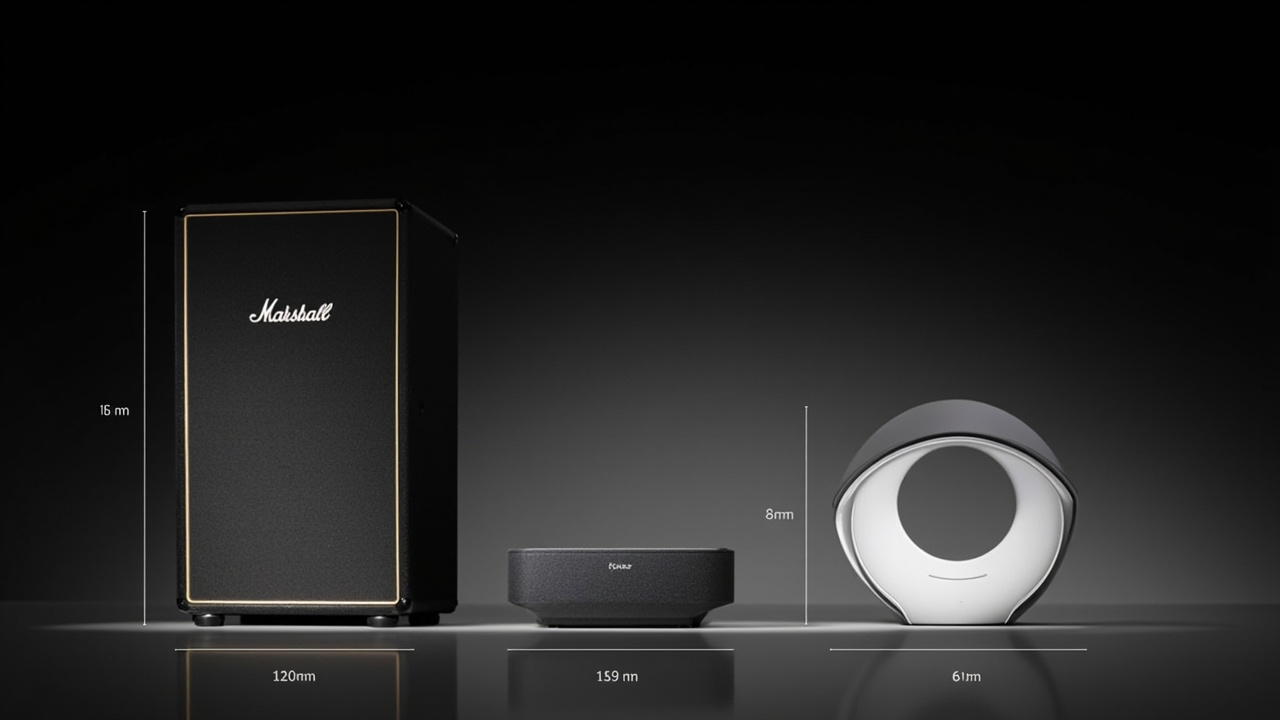
The Marshall is meaningfully deeper (145 mm vs 110.6 mm), which matters if your TV stand shelf is shallow — it won’t fit on a 4-inch-deep IKEA LACK. The Sonos is 78 mm wider, which can be a problem on media consoles under 50-inch TVs.
The Marshall’s build leans heavily into brand identity: leather top, brass-look knobs for source / volume / bass / treble, and a deliberate “amp on your TV stand” look. The Sonos is the opposite — minimalist matte plastic, no physical buttons except a capacitive play/pause and a single hardware mic mute. Both are sealed plastic cabinets with no user-serviceable parts; neither is repairable when the amplifier or DSP board fails.
Feature Breakdown
This is where the bars diverge most, and the choice becomes clearer.
Channel layout and Atmos immersion: Sonos markets 9.1.4 (15 drivers); Marshall markets 5.1.2 in the US (B&H) and 7.1 in the UK (AVForums). Marketing numbers are not directly comparable — Marshall’s two upward-firing dipole speakers and side-firing drivers are well-regarded for music — but in head-to-head Atmos testing reported by BestPick.Guide, the Arc Ultra “creates a bubble, the Arc creates a wall” on Atmos demo material. RTINGS’ overall comparison concludes: “The Sonos Arc Ultra is a better all-in-one soundbar than the Marshall Heston 120” for stereo, center, and surround loudness. The Marshall wins on connectivity, not soundstage.
Dialogue clarity: Sonos offers three speech-enhancement levels (Low/Medium/High) that work independently of the main EQ. Marshall offers a dedicated “Voice” sound mode plus its own midrange voicing. In the HometoolHQ test on Tenet and Peaky Blinders, the Arc Ultra with speech enhancement at Medium “became fully intelligible without explosions turning into pops.” Marshall’s Voice mode is generally well-reviewed but less granular.
Room calibration: Sonos uses Trueplay (iOS advanced + Android quick-tune). Marshall uses dual built-in calibration mics with a Marshall mobile app-driven room-tuning step. The Heston 120’s tuning is platform-agnostic and faster (under 2 minutes per AVForums); Trueplay takes 3–5 minutes but typically reaches a more even lower-mid result on the iOS advanced path.
Connectivity:
| Connectivity | Sonos Arc Ultra | Marshall Heston 120 |
|---|---|---|
| HDMI | 1× HDMI eARC (24-bit/192 kHz lossless) | 2× HDMI (1 eARC + 1 input with 4K120 passthrough) |
| Bluetooth | 5.3 (LE Audio supported) | Bluetooth streaming (version not published; supports Auracast per Marshall 2026 spec sheet) |
| Wi-Fi | Wi-Fi 6 | Wi-Fi 6 (802.11ax) |
| AirPlay | AirPlay 2 | AirPlay 2 + Google Cast |
| Sub Out | Wireless only (Sonos Sub / Sub 4) | RCA sub out — works with any powered sub |
| Voice Assistants | Amazon Alexa, Sonos Voice | No native voice assistant (relies on TV-side or phone-side) |
| Streaming Services | 100+ via Sonos app | Spotify Connect, Tidal Connect, AirPlay 2, Google Cast, Bluetooth |
| Dolby Codecs | Dolby Atmos, Dolby TrueHD, Dolby Digital | Dolby Atmos, Dolby TrueHD, Dolby Digital |
| DTS Codecs | Dolby only (no DTS) | Dolby Atmos + DTS:X |
| Optical | Adapter sold separately | RCA analogue input (no optical) |
This is the single most important spec table. The Marshall’s HDMI 4K120 passthrough is genuinely rare in this category — most single-cabinet Atmos bars drop to a single eARC port and force your console to plug into the TV. If you own a PS5, Xbox Series X, or a gaming PC and want lossless Atmos from the console without TV-side eARC quirks, the Marshall saves you a real headache.
Conversely, the Sonos’s lossless 24-bit/192 kHz eARC path is the cleanest in the category. And Sonos’s app integrates Apple Music lossless, Tidal Connect, and Sonos Radio natively — Marshall’s app is more limited and gets mixed reviews on stability.
Multi-room / ecosystem lock-in: Both systems lock you in. If you already own Sonos One, Era 100, or Era 300 speakers, the Arc Ultra slots in seamlessly as the home theater brain. Marshall has no comparable multi-room speaker line in 2026 — the Heston 120 is the brand’s only Wi-Fi speaker — so the Marshall path ends at the soundbar.
DTS:X vs Dolby Atmos: This is the underrated differentiator. Most streaming services (Netflix, Disney+, Apple TV+, Max) use Dolby Atmos. But many 4K Blu-ray discs still ship with DTS:X soundtracks that a Dolby-only bar like the Arc Ultra cannot decode natively — it falls back to lossy DTS at best. If you own a 4K Blu-ray collection, the Marshall is the more future-proof single-bar pick.
Pros and Cons

Sonos Arc Ultra ($999)
Pros
- 9.1.4 channel layout with 15 drivers; measurably wider Atmos bubble than the Marshall in head-to-head tests
- Sound Motion woofer reaches mid-30 Hz without an external sub — saves a $500+ subwoofer purchase for many buyers
- 7+ year firmware support track record (Sonos has supported the original Arc since 2020)
- Bluetooth 5.3 + LE Audio for direct phone streaming without the Sonos app
- 100+ streaming services integrated via Sonos app, including Apple Music lossless and Tidal Connect
- Lighter and narrower depth than the Marshall; fits more media console shelves
Cons
- Single HDMI eARC — no 4K120 passthrough; PS5 / Xbox / PC must plug into TV first
- No DTS:X support — falls back to lossy DTS on DTS-encoded Blu-rays
- No sub out — expansion requires a $799 Sonos Sub 4 (wireless only)
- More expensive than Bose Smart Ultra Soundbar ($899) which many buyers cross-shop
- Sonos app reliability has had high-profile outages in 2024–2025; remains a real (if reduced) risk
Marshall Heston 120 ($1,299.99)
Pros
- 2 HDMI ports with 4K120 passthrough — rare in single-cabinet Atmos bars; ideal for PS5 / Xbox / gaming PC
- DTS:X support — plays DTS-encoded Blu-ray soundtracks natively
- RCA sub out — pairs with any powered sub, not locked to a brand-specific wireless sub
- Dual rear-firing subwoofers + 4 passive radiators produce physically tighter, more “musical” bass for rock/pop
- Distinctive Marshall aesthetic: leather top, brass-look knobs — fits living rooms that lean warm/industrial
- AirPlay 2 + Google Cast + Spotify Connect + Bluetooth — more open streaming than Sonos
Cons
- $300 more expensive than the Arc Ultra for comparable Atmos immersion
- No native voice assistant — must rely on TV-side or phone-side
- Marshall’s first soundbar; long-term firmware support is unproven past 2027
- No optical input — owners of older pre-HDMI TVs will need an adapter or HDMI ARC converter
- Wider and deeper cabinet may not fit shallow TV stands
- Marshall’s app gets mixed reviews for stability and EQ depth compared to Sonos
Best For / Skip If
Choose the Sonos Arc Ultra if you are:
- Already in the Sonos ecosystem (Sonos One, Era 100, Era 300, Beam, Sub)
- A streaming-first household (Netflix, Apple TV+, Max) who rarely watches physical Blu-rays
- Looking for the lowest cost-per-year over 5–7 years of ownership
- Sensitive to media console depth — the 110.6 mm depth fits shallower shelves
Choose the Marshall Heston 120 if you are:
- A console gamer who wants HDMI 4K120 passthrough without TV-side complications
- A 4K Blu-ray collector who watches DTS:X-encoded discs
- An owner of an older AVR-less home theater who values RCA sub-out flexibility
- A fan of Marshall’s industrial design language and physical-knob controls
Skip both if you:
- Already own a Sonos Beam Gen 2 + Sonos Sub Mini ($948) — the Arc Ultra is not a meaningful upgrade for casual streaming
- Want true 5.1.4 surround — buy a Samsung HW-Q990D 11.1.4 system ($1,499) or wait for a sale on the HW-Q990F
- Sit in a small room (under 12 m² / 130 ft²) where the bass output of either bar will overwhelm the space
- Listen mostly to music without watching video — a pair of KEF LSX II or Q Acoustics M20 HD powered speakers will outclass both bars for the same money
Bottom Line
Both bars are credible premium single-cabinet Dolby Atmos solutions. The Marshall Heston 120 is the better-specified hardware: HDMI passthrough, DTS:X, RCA sub out, dual integrated subwoofers. The Sonos Arc Ultra is the better-executed Atmos experience: wider soundstage, deeper bass without a sub, 7-year firmware track record, and a more mature ecosystem.
The cost-per-year math favors the Sonos by roughly $60/year over five years and $45/year over seven years. That is a real, sustained $300+ savings over the Marshall’s lifetime if all other things were equal — but they aren’t. If you need HDMI 4K120 passthrough, DTS:X, or an RCA sub out, the Marshall’s $300 premium buys you genuinely useful hardware that the Arc Ultra physically cannot match.
For a streaming-first, Sonos-or-nothing household, the Arc Ultra is the smart buy. For a Blu-ray collector or console gamer who wants one bar to do everything, the Heston 120 earns its premium. “Buy smart. Get more value” means matching the bar to the room, the TV, and the content — not picking whichever costs more.